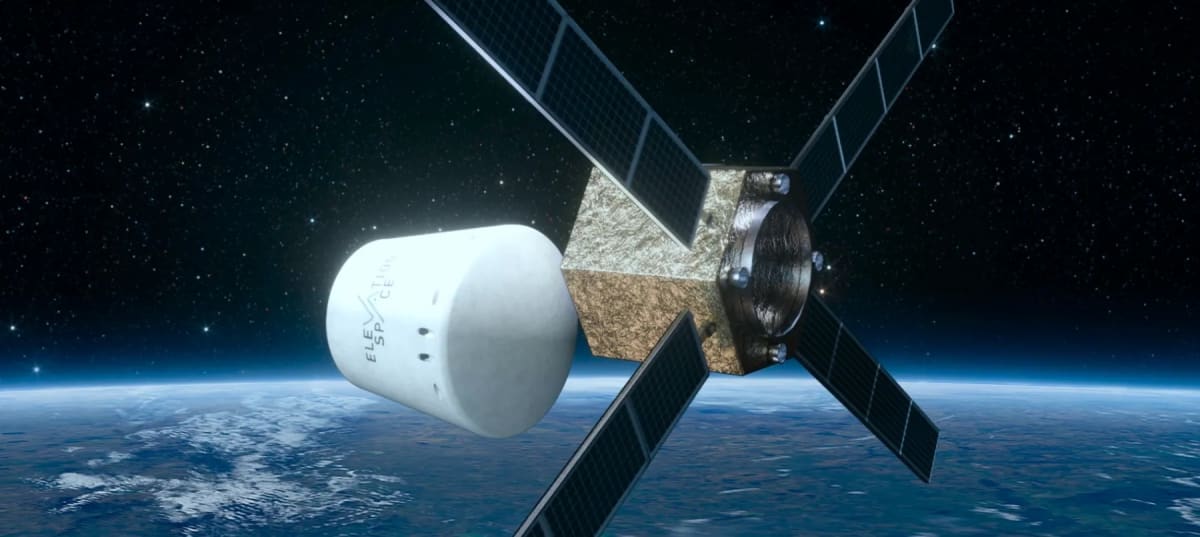
Japan's ElevationSpace Raises $40M for Gentler Cargo Returns
A Japanese startup is making it possible to bring delicate medical experiments back from space without the rough ride. Their gentler reentry technology could help scientists develop life-saving drugs in orbit.
Getting fragile cargo back from space safely just got a major boost, and it could change how we make medicine.
ElevationSpace, a 90-person Japanese startup, just closed a $40 million funding round to build spacecraft that can return delicate payloads from orbit with unprecedented care. The company's secret is lift-controlled reentry, a technique that dramatically reduces the force cargo experiences when returning to Earth compared to traditional ballistic reentry.
"In terms of gentleness, it is suitable for any payload," said Kazunari Miyamaru, the company's chief operating officer. The technology also enables precise landings anywhere on Earth.
The timing couldn't be better. Companies are increasingly interested in manufacturing pharmaceuticals and biotechnology products in space, where microgravity enables unique processes impossible on Earth. But getting those sensitive samples back home without damaging them has been a major challenge.
ElevationSpace recently signed a deal with Luxembourg-based Space Cargo Unlimited to fly their BentoBox experiment platform. The partnership aims to create a reliable pipeline for returning pharmaceutical and biotech samples safely to scientists on the ground.
The company is building two types of vehicles. The ELS-R is a free-flying spacecraft that launches to orbit, hosts experiments, and returns them to Earth. The ELS-RS launches to space stations on cargo spacecraft and brings back station experiments.
Their first test vehicle, AOBA, is scheduled to launch in mid-2027. With $63.5 million raised so far, ElevationSpace is moving quickly to capture a market that barely existed a few years ago.
The Ripple Effect
SpaceX recently entered the reentry vehicle market with its own Starfall vehicle, sparking concerns about competition. But industry experts see room for multiple players with different capabilities, much like the variety of aircraft in commercial aviation.
"There's a clear market gap," said Dana Baki of The Exploration Company. "Now is the time because we don't want the world to be dependent on one country or one company."
Currently, only a handful of countries have reentry capabilities. The emergence of multiple commercial options means more scientists worldwide will be able to conduct groundbreaking research in space and safely return their discoveries.
As one industry leader put it, the lesson from the launch market is clear: stay confident in the size of the opportunity and keep innovating.
More Images


Based on reporting by SpaceNews
This story was written by BrightWire based on verified news reports.
Spread the positivity!
Share this good news with someone who needs it