JWST Spots 13-Billion-Year-Old Galaxy With First Stars
Scientists using the James Webb Space Telescope discovered a tiny galaxy from 800 million years after the Big Bang that contains remains of the universe's very first stars. This "cosmic fossil" is helping astronomers understand how the earliest stars created the elements that eventually made planets and people possible.
Scientists just found a window into the universe's birth, and it's revealing the stars that made everything we are.
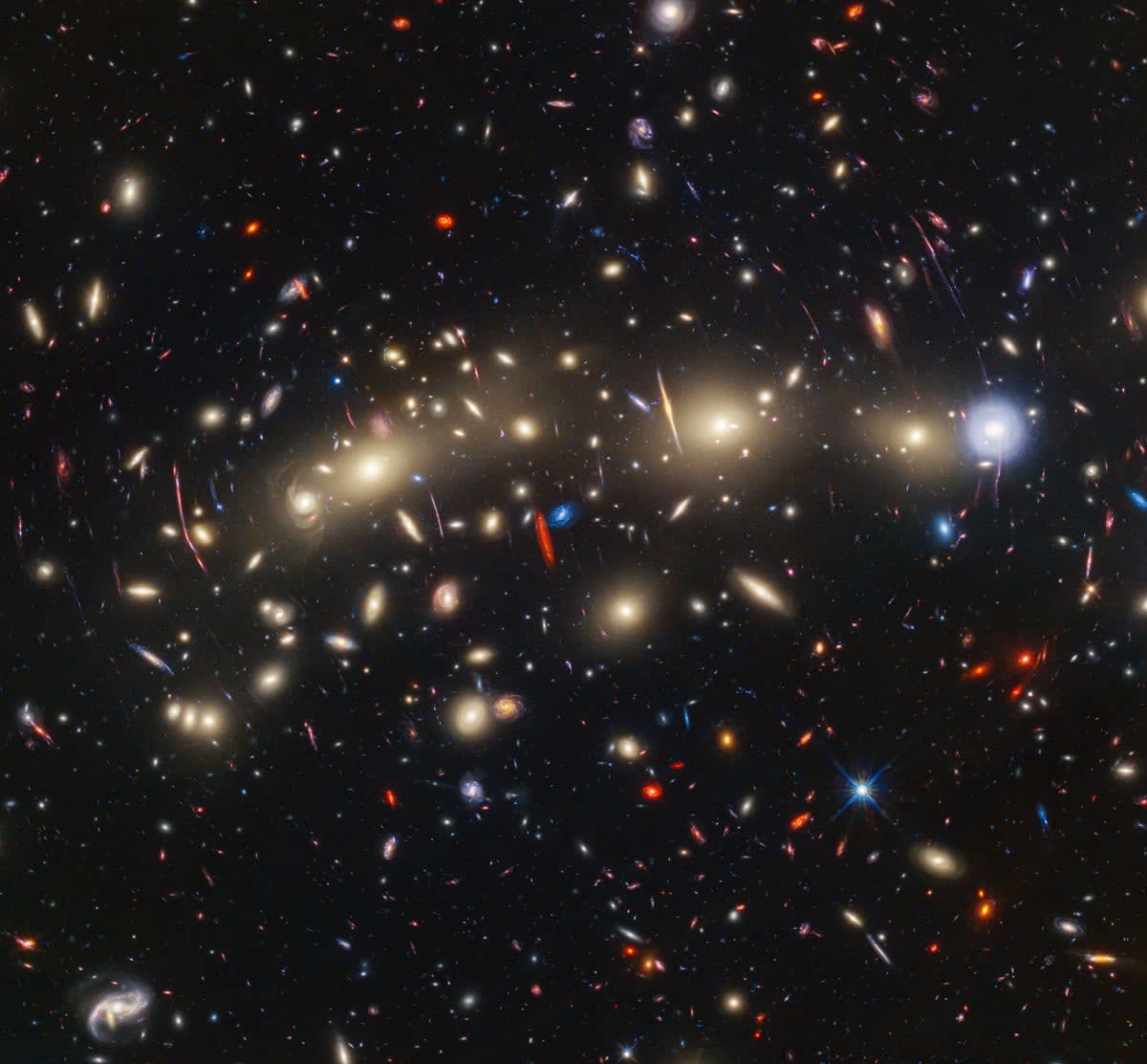
Using the James Webb Space Telescope, researchers spotted a tiny galaxy called LAP1-B that existed just 800 million years after the Big Bang. The galaxy appears to contain fresh remains from Population III stars, the universe's very first suns that have never been directly observed until now.
These ancient giants matter because they're essentially our cosmic ancestors. The oxygen you breathe, the iron in your blood, and the calcium in your bones all came from these first stars. When they exploded, they scattered the heavy elements that eventually formed later stars, planets, and ultimately life itself.
LAP1-B is special because it's a cosmic puzzle piece frozen in time. It resembles the ultrafaint dwarf galaxies near our Milky Way, which scientists believe are leftover building blocks from when the universe was young. Finding one this far back in time is like discovering a fossil that shows exactly how bigger galaxies assembled.
The telescope could only see LAP1-B because of a lucky cosmic accident. The galaxy sits behind a massive galaxy cluster that bends spacetime like a magnifying glass, boosting the tiny galaxy's light 100 times brighter. Without this gravitational lens, even JWST's powerful instruments would have missed it entirely.
Lead researcher Kimihiko Nakajima from Kanazawa University in Japan used JWST to analyze the galaxy's chemical makeup. The findings revealed mostly pure hydrogen and helium from the Big Bang, plus traces of oxygen and carbon from those first dying stars. The specific mix of elements matches predictions about how Population III stars would have exploded.
Why This Inspires
This discovery proves that humanity can now peer back to the very dawn of cosmic creation. JWST is finally delivering on its promise to show us the universe's earliest chapters, revealing how simple hydrogen became the complex chemistry of life.
Finding LAP1-B also validates decades of theoretical work. Astronomers have long believed these tiny dark matter halos seeded with first generation stars were the universe's fundamental building blocks. Now they can actually see one caught in the act of formation, confirming their models were right.
The galaxy's chemical signature tells a creation story spanning 13 billion years. Those ancient stars burned bright and died young, but their legacy lives on in every atom of our bodies and every object around us.
Scientists are now searching for more cosmic fossils like LAP1-B to understand how common these building blocks were. Each discovery adds another piece to the puzzle of how our universe evolved from primordial simplicity to the rich complexity we see today.
This breakthrough shows we're living in a golden age of cosmic discovery, where questions that seemed permanently unanswerable are finally yielding their secrets to human curiosity and ingenuity.
More Images


Based on reporting by Scientific American
This story was written by BrightWire based on verified news reports.
Spread the positivity!
Share this good news with someone who needs it