Kolkata Girls Play Football, Defy Gender Barriers
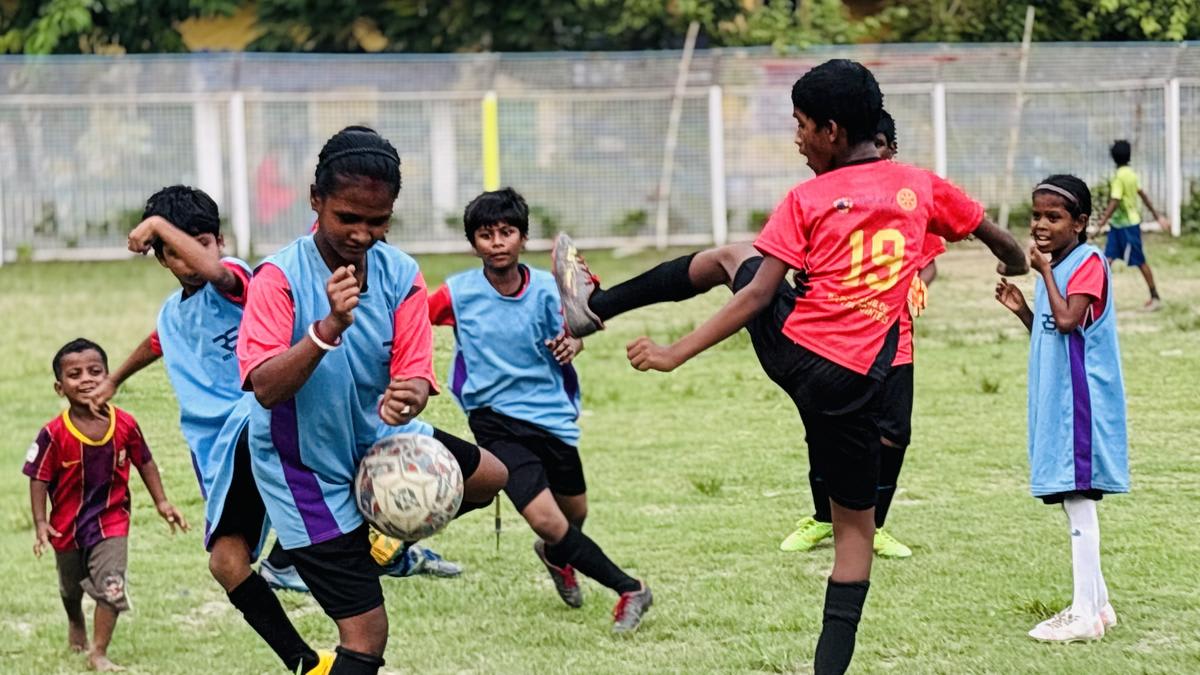
In Kolkata's red-light district, girls and boys train together on a football team that's challenging deep-rooted beliefs about who belongs on the field. Their biggest victories aren't trophies but the freedom they claim with every match.
When Chandana Mondal steps onto a football field in Kolkata, she's not just playing a game. She's proving that the pitch belongs to her as much as anyone else.
Chandana is part of Meye-Cheleder Khela (Girls and Boys Play Together), a mixed-gender football team run by NGO Bondhu Collective. The 20-member squad brings together children aged seven to 20 from Kolkata's Kalighat red-light area and nearby underprivileged neighborhoods.
The team's name itself is an act of rebellion. In Bengali, "meye-cheleder khela" is often used as a slur to dismiss something as trivial child's play. The team has reclaimed it as a statement of equality.
"Football has given me a sense of freedom," said Chandana, who recently secured admission to a BBA program. "When I am on the field, I don't feel limited by what society expects from girls."
Her teammate Bandana Mondal, now studying Women's Studies, faces similar challenges. She balances training with discouraging remarks from neighbors and the constant struggle to find safe practice spaces.
The team wasn't created just to teach football skills. When girls from the community told founder-secretary Smritiparna Sengupta they wanted to play, they faced social barriers at every turn. The NGO wanted to create a space where everyone could play with dignity, regardless of gender.
Boys from the neighborhood asked to join after watching the girls practice. They were welcomed, but only if the team kept its name centered on equality for all genders.
The Ripple Effect
The team's impact extends beyond the field. Some members have been playing for five years, gaining confidence that carries into their education and daily lives. They're showing their communities that girls can claim space in areas traditionally reserved for boys.
Finding places to play remains their biggest challenge. Public grounds are often occupied or given to boys' teams first. Funding and equipment are constant concerns.
Coach Pijush Halder sees enormous untapped potential. "Talent is not the issue; opportunity is," he said. "With consistent coaching and equal opportunities, these players can compete at much higher levels."
Even arranging matches proves difficult. A few months ago, the team struggled to find a ground to host a game against another women's side.
Their victories are measured differently now: by the stigma they overcome, the questions they raise, and their determination to keep playing the game that sets them free.
Based on reporting by The Hindu
This story was written by BrightWire based on verified news reports.
Spread the positivity!
Share this good news with someone who needs it

%2Ffile%2Fattachments%2F2996%2Fharriethoriz_750866.jpg)