Lego Task Reveals New Path to Earlier Autism Detection
Scientists at York University discovered that watching autistic adults build with Lego reveals unique movement patterns that could help identify autism much earlier in life. The simple building task uncovered distinctive motor signatures that appear long before the communication skills doctors currently use for diagnosis.
A playful task involving Lego bricks has opened an unexpected window into the autistic brain, offering hope for much earlier support for children.
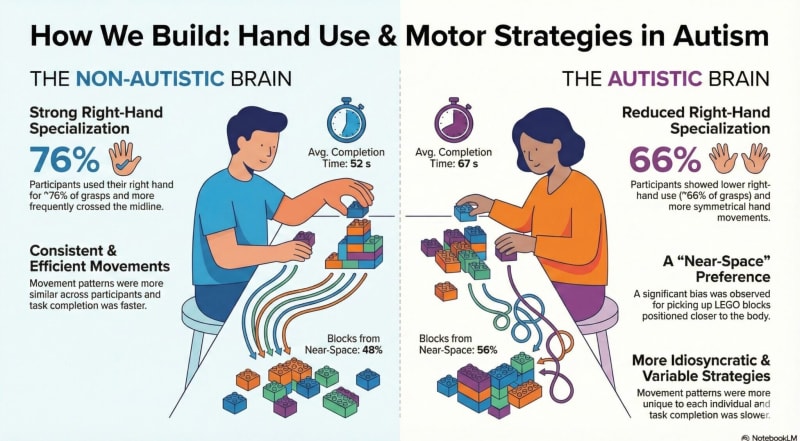
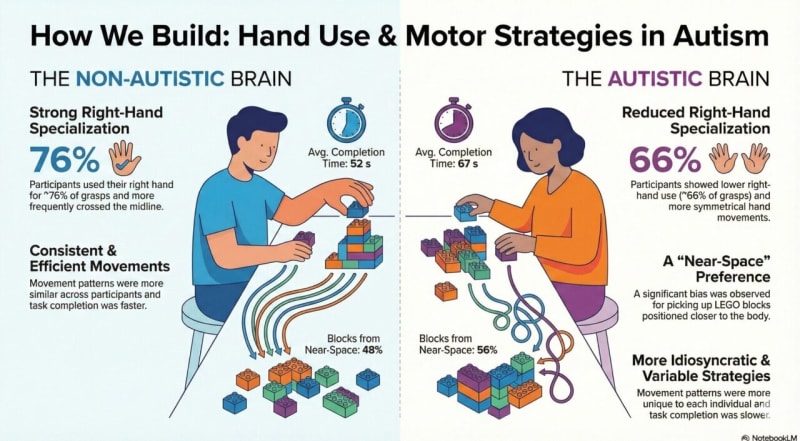
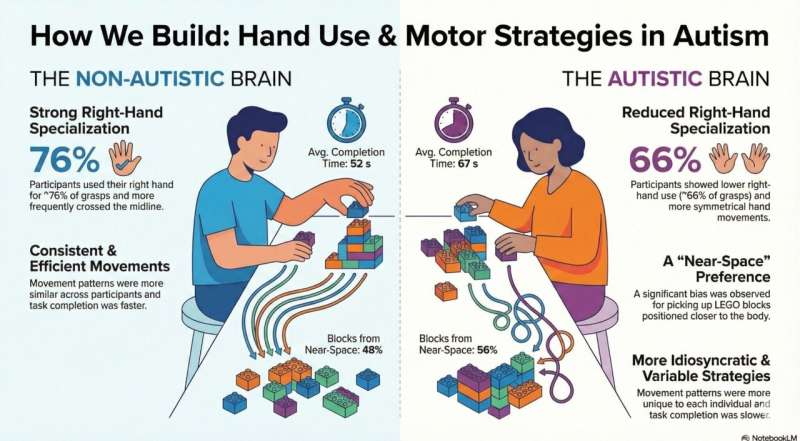
Researchers at York University asked 54 right-handed adults to recreate complex Lego models while cameras tracked their every movement in 3D space. Half of the participants had autism diagnoses, and half did not. What the team discovered could change how we understand and identify autism from infancy.
Even though all participants identified as right-handed, the autistic adults moved completely differently. They used their right hand far less often for grasping pieces and showed highly individualized movement patterns, with each person following their own distinct path through the task. The non-autistic participants, by contrast, moved in remarkably similar ways to each other.
The autistic participants also organized their workspace differently, focusing on blocks closer to them rather than reaching across their body. This suggests their brains process space and movement in a less specialized but more variable way than previously understood.
Associate Professor Erez Freud, who led the study with Master's student Emily Fewster, explains that handedness reflects how our brain's hemispheres divide tasks. About 90% of people show strong right-hand dominance because the left brain hemisphere specializes in fine motor skills. In autistic individuals, this specialization appears much less pronounced.
Why This Inspires
Traditional autism questionnaires simply ask which hand someone uses to write. They miss the rich, dynamic reality of how people actually move through space. This naturalistic approach captures something questionnaires cannot: objective markers that exist from infancy.
Motor skills emerge in babies long before the complex communication abilities doctors currently rely on to diagnose autism. If these distinctive movement patterns appear early in development, they could help families access support years sooner than current methods allow.
The study, published in Autism Research, suggests that each autistic person develops their own unique motor signature. Rather than viewing this variability as a deficit, the researchers see it as evidence of how differently the autistic brain organizes information across its networks.
The findings point toward a future where a simple building task could help identify children who might benefit from early support, allowing interventions to begin when they can make the biggest difference.
More Images


Based on reporting by Medical Xpress
This story was written by BrightWire based on verified news reports.
Spread the positivity!
Share this good news with someone who needs it