Mars Valley Reveals Clues to Ancient Ocean 3.5 Billion Years Ago
A massive 1,300-kilometer valley on Mars is offering scientists fresh evidence that the Red Planet once hosted an ocean during a warmer, wetter era. New images from the Mars Express spacecraft show dramatic flood channels, collapsed terrain, and volcanic features that paint a picture of ancient water reshaping an entire world.
Scientists are piecing together one of the solar system's most hopeful mysteries: Mars may have once been home to a vast ocean, and a giant scar across its surface is helping prove it.
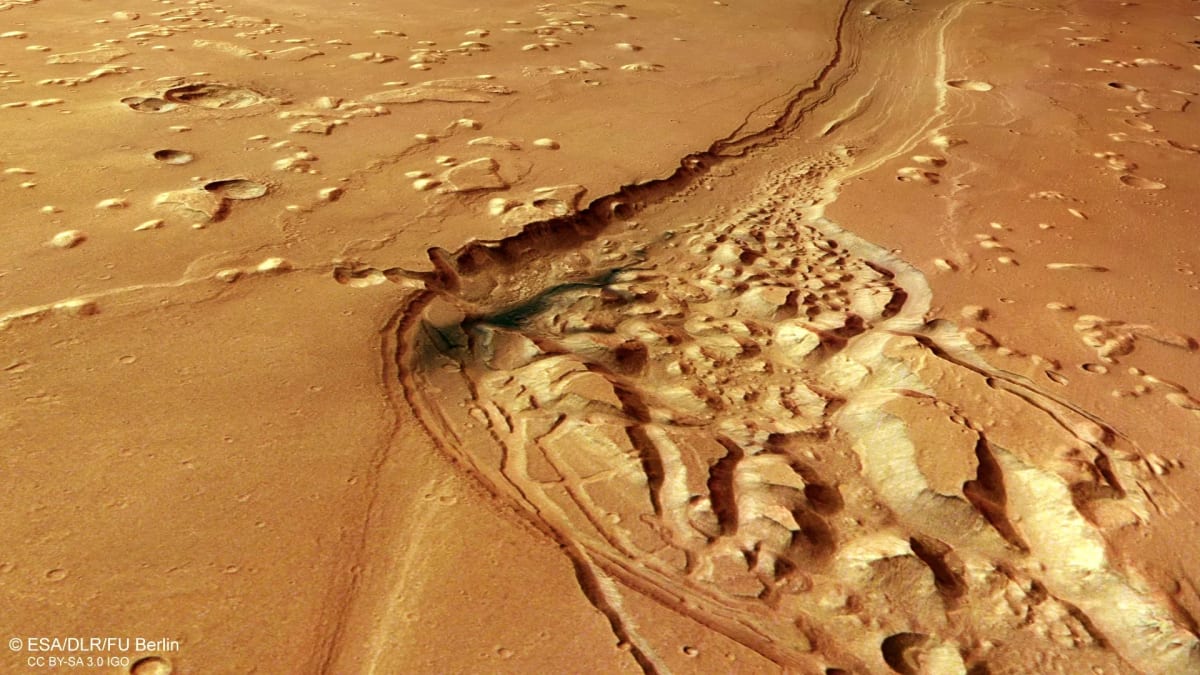
The European Space Agency's Mars Express spacecraft has captured stunning new images of Shalbatana Vallis, a massive valley stretching 1,300 kilometers across the Martian equator. That's roughly the length of Italy, carved deep into the rust-colored landscape.
The valley tells a dramatic story from 3.5 billion years ago. Scientists believe enormous floods of groundwater suddenly burst through the planet's surface, tearing through the landscape with enough force to gouge channels 10 kilometers wide and 500 meters deep.
The flooding didn't happen just once. The valley sits among many similar channels that all flow toward Chryse Planitia, one of the lowest regions on Mars, where researchers think a large ocean may have collected during the planet's warmer period.
Today, the valley is a geological time capsule. Dark volcanic ash lies scattered across its floor, redistributed over billions of years by Martian winds. Wrinkle ridges show where ancient lava flows cooled and contracted, folding like a giant crumpled blanket.
The surrounding terrain holds even more clues. Scientists have identified what they call "chaotic terrain," jumbled blocks and irregular mounds of rock that formed when underground ice melted and the ground collapsed above it. Impact craters dot the region, some sharp and fresh, others buried under layers of material that accumulated over eons.
Why This Inspires
This discovery reminds us that worlds can transform completely over time. Mars wasn't always the cold, dry desert we see today. It once had flowing water, active volcanoes, and possibly even an ocean teeming with the conditions necessary for life.
The Mars Express spacecraft has been studying the Red Planet for more than 20 years since its 2003 launch. Its High Resolution Stereo Camera has mapped the Martian surface in unprecedented three-dimensional detail, allowing scientists to reconstruct the planet's watery past with increasing confidence.
Each new image reveals more about how dramatically Mars has changed. The same valleys that once channeled catastrophic floods now sit silent and frozen, but they're teaching us that planetary climates can shift in ways we're only beginning to understand.
Understanding Mars's transformation from a wet world to a dry one helps scientists learn about planetary evolution throughout our solar system. It also offers perspective on how precious and dynamic our own blue planet truly is.
The research continues as Mars Express orbits above, capturing more details of this ancient valley and the ocean it may have once fed.
Based on reporting by Science Daily
This story was written by BrightWire based on verified news reports.
Spread the positivity!
Share this good news with someone who needs it