Mathematician Proves Random Walks to Clear His Name
George Pólya kept accidentally running into his student during forest walks, so he proved a beautiful mathematical theorem to show he wasn't stalking them. His discovery now explains everything from casino gambling to how molecules find their targets in your cells.
A century ago, mathematician George Pólya had an embarrassing problem: he kept accidentally bumping into the same student and his fiancée during his solitary forest walks near Zurich. After the third awkward encounter, Pólya worried they'd think he was following them.
So he did what any mathematician would do. He proved a theorem.
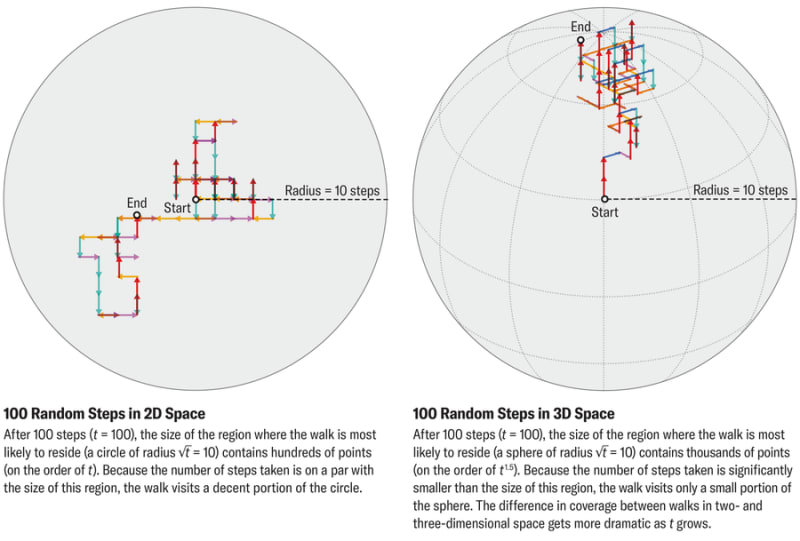
Pólya simplified the question: if two people wander randomly through space, are they mathematically destined to meet again? He imagined a single walker on an infinite grid, choosing directions at random every second, completely independent of previous choices.
What he discovered changed mathematics forever. A random walker on a flat surface will always return to their starting point if they walk long enough. In fact, they'll return infinite times and visit every spot on the grid infinite times too.
But here's where it gets wild: in three dimensions, everything changes. A random walker in 3D space has a 66 percent chance of never returning home.
Mathematician Shizuo Kakutani summed it up perfectly in 1970: "A drunk man will eventually find his way home, but a drunk bird may get lost forever." The drunk bird represents a walker moving randomly through three dimensional space, choosing not just north, south, east, and west, but also up and down.
Pólya's theorem cleared his name. He wasn't stalking his student. He just lacked a third dimension to escape into.
The Ripple Effect
This quirky personal story became one of the most useful theorems in science. Chemists use it to understand how molecules find receptors on cell surfaces. The two dimensional nature of a cell membrane means molecules will eventually find their target through random motion.
It also explains why casinos always win. Your money follows a random walk on a number line, and Pólya proved you'll eventually hit zero if you keep playing. Mathematicians call this "the gambler's ruin," and it's why they recommend never gambling at all.
The math behind it is elegant. After 100 random steps, you'll typically be just 10 steps from where you started. That's because steps cancel each other out: go east, then west, and you're back where you began.
In two dimensions, this means you keep circling back to familiar territory. In three dimensions, there's enough room to wander away forever. It's not just that 3D offers more space. Something fundamental changes about how probability works when you add that third dimension.
Today, random walk theory helps scientists model everything from stock prices to animal foraging patterns to how diseases spread through populations. All because one mathematician wanted to prove he wasn't being creepy in the woods.
More Images

Based on reporting by Scientific American
This story was written by BrightWire based on verified news reports.
Spread the positivity!
Share this good news with someone who needs it