Microsoft Links AI to Robot Labs for Faster Drug Discovery
Microsoft just connected AI brainstorming directly to automated labs that can run real experiments, slashing years off drug discovery timelines. Scientists can now test hypotheses without building their own lab equipment.
Imagine if a scientist could think of an idea in the morning and have a robot lab test it by afternoon, all without leaving their desk.
That's exactly what Microsoft made possible on June 2, 2026. The company launched Discovery, a platform that lets researchers feed questions to AI and have those AI-generated experiments run automatically in real laboratories.
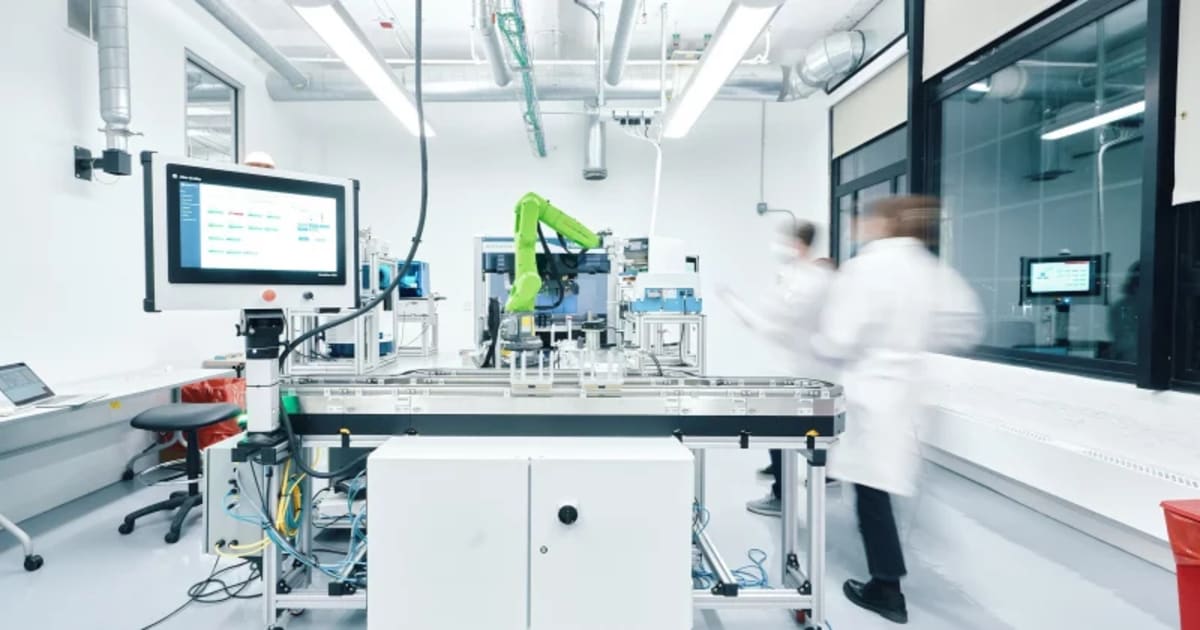
The game-changer is Microsoft's partnership with Ginkgo Bioworks, a synthetic biology company that operates what it calls Cloud Lab. These autonomous laboratories can run biological experiments at massive scale without human hands touching test tubes.
Here's how it works: A researcher asks a question about, say, a new cancer drug. AI agents scan thousands of research papers, propose a hypothesis, design an experiment, and send instructions directly to Ginkgo's robot labs. The results flow back to the AI, which refines the hypothesis and designs the next test.
Microsoft built in human oversight at every step. Scientists stay in control while AI handles the grunt work of literature reviews and experiment design. The system keeps detailed records so other researchers can reproduce results.
Yale is already using Discovery to search for better battery materials. Georgia Tech applied it to questions about how life began on Earth. Pacific Northwest National Laboratory is tackling energy challenges with it.
Microsoft spent over a year testing Discovery before opening it to everyone. They first showed it at a conference in May 2025, then expanded access to more researchers in April 2026.
The Ripple Effect
This isn't just about faster experiments. It's about democratizing cutting-edge research. Small labs without millions to spend on automation can now access the same robot infrastructure as major pharmaceutical companies.
The platform works across biology, chemistry, materials science, and drug development. That means breakthroughs in one field can spark discoveries in another, all on the same system.
Ginkgo's CEO Jason Kelly believes this combination of AI brains and robot hands will "revolutionize every aspect of the scientific process." He's not alone in that optimism. Other tech giants have made noise about AI in science, but none have connected the full chain from AI hypothesis to physical experiment.
Microsoft also released a lighter Discovery app for researchers who want to explore ideas before committing to full experiments. It's a gentle on-ramp to AI-powered science.
The timeline matters here: drugs typically take over a decade to develop. If this platform shaves even a year or two off that process, patients get life-saving treatments faster and researchers can tackle more ambitious questions in their careers.
A future where good ideas get tested immediately, not shelved for lack of equipment, just became real.
More Images

Based on reporting by Google: scientific discovery
This story was written by BrightWire based on verified news reports.
Spread the positivity!
Share this good news with someone who needs it