MIT Physicist Wins $1M Prize for "Magic Angle" Discovery
Three scientists just won a major international prize for discovering how twisting ultra-thin materials at precise angles creates entirely new properties. Their breakthrough launched a whole new field of physics that could one day lead to room-temperature superconductors.
A simple twist could unlock the future of quantum technology, and three physicists just won $1 million for proving it.
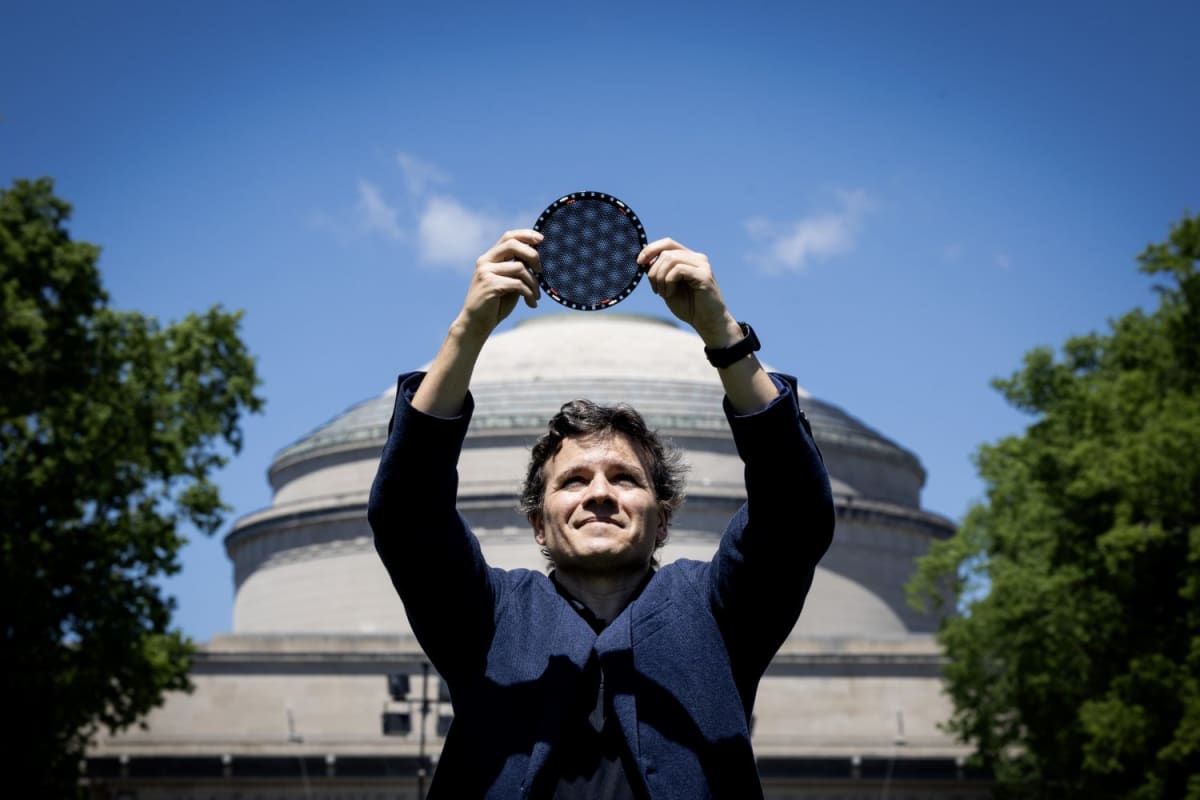
MIT professor Pablo Jarillo-Herrero shares the 2026 Kavli Prize in Nanoscience with Eva Y. Andrei of Rutgers University and Allan MacDonald from the University of Texas at Austin. Together, they founded an entirely new field called "twistronics," where rotating paper-thin materials by tiny angles creates surprising new capabilities.
The discovery started with graphene, a single layer of carbon atoms arranged like chicken wire. In 2009, Andrei's team found that twisting two graphene sheets at slightly different angles completely changed how electrons moved through the material. This was revolutionary because scientists had always changed materials by altering their chemistry, not their geometry.
MacDonald provided the mathematical explanation in 2011, identifying specific "magic angles" where the twist creates the most dramatic effects. His equations became the instruction manual for the entire field, guiding researchers worldwide.
Then in 2018, Jarillo-Herrero's group delivered the knockout punch. They built devices using graphene twisted to these magic angles and observed both superconductivity and unusual insulating behavior. Suddenly, researchers had a playground for creating custom quantum materials with properties they could dial in by simply adjusting the twist.
"It was a big surprise, because the technique we used, though conceptually straightforward, was hard to pull off in the lab," Jarillo-Herrero said. His win brings MIT's total Kavli Prize recipients to nine, joining recent winners like Nancy Kanwisher and Sara Seager.
The Ripple Effect
This discovery sparked what colleagues call "a revolution in condensed matter physics." Laboratories around the world are now exploring twisted materials, searching for new forms of superconductivity and magnetism that don't exist in nature.
The potential applications reach far beyond the lab. Room-temperature superconductors, which this research edges closer to reality, could transform power grids, transportation, and computing. Superconductors carry electricity without any loss, but today's versions only work at extremely cold temperatures.
Jarillo-Herrero emphasized the importance of supporting fundamental research without demanding immediate applications. "In the long run it happens to be the most transformative and impactful in society," he noted.
The Kavli Prize, awarded every two years by a partnership between Norwegian institutions and the Kavli Foundation, honors breakthroughs that help us understand "the big, the small and the complex." Physics department head Deepto Chakrabarty calls the work a spark that "inspired physicists worldwide to explore superconductivity and other emergent phenomena in engineered quantum materials."
Sometimes the biggest breakthroughs come from the smallest twists.
More Images
Based on reporting by MIT News
This story was written by BrightWire based on verified news reports.
Spread the positivity!
Share this good news with someone who needs it