Moon's Far Side Hit Harder by Solar Wind, China Finds
China's Chang'e-6 mission discovered Earth's magnetic field has been protecting one side of the Moon for billions of years. The finding could help scientists unlock secrets about our planet's ancient magnetic history.
For the first time, scientists have proof that Earth has been shielding part of the Moon from dangerous solar radiation for eons.
China's Chang'e-6 mission returned with moon dust from the lunar far side in 2026, and what researchers found inside changed our understanding of how Earth protects its celestial neighbor. The samples revealed that solar wind particles penetrated much deeper into the far side soil than any samples ever collected from the near side.
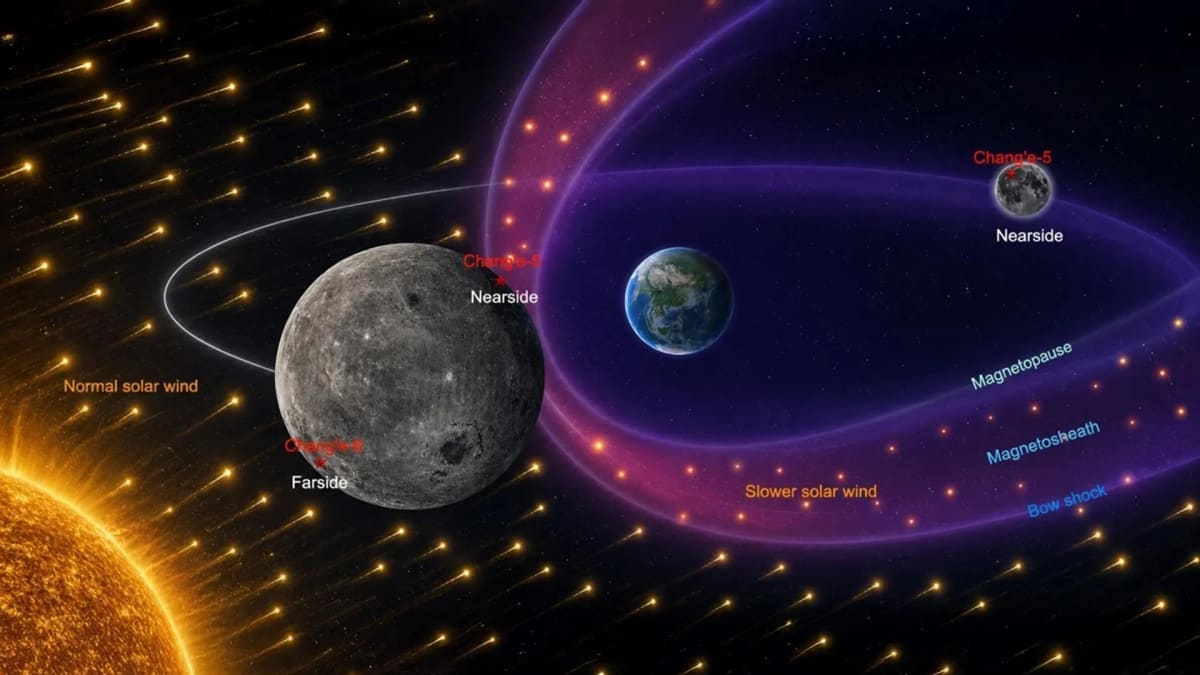
The reason comes down to location. The Moon's near side always faces Earth, which means it regularly passes through our planet's magnetic shield. Inside this protective bubble, solar wind particles slow from about 400 kilometers per second to roughly 200 kilometers per second, hitting the surface with far less force.
The far side gets no such protection. It faces the full blast of solar wind at top speed, allowing particles to burrow deeper into the lunar soil.
Researcher Xuhang Zhang and his team at the Chinese Academy of Sciences discovered the difference by studying noble gases trapped in the regolith. These gases don't react chemically with other materials, making them perfect time capsules of solar wind exposure. The team found that neon isotopes in the far side samples showed much stronger fractionation, and heavy gases like xenon were locked deeper in the soil than near side samples.
The Chang'e-6 mission brought back just 1.935 grams of material from the South Pole Aitken basin, but it was enough to solve a mystery scientists couldn't crack with near side samples alone. Until this mission, researchers had no way to directly compare how solar wind affected both hemispheres.
The Bright Side
This discovery does more than explain differences in moon dust. It opens a window into Earth's magnetic past that scientists never knew existed.
The noble gases preserved in lunar soil could act as fossil records of how Earth's magnetosphere has changed over billions of years. By studying samples of different ages from both sides of the Moon, researchers may be able to trace the history of our planet's magnetic shield, which protects all life on Earth from harmful radiation.
The finding also confirms that about 25 percent of the solar wind hitting the Moon's near side has been slowed by Earth's influence. That means our planet has been quietly protecting part of the Moon's surface for as long as the two have orbited together.
Future missions collecting samples from different locations and depths could help scientists build a complete timeline of Earth's magnetic field stretching back hundreds of millions of years. The Moon has been keeping our secrets all along.
Based on reporting by Science Daily - Environment
This story was written by BrightWire based on verified news reports.
Spread the positivity!
Share this good news with someone who needs it