NASA Discovers New Atmospheric Effect on Mars
Scientists using NASA's MAVEN spacecraft spotted something never seen before at Mars: an atmospheric phenomenon that was thought to only exist around Earth. This discovery opens new doors to understanding how space weather shapes the Red Planet.
Scientists studying Mars just found something they never expected to see in another planet's atmosphere.
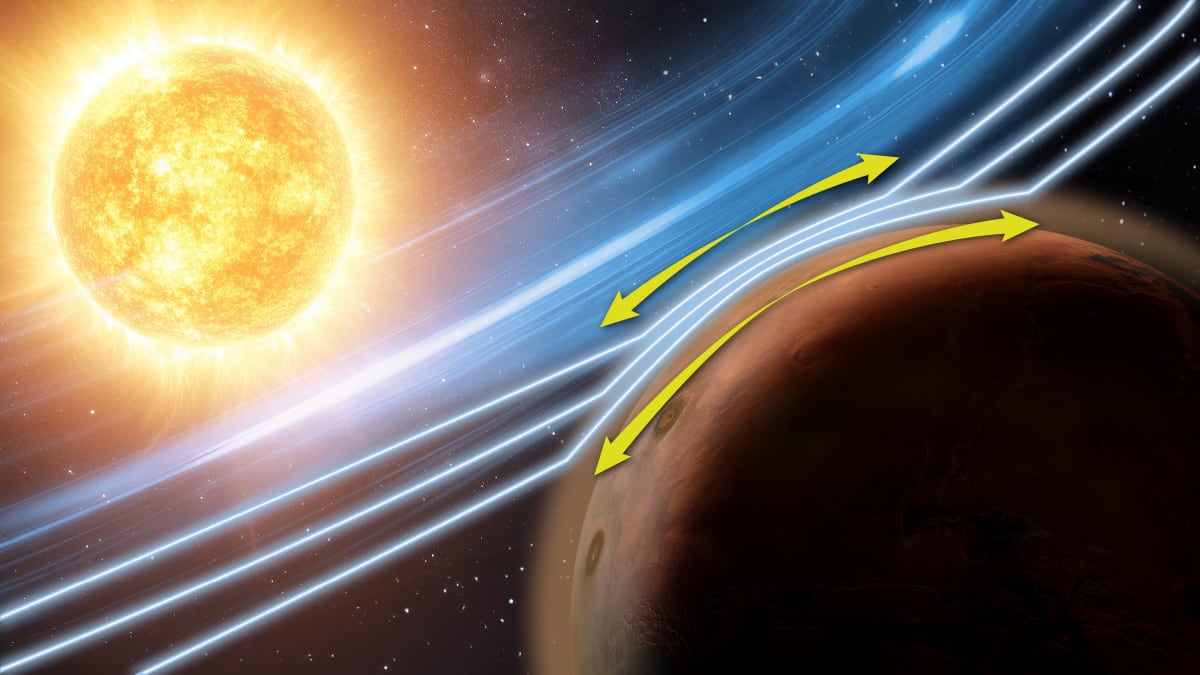
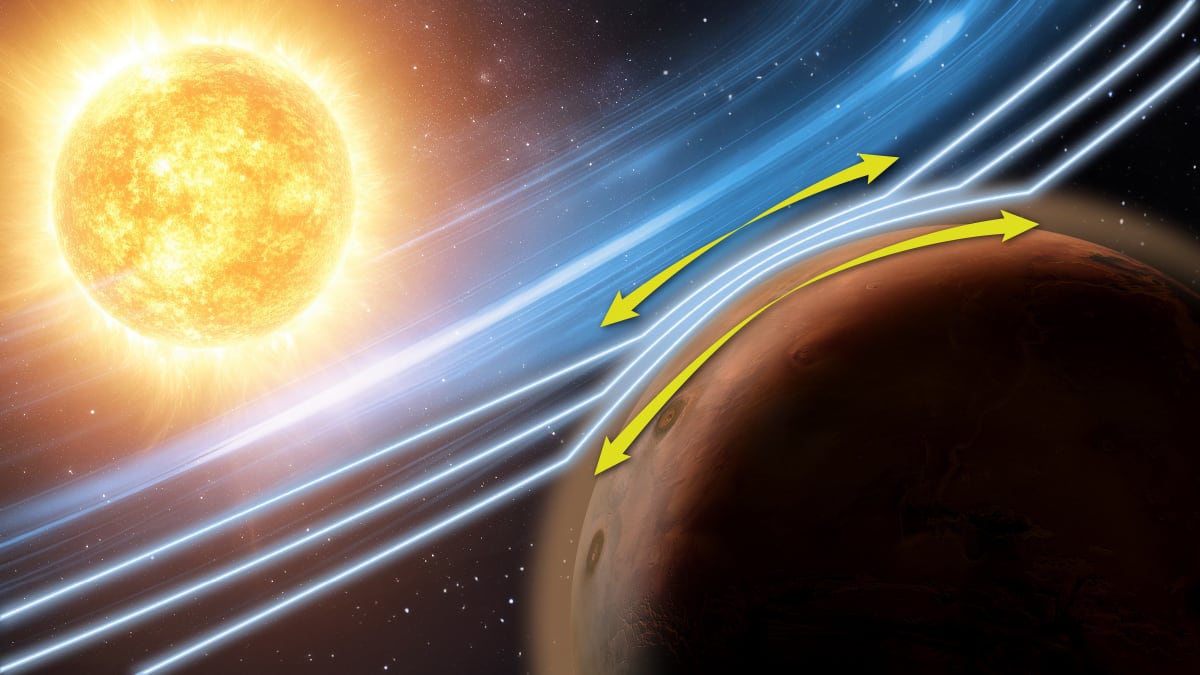
In December 2023, researchers analyzing data from NASA's MAVEN spacecraft discovered the Zwan-Wolf effect happening deep within Mars' atmosphere. This phenomenon, where charged particles get squeezed along magnetic structures like toothpaste from a tube, has been studied at Earth for nearly 50 years but never observed at another planet.
Christopher Fowler, a research assistant professor at West Virginia University, was reviewing the data when he noticed unusual wiggles in the measurements. "I would never have guessed it would be this effect, since it's never been seen in a planetary atmosphere before," he said.
The discovery happened during a large solar storm hitting Mars. The storm amplified the effect enough for MAVEN's instruments to detect it, revealing charged particles being squeezed and distributed around Mars' ionosphere below 200 kilometers.
What makes this finding particularly exciting is that Mars lacks a global magnetic field like Earth's. Instead, it has an induced magnetosphere created when solar wind interacts with its atmosphere. This difference means the Zwan-Wolf effect works differently at Mars than it does at Earth.
The discovery required detective work. Fowler and his team examined data from multiple instruments aboard MAVEN, ruling out several other explanations before identifying the telltale signs of the Zwan-Wolf effect in the measurements.
Why This Inspires
This breakthrough shows how much we still have to learn about our neighboring planet. The team believes the Zwan-Wolf effect might be happening constantly at Mars but typically at levels too subtle to detect.
Understanding this phenomenon helps scientists predict how space weather affects Mars, which becomes increasingly important as we send more spacecraft and potentially astronauts to the Red Planet. The findings also provide insights into similar unmagnetized worlds like Venus and Saturn's moon Titan.
The MAVEN spacecraft has been orbiting Mars since 2014, studying how the planet's atmosphere interacts with the Sun and solar wind. Every observation brings us closer to understanding why Mars lost most of its atmosphere over billions of years and what that means for the planet's past habitability.
Shannon Curry, MAVEN's principal investigator, captured the excitement perfectly: "The MAVEN team continues making new discoveries with our datasets and finding these links between our host star and the Red Planet."
Space exploration keeps reminding us that the universe still has surprises waiting to be discovered.
More Images
Based on reporting by Google: NASA discovery
This story was written by BrightWire based on verified news reports.
Spread the positivity!
Share this good news with someone who needs it