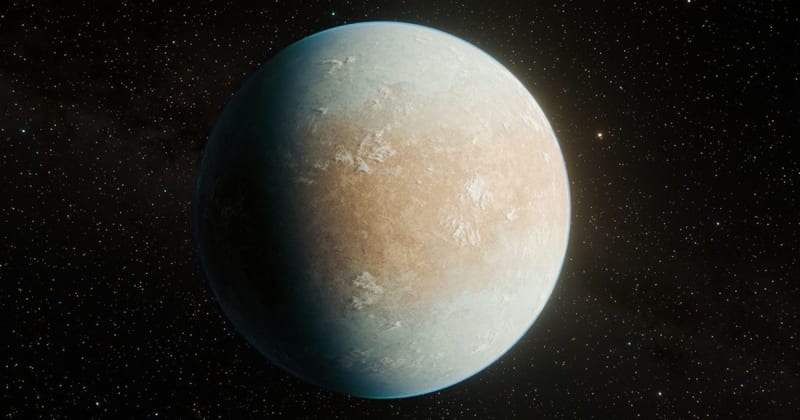
NASA Finds Earth Twin Just 150 Light-Years Away
Scientists have discovered a rocky planet nearly identical to Earth in size and orbit, circling a Sun-like star in our cosmic neighborhood. The planet could harbor conditions for life if it has the right atmosphere.
Astronomers just found what might be Earth's distant cousin, and it's closer than any similar world we've ever discovered.
The rocky planet, called HD 137010 b, orbits a Sun-like star just 150 light-years from us. That makes it four times closer than the next best Earth-sized planet in a habitable zone, giving scientists an unprecedented opportunity to study a world that mirrors our own.
Researchers at NASA made the discovery while reviewing data from the Kepler space telescope's 2017 observations. The planet is nearly identical to Earth in size and takes about 355 days to complete one orbit around its star, almost matching our own year.
Chelsea Huang, a researcher at the University of Southern Queensland in Australia, says the proximity makes all the difference. The star is 20 times brighter than other candidates, making it much easier to study and potentially confirm whether life could exist there.
The catch? HD 137010 b's star is an orange dwarf, slightly smaller and cooler than our yellow Sun. That means the planet receives less than a third of the light and heat Earth gets, with surface temperatures potentially dropping below minus 90 degrees Fahrenheit.
But here's where it gets interesting. Scientists believe the planet could still be temperate and even have liquid water if it has a carbon dioxide-rich atmosphere that traps heat. Mars likely had similar conditions billions of years ago before losing most of its atmosphere.
The team only captured one transit of the planet crossing in front of its star, though scientists typically prefer three observations to confirm discoveries. Still, Huang calls it a "textbook example" of a planetary transit thanks to the star's brightness and closeness.
Why This Inspires
This discovery reminds us that Earth might not be so special after all. Finding worlds that resemble our own, even in our relative neighborhood, suggests the universe could be teeming with planets capable of supporting life.
The real excitement comes from what happens next. Unlike distant candidates that remain forever out of reach for detailed study, HD 137010 b is close enough for future telescopes to analyze its atmosphere and search for signs of habitability or even life itself.
Follow-up observations will determine whether this world is a frozen wasteland or a temperate paradise, but either way, we're one step closer to answering humanity's oldest question: Are we alone?
More Images

Based on reporting by Google: NASA discovery
This story was written by BrightWire based on verified news reports.
Spread the positivity!
Share this good news with someone who needs it