NASA Finds Hidden Magnetic Effect Squeezing Mars' Air
Scientists discovered the Zwan-Wolf effect happening in Mars' atmosphere for the first time, revealing how the Red Planet's thin air gets squeezed during solar storms. This breakthrough helps explain how Mars transformed from a wet world to today's cold desert.
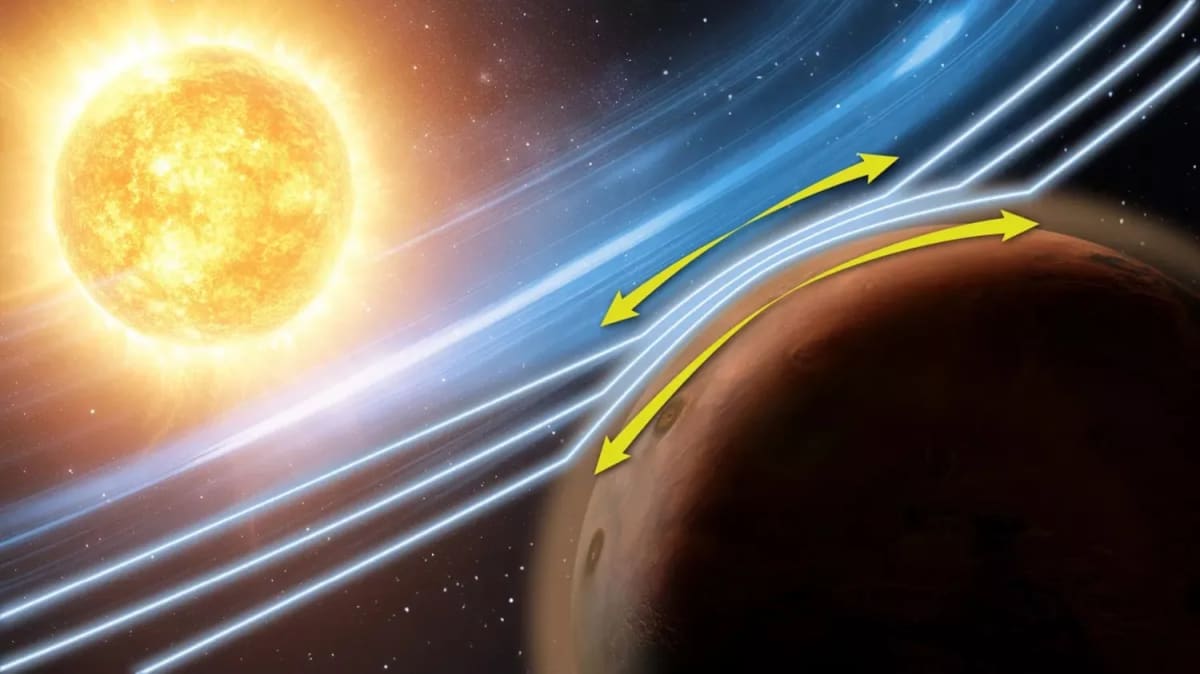
Scientists just spotted something on Mars that wasn't supposed to be there: a magnetic phenomenon squeezing the planet's atmosphere like toothpaste in a tube.
NASA's MAVEN spacecraft detected the Zwan-Wolf effect deep within Mars' atmosphere, marking the first time this process has been observed beyond Earth's protective magnetic bubble. The discovery changes how we understand what happened to Mars billions of years ago.
On Earth, this effect acts like an invisible shield, deflecting harmful solar wind and protecting our atmosphere. Scientists thought it only worked on planets with strong magnetic fields like ours. Mars doesn't have that protection.
Instead, the Red Planet has a weak, constantly shifting magnetic barrier created when solar wind crashes into its atmosphere. That makes it vulnerable to getting stripped away bit by bit over millions of years.
The MAVEN team noticed strange swings in their magnetic field readings during a powerful solar storm. The effect became so strong that instruments could finally measure it happening below 200 kilometers in Mars' ionosphere, where electrically charged particles fill the air.
Researchers believe this squeezing process happens continuously on Mars but usually stays too weak to detect. During solar storms, it intensifies enough to compress and reshape the atmosphere in real time.
Why This Inspires
Understanding how space weather batters Mars gives us crucial information for protecting future astronauts who visit the Red Planet. Solar storms pose real dangers to both spacecraft and humans without Earth's magnetic protection.
This finding also connects Mars to other unmagnetized worlds like Venus and Saturn's moon Titan. The same atmospheric squeezing could be happening across our solar system wherever solar wind meets exposed planetary air.
Shannon Curry, MAVEN's principal investigator at the University of Colorado Boulder, emphasizes the importance: "Knowing how space weather interacts with Mars is essential. The MAVEN team continues making discoveries with our datasets and finding these links between our host star and the Red Planet."
MAVEN has been circling Mars since 2014, slowly piecing together the story of how the planet lost most of its atmosphere. Each observation fills in another part of the puzzle showing Mars' transformation from a warm, wet world that might have supported life to today's frozen desert.
The spacecraft itself faces uncertainty after communication issues in late 2025, but its legacy remains secure. MAVEN proved that Mars isn't a dead world but a dynamic planet constantly being reshaped by its relationship with the Sun.
This hidden magnetic signature in Mars' atmosphere reminds us that even small processes can drive massive planetary changes over time, and that our cosmic neighborhood still holds secrets waiting to be revealed.
More Images
Based on reporting by Google: NASA discovery
This story was written by BrightWire based on verified news reports.
Spread the positivity!
Share this good news with someone who needs it