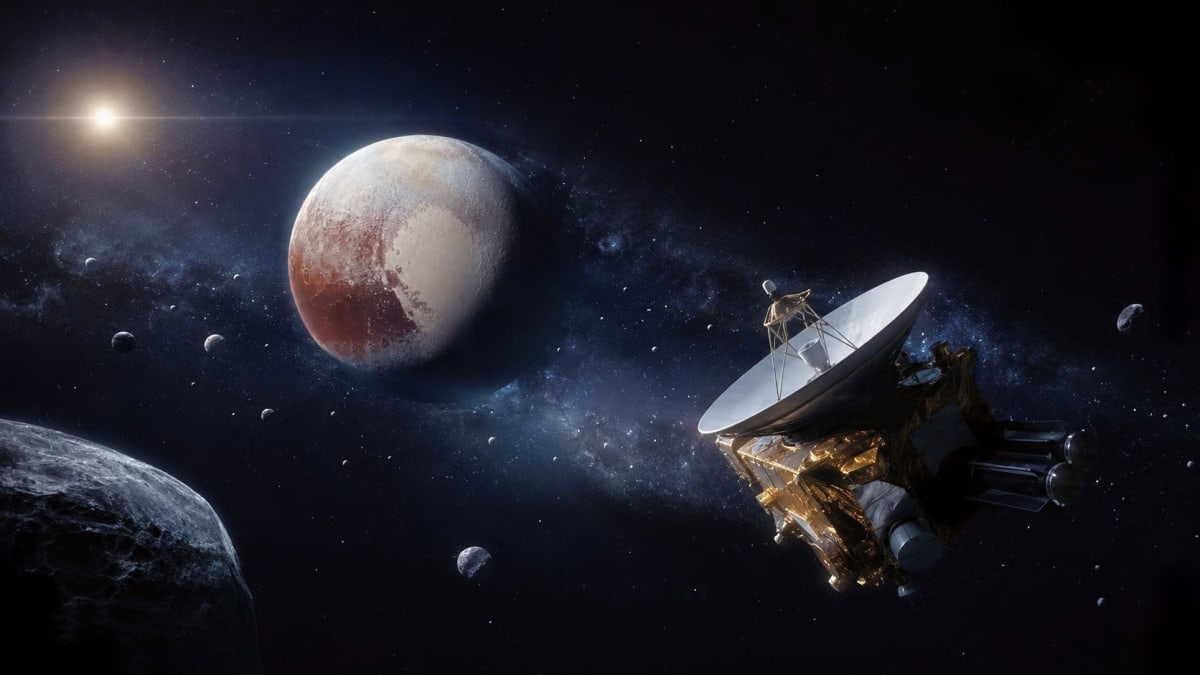
NASA Probe Reveals Pluto's Heart After 3 Billion Mile Trip
For 85 years, Pluto was just a fuzzy dot in our telescopes. Then a piano-sized spacecraft changed everything we thought we knew about our solar system's most mysterious world.
After traveling more than three billion miles across space, NASA's New Horizons spacecraft gave humanity its first real look at Pluto in 2015, and what it found left scientists speechless.
The probe discovered a massive heart-shaped glacier stretching 1,000 kilometers across Pluto's surface. Scientists informally named it Sputnik Planum, and it became the iconic symbol of one of NASA's most daring missions.
New Horizons launched from Cape Canaveral, Florida in January 2006, traveling faster than any spacecraft before it at 36,000 miles per hour. Even at that incredible speed, it took nearly a decade to reach the dwarf planet discovered by astronomer Clyde Tombaugh in 1930.
The wait was worth it. Alan Stern, the mission's Principal Investigator, said the complexity and activity on Pluto's surface was "far beyond what we expected." The probe found young, active surfaces that are still changing today, defying all predictions.
Pluto's atmosphere surprised scientists too. The probe detected mysterious hazes and an atmospheric escape rate much lower than models predicted, forcing researchers to completely rethink their understanding of this distant world.
The mission also solved mysteries about Pluto's five moons. By studying surface craters, New Horizons determined they likely formed together in an ancient collision between Pluto and another massive object in the Kuiper Belt.
Why This Inspires
New Horizons proved that distance doesn't limit human curiosity. The spacecraft was built by a team at Johns Hopkins Applied Physics Laboratory who dared to explore a world so far away that previous generations thought it impossible.
Today, New Horizons continues traveling through the Kuiper Belt, more than 5.7 billion miles from Earth. It entered hibernation in August 2025 after a software upgrade, but it's still collecting data as it drifts through unexplored space.
The probe won't wake until at least June 2026, depending on NASA's budget decisions. Even in sleep mode, it sends status updates back to Earth, though those signals take over eight hours to arrive.
What started as a mission to photograph a mysterious dot has become a journey into the unknown reaches of our cosmic neighborhood, proving that the best discoveries often lie in the places we've never been brave enough to explore.
More Images



Based on reporting by Google: NASA discovery
This story was written by BrightWire based on verified news reports.
Spread the positivity!
Share this good news with someone who needs it