NASA Probe Survives 692,000 MPH Dive Through Sun's Crown
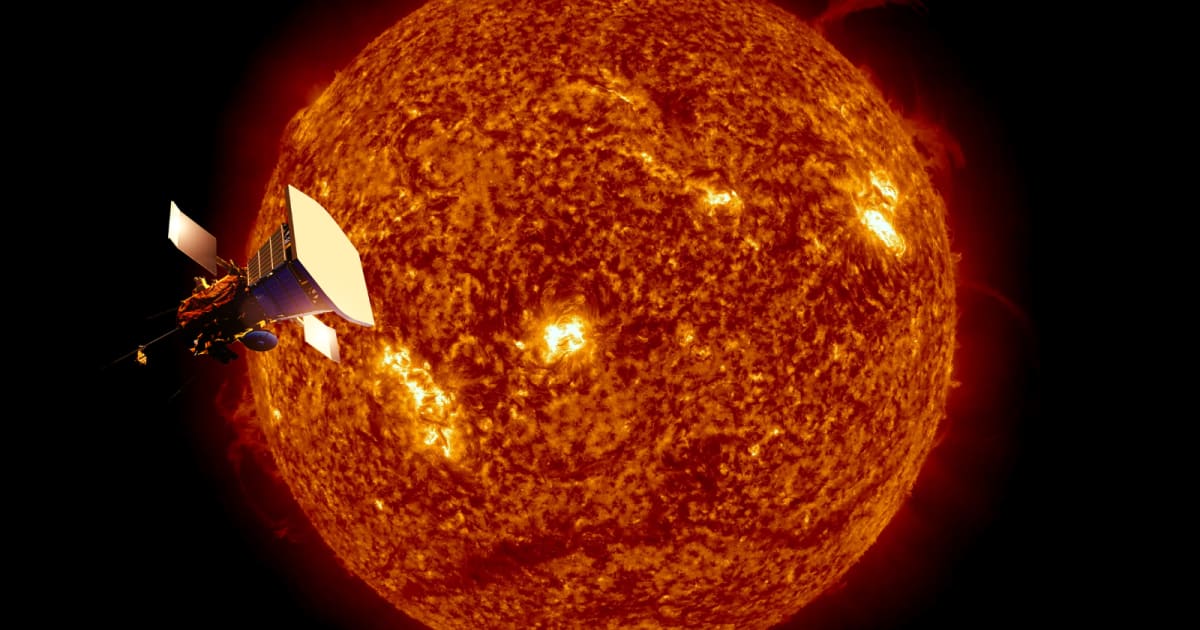
NASA's Parker Solar Probe just survived flying through the Sun's scorching corona at record-breaking speed, gathering data that could solve a puzzle that's stumped scientists for 80 years. The spacecraft came within 3.8 million miles of the Sun's surface on Christmas Eve, endured temperatures over a million degrees, and lived to tell the tale.
A spacecraft the size of a small car just flew closer to the Sun than anything humans have ever built, and it's sending back secrets from one of the universe's strangest mysteries.
NASA's Parker Solar Probe screamed through the Sun's outer atmosphere on December 24, 2024, at 692,000 kilometers per hour. That's fast enough to cross the United States in about 20 seconds, making it the fastest human-made object ever.
Two days later, a simple beep confirmed what engineers had been hoping for: Parker had survived. Full health data arrived on New Year's Day, showing the spacecraft was doing just fine despite being roasted by temperatures exceeding a million degrees Celsius.
The probe's secret weapon is a carbon shield just 11 centimeters thick. While one side faces heat that could vaporize most materials, the instruments on the other side stay cool enough to work, measuring the plasma swirling around them in real time.
What makes this mission so exciting isn't just the record-breaking numbers. It's the puzzle Parker might finally help solve.
Scientists have been scratching their heads since the 1940s about a weird temperature quirk. The Sun's visible surface sits at about 5,500 degrees Celsius, but the corona hovering above it blazes at over a million degrees. That shouldn't happen, because heat doesn't naturally flow from cooler areas to hotter ones.
Something is pumping enormous amounts of energy into the Sun's outer atmosphere. For decades, researchers have proposed two main explanations: magnetic waves carrying energy upward, or countless tiny magnetic explosions called nanoflares. Both might be true, but nobody knew which one dominates.
Parker has already discovered switchbacks, strange S-shaped kinks in the Sun's magnetic field that appear near the solar wind's birthplace. These magnetic twists carry energy that could help heat the corona and accelerate particles into space.
A 2024 study found these switchbacks are common in the solar wind but absent from deeper inside the corona itself. That tells scientists where these features form, narrowing down the possibilities.
Why This Inspires
This isn't just abstract science happening millions of miles away. The Sun's corona constantly sends charged particles streaming past Earth as solar wind. Understanding how that wind forms and accelerates helps protect our satellites, power grids, and astronauts from damaging space weather.
Parker reached its record distance gradually, using seven flybys of Venus to slowly lower its orbit over several years. It first dipped into the corona in April 2021 and has been diving deeper ever since, with its most recent pass in March 2026.
The spacecraft will continue its daring loops through 2026 and possibly beyond, gathering data while the Sun reaches the active phase of its 11-year cycle. That's when magnetic activity peaks, giving Parker the best chance to witness the heating mechanisms in action.
Every pass brings scientists closer to understanding why our nearest star behaves the way it does, proving that some of humanity's boldest journeys happen when we fly straight toward the fire.
More Images


Based on reporting by Google News - Science
This story was written by BrightWire based on verified news reports.
Spread the positivity!
Share this good news with someone who needs it