NASA Telescope to Reveal Millions of Hidden Neutron Stars
NASA's upcoming Roman Space Telescope could finally uncover millions of invisible neutron stars hiding across the Milky Way using gravity as a cosmic detective tool. The breakthrough could answer mysteries about how stars explode and why these objects rocket through space at incredible speeds.
Scientists believe millions of neutron stars are scattered throughout our galaxy, but almost all of them remain completely invisible to current telescopes.
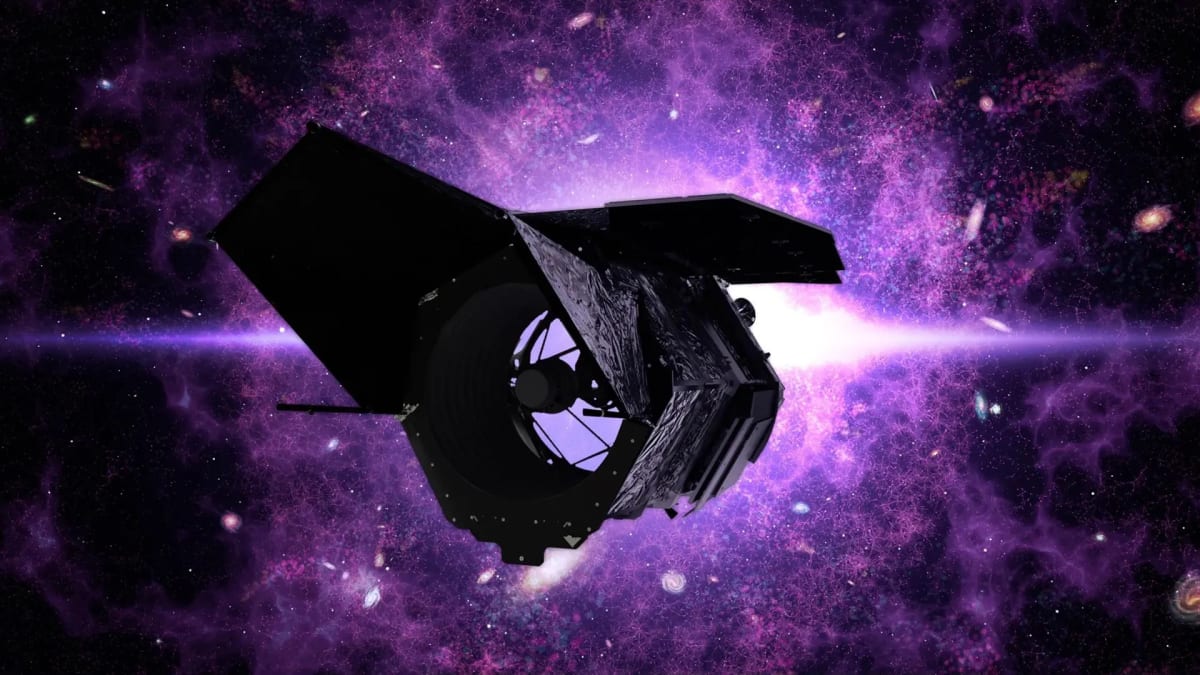
NASA's Nancy Grace Roman Space Telescope is about to change that. The upcoming mission could detect dozens of these hidden cosmic objects and even weigh them for the first time, according to a new study published in Astronomy and Astrophysics.
Neutron stars are the ultra-dense remnants left behind when massive stars explode. They pack more mass than the Sun into an object roughly the size of a city, making them some of the most extreme objects in the universe.
The problem is that most neutron stars are dim and isolated. Unless they emit radio waves as pulsars or shine in X-rays, even our most powerful telescopes miss them completely.
Roman will use a clever trick called gravitational microlensing. When a neutron star passes in front of a distant star, its gravity bends and magnifies the background starlight, causing it to brighten temporarily and shift position slightly.
Many telescopes can detect the brightening, but Roman will do something special. The observatory will measure both the brightness change and the tiny positional shift of the background star with incredible precision.
"What's really cool about using microlensing is that you can get direct mass measurements," said Peter McGill of Lawrence Livermore National Laboratory, a study co-author. "By measuring that tiny deflection on the sky, we can directly weigh something that is otherwise unseen."
So far, astronomers have identified only a few thousand neutron stars. Scientists estimate the Milky Way could actually contain anywhere from tens of millions to hundreds of millions of these objects, representing a vast hidden population waiting to be discovered.
The Ripple Effect
The discoveries could solve major cosmic mysteries. Scientists want to understand the powerful "kicks" neutron stars receive during supernova explosions that launch them through space at hundreds of miles per second.
The mission could also reveal whether there's a true gap between neutron star and black hole masses, helping researchers better understand how stars evolve, explode, and distribute heavy elements throughout the cosmos.
Lead researcher Zofia Kaczmarek of Heidelberg University in Germany emphasized how valuable even small discoveries would be. "Even a single mass measurement would be very powerful," she said. "If we found just one isolated neutron star, it would already be incredibly stimulating to our research."
The team plans to start searching as soon as Roman begins its Galactic Bulge Time Domain Survey, which will repeatedly observe millions of stars across enormous sections of sky. "We're going to get to work as soon as the data start coming in," McGill said.
What makes this discovery particularly exciting is that it wasn't part of the original plan. Roman was designed mainly to discover exoplanets, but its advanced precision has opened the door to entirely new kinds of science.
Within months of launching, Roman could begin identifying the first members of this invisible cosmic population and revealing secrets hidden in plain sight across our galaxy.
Based on reporting by Science Daily
This story was written by BrightWire based on verified news reports.
Spread the positivity!
Share this good news with someone who needs it