NASA Unveils Permanent Moon Base Plans Starting 2027
NASA just revealed blueprints for humanity's first permanent lunar outpost, complete with habitats, hopping drones, and water mining technology. The ambitious Artemis program aims to establish continuous human presence on the Moon's south pole by 2032.
More than 50 years after we last walked on the Moon, we're finally going back to stay.
NASA unveiled its first comprehensive blueprint for a permanent lunar base on Tuesday, marking a historic shift from brief visits to long-term habitation. The agency has awarded contracts to four US companies, including Jeff Bezos's Blue Origin, to build the infrastructure needed for humanity's first outpost on another world.
"The Moon base will be America's and humanity's first outpost on another celestial world," said NASA administrator Jared Isaacman. Unlike the quick trips of the Apollo era, this mission is designed for the long haul.
The plan unfolds in three phases over the next decade. Phase one starts with landing astronauts and deploying robotic systems near the Moon's south pole as early as 2027, with surface landings potentially happening by 2028.
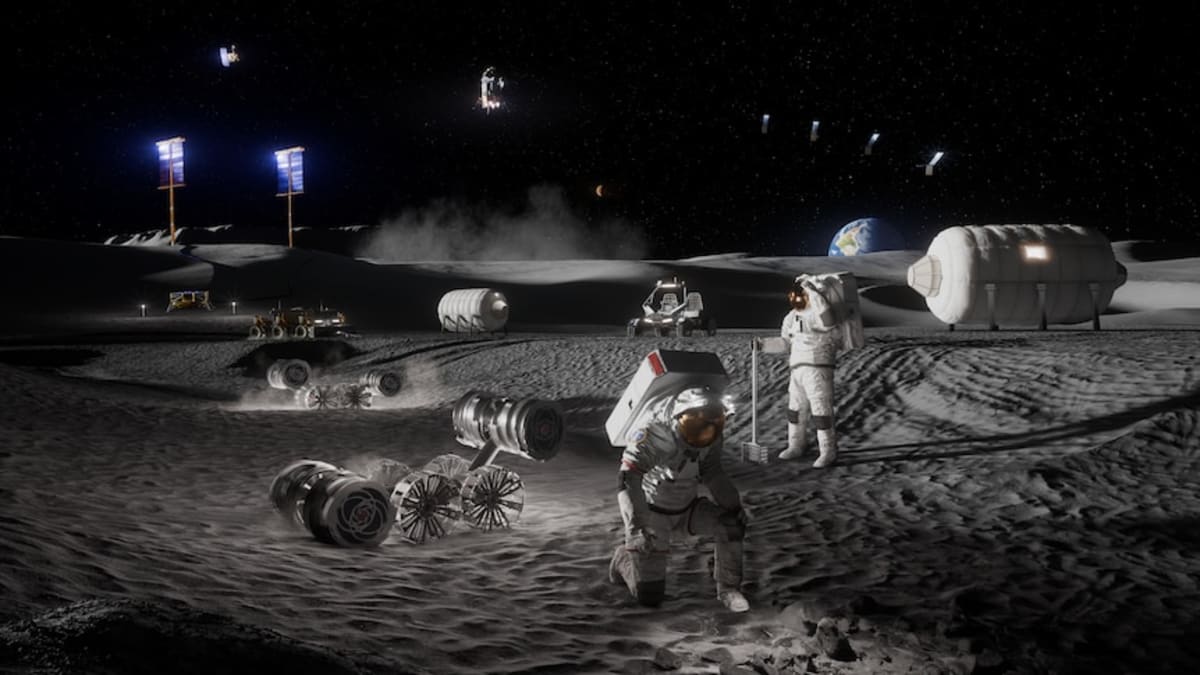
Phase two, running through the early 2030s, focuses on building critical infrastructure including pressurized living quarters, long-range rovers, and solar power systems. The south pole receives near-continuous sunlight, making it ideal for stable energy generation.
The real game changer? Rocket-propelled hopping drones that can leap across difficult lunar terrain and explore deep shadowed craters where traditional rovers can't venture.
Phase three, starting around 2032, aims for continuous occupation with advanced permanent structures. "Then we'll be able to say, 'Hey, we're permanently here, and we're not giving it up,'" said program executive Carlos Garcia-Galan.
The location choice is strategic. Scientists believe the Moon's south pole contains significant deposits of frozen water in craters that haven't seen sunlight for billions of years. That water could be converted into drinking supplies, breathable oxygen, and even rocket fuel.
NASA isn't building a sprawling Moon city yet. The current vision involves interconnected habitats, laboratories, and vehicles spanning several kilometers, where astronauts could live and work for weeks or months at a time while sheltered from radiation and extreme temperatures.
The Ripple Effect
This lunar base serves a purpose far beyond the Moon itself. NASA sees it as a crucial training ground for eventual human missions to Mars, where similar technologies and strategies would be essential for survival.
The timing reflects growing global competition in space exploration, with China pursuing its own lunar base project in partnership with Russia. But the broader vision is collaborative, with territory markers designed to avoid interference with equipment from other nations operating nearby.
"For those waiting patiently, the grand return is close at hand, and we will not slow down," Isaacman said. "We are really just getting started."
After decades of dreams, humanity's permanent foothold beyond Earth is finally taking shape, one carefully planned phase at a time.
More Images


Based on reporting by ABC Australia
This story was written by BrightWire based on verified news reports.
Spread the positivity!
Share this good news with someone who needs it