NASA's Psyche Spacecraft Aces Mars Flyby En Route to Asteroid
NASA's Psyche spacecraft just pulled off a flawless Mars flyby, using the Red Planet's gravity to slingshot itself 1,000 mph faster toward a mysterious metal asteroid. The bonus? It captured stunning crescent Mars photos that surprised even the mission scientists.
A spacecraft the size of a small van just got a massive speed boost from Mars, and it didn't cost a drop of fuel.
NASA's Psyche spacecraft zipped past Mars on May 15 at less than 3,000 miles away, using the planet's gravity to pick up an extra 1,000 miles per hour. The maneuver worked perfectly, sending the craft hurtling toward its ultimate destination: a metal-rich asteroid that might hold secrets about how Earth and other planets first formed.
"Although we were confident in our calculations and flight plan, monitoring the signal in real time during the flyby was still exciting," said Don Han, the mission's navigation lead. The spacecraft is now locked on course to reach the asteroid Psyche in summer 2029.
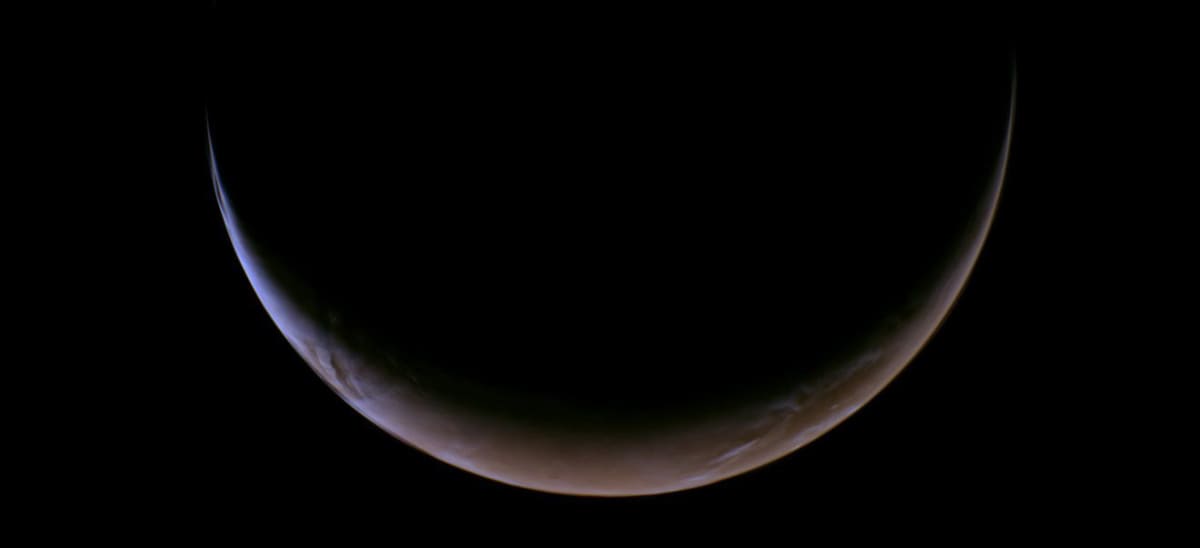
But the Mars encounter wasn't just about gravity. Scientists decided to wake up Psyche's instruments just days before the flyby to give them a test run. The cameras, designed to study a distant asteroid, got an unexpected chance to photograph Mars from an unusual angle.
The results surprised everyone. Mars appeared as a brilliant crescent, extending farther and shining brighter than the team predicted. The spacecraft captured thousands of images of the Martian surface and atmosphere, including stunning detail of the Huygens crater and the planet's southern highlands.
"This dataset provides unique and important opportunities for us to calibrate and characterize the performance of the cameras," said Jim Bell, who leads the imaging team at Arizona State University. The unexpected brightness gave scientists valuable data to fine-tune their instruments before the main mission begins.
The magnetometer made its own discovery too. Scientists believe it detected Mars's bow shock, a shock wave created when solar winds slam into the planet's magnetic field.
Why This Inspires
This mission represents humanity's first visit to a metal world. The asteroid Psyche, sitting 173 miles wide in the belt between Mars and Jupiter, might be the exposed core of an ancient planetesimal, a building block left over from the solar system's earliest days. If scientists are right, studying this cosmic fossil could reveal how rocky planets like Earth got their start 4.6 billion years ago.
The fact that a spacecraft can travel millions of miles, execute a perfect gravity assist without using fuel, snap unexpected photos, and still have four more years to go shows just how far human ingenuity can reach.
"We can thank the Red Planet for giving our spacecraft a critical gravitational slingshot farther into the solar system," said Lindy Elkins-Tanton, the mission's principal investigator. By 2029, we'll finally meet a world unlike any we've ever visited.
Based on reporting by Google: space mission success
This story was written by BrightWire based on verified news reports.
Spread the positivity!
Share this good news with someone who needs it