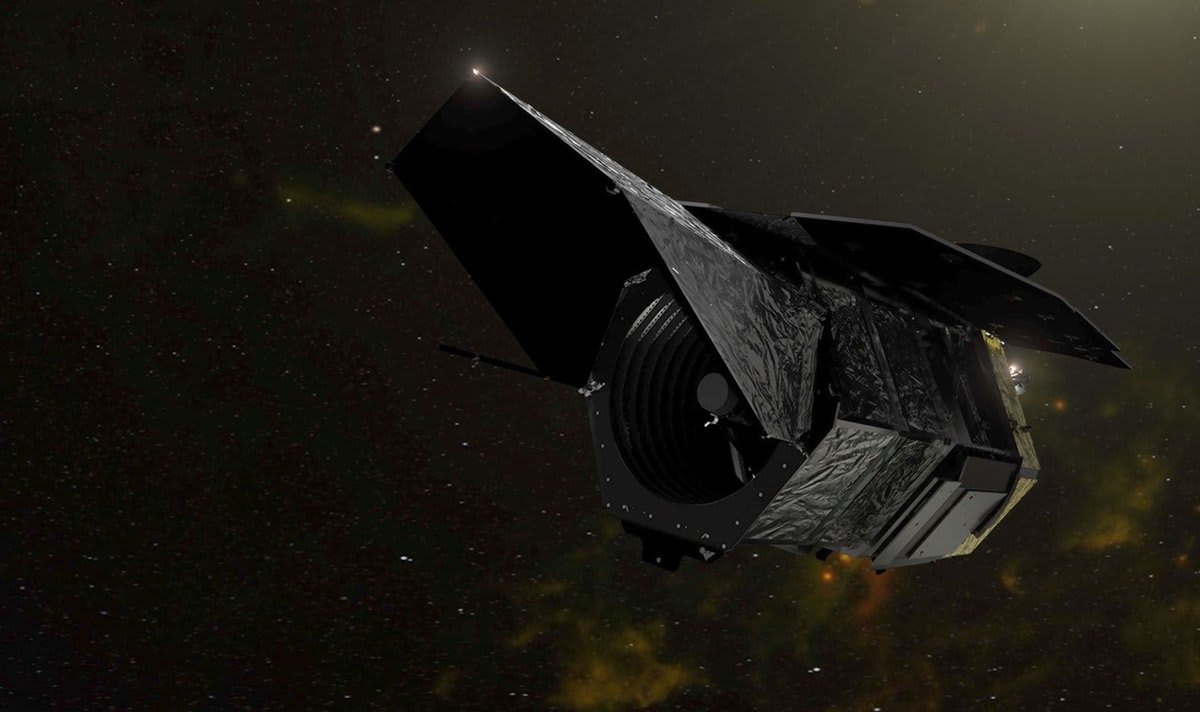
NASA's Roman Telescope Launches to Solve Dark Energy Mystery
NASA's newest space telescope, launching August 30, could finally crack the universe's biggest puzzle: the mysterious force making space expand faster every year. Scientists are calling it our best shot yet at understanding dark energy, which makes up most of the cosmos.
After nearly three decades of searching for answers, scientists are closer than ever to understanding the mysterious force that's pushing our universe apart.
NASA's Nancy Grace Roman Space Telescope launches August 30 with one bold mission: solve the riddle of dark energy. This invisible force, discovered in 1998, is causing the universe to expand faster and faster over time, and scientists still don't know why.
The breakthrough discovery came when astronomers noticed distant galaxies moving in unexpected ways. Instead of slowing down, the universe's expansion was speeding up. Something powerful was pushing everything apart, but no one could explain what.
"Some of us think these tensions may be indicating that we're ripe for another revolution in cosmology," says Jason Rhodes, a cosmologist at NASA's Jet Propulsion Laboratory who works on the Roman team.
The telescope joins two other major projects already hunting for clues: the Dark Energy Survey and the Dark Energy Spectroscopic Instrument. Both have recently found hints that dark energy might be changing over time, making it even more mysterious than scientists thought.
Think of dark energy like an invisible ocean current moving everything in space. Scientists know it's there because they can see its effects, but they can't touch it or directly measure it. The Roman telescope will map millions of galaxies, tracking how this cosmic force has shaped the universe over billions of years.
The mystery matters because dark energy makes up most of our universe. Without understanding it, scientists can't fully explain how the cosmos works or predict its future.
Why This Inspires
This mission represents humanity's boldest attempt yet to answer one of existence's biggest questions. The Roman telescope combines decades of scientific knowledge with cutting-edge technology, bringing together researchers from around the world united by curiosity.
What makes this moment special is the timing. Multiple studies are all pointing toward the same exciting conclusion: we might be on the edge of a major breakthrough. The universe is revealing tiny clues, and scientists finally have the right tools to piece them together.
"That's gotten everyone in a bit of a tizzy," says Tamara Davis, an astrophysicist at the University of Queensland who works on both ground-based projects. The energy in the scientific community is electric.
Adam Riess, who won the 2011 Nobel Prize for discovering dark energy, puts it simply: maybe the universe has "sprinkles" and "chocolate chips" we haven't noticed yet. The cosmos might be far more interesting than anyone imagined.
When Roman becomes operational early next year, it will begin the most detailed survey of the universe ever attempted, bringing us closer to understanding the invisible force that shapes everything we see.
More Images



Based on reporting by Scientific American
This story was written by BrightWire based on verified news reports.
Spread the positivity!
Share this good news with someone who needs it