New Moon Tonight Offers Best Stargazing of February
The moonless skies around February 17's new moon are creating perfect conditions for spotting planets, constellations, and distant star clusters. Anyone with clear skies can explore stunning cosmic sights without any special equipment. #
The darkest nights of the month are here, and they're offering skygazers a front-row seat to some of the most beautiful objects in our night sky.
February 17's new moon means our natural satellite won't be casting any glow across the heavens for several nights. That darkness transforms the sky into a cosmic showcase where planets, constellations, and even distant nebulae become visible to the naked eye.
Mercury is shining bright in the western sky right after sunset, appearing less than 20 degrees above the horizon. Saturn sits just above and to the left, its famous rings starting to reveal themselves again after appearing edge-on and nearly invisible last November.
Jupiter dominates the evening sky, serving as a brilliant guidepost to find the twin stars Castor and Pollux in the constellation Gemini. To Jupiter's lower right, Sirius blazes as the brightest star in our night sky, marking the heart of Canis Major, the big dog constellation.
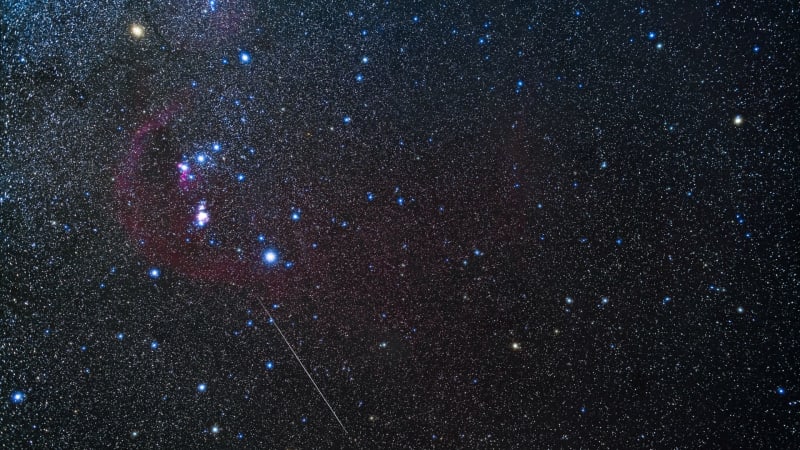
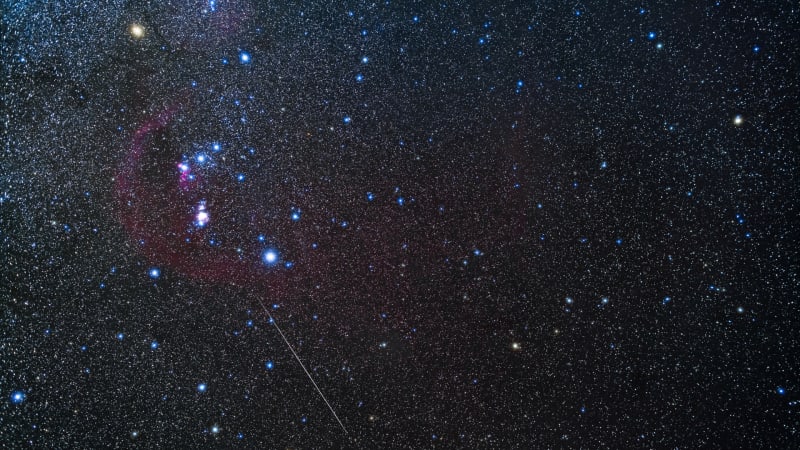
The hunter Orion stands proud in the hours after sunset, with the red giant Betelgeuse marking his shoulder and blue supergiant Rigel at his foot. Between them hang the three stars of Orion's Belt, and just below that, the milky glow of the Orion Nebula shines from 1,500 light years away.
Look to the right of Orion to spot Aldebaran's red light marking the eye of Taurus the bull. A fuzzy patch above it reveals the Pleiades, a star cluster containing over a thousand blue-white stars that looks magnificent even without binoculars.
Why This Inspires
These moonless nights remind us that the universe's greatest wonders are still accessible to everyone. You don't need expensive telescopes or special locations. Just step outside, look up, and let your eyes adjust to the darkness for a few minutes.
The Big Dipper stands on end in the northeast, its two uppermost stars pointing directly to Polaris, the North Star around which our entire sky appears to rotate. Follow that line further to find Cassiopeia's distinctive zigzag pattern, five bright stars forming an "M" or "W" depending on the season.
These dark sky conditions won't last long as the moon grows brighter each night, but they offer a precious window to reconnect with the cosmos that surrounds us.
The universe is putting on a show, and admission is absolutely free.
#
More Images



Based on reporting by Space.com
This story was written by BrightWire based on verified news reports.
Spread the positivity!
Share this good news with someone who needs it