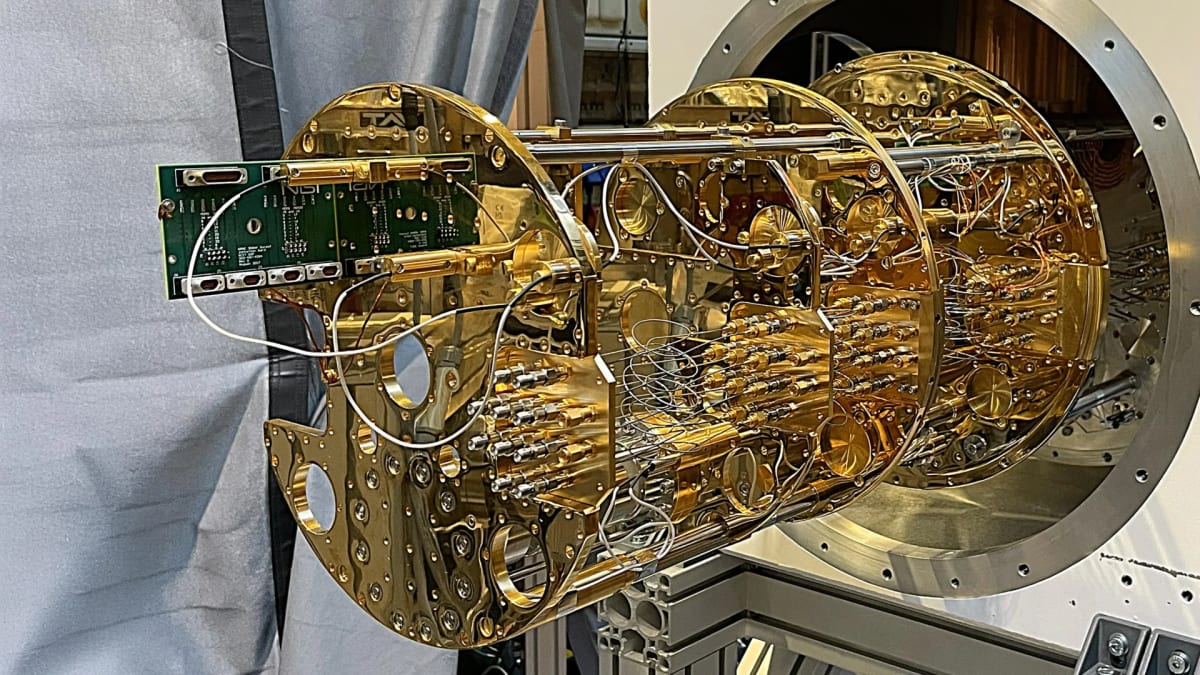
New X-ray Detector 1,000x More Sensitive Opens in Europe
Scientists in Berlin just fired up Europe's most powerful X-ray detector, making discoveries that used to take hours possible in minutes. The breakthrough could unlock secrets hidden in materials as thin as a single layer of atoms.
Scientists can now see things they've never been able to detect before, thanks to a revolutionary new tool that just came online in Berlin.
A superconducting X-ray detector at the BESSY II research facility is detecting photons up to 1,000 times more efficiently than conventional systems. This isn't just a minor upgrade. It's the difference between needing a mountain of material to study and being able to examine samples the size of a speck of dust.
The new Transition Edge Sensor (TES) spectrometer represents a major win for European research. Before this installation, only five similar detectors existed worldwide, all located in the United States and Japan. Europe now has its first.
Here's what makes it special: the system uses 248 sensors cooled to just 25 thousandths of a degree above absolute zero. That's colder than outer space. At this temperature, the sensors become superconducting, allowing them to detect individual photons with stunning precision.
When an X-ray photon hits a sensor, it causes a tiny temperature spike that disrupts the superconducting state. Scientists measure this change using quantum devices called SQUIDs, capturing information that would have been impossible to gather before.
The Ripple Effect
The implications reach far beyond the lab. Researchers can now study quantum materials, atomically thin layers, and ultra-dilute samples that were previously off limits. This opens doors to breakthroughs in molecular chemistry, biology, and advanced materials science.
Experiments that once required hours of data collection now finish in minutes. That means more discoveries, faster progress, and better use of precious research time at facilities like BESSY II.
The team developed the detector through collaboration between Germany's Helmholtz-Zentrum Berlin, the Max Planck Institute, and the National Institute of Standards and Technology in Colorado. They're now accepting research proposals from scientists across Europe and beyond.
Lead scientist Régis Decker says the detector complements other advanced techniques, allowing researchers to map the electronic properties of materials at scales never before possible. Scientists can study single atomic layers, nanostructures, and even trace impurities in materials.
The technology originally came from astrophysics, where detecting faint signals from distant stars requires extreme sensitivity. Now that same innovation is accelerating materials research here on Earth.
Future upgrades will add magnetic field capabilities, expanding the range of experiments even further. The detector is already operational at BESSY II's UE52-SGM beamline, equipped with full polarization control and a custom ultra-high vacuum chamber.
Europe's scientific community just gained a powerful new tool for discovery, and the findings it enables are only beginning to unfold.
Based on reporting by Science Daily
This story was written by BrightWire based on verified news reports.
Spread the positivity!
Share this good news with someone who needs it