NVIDIA and Hugging Face Open Robotics AI to All Developers
Two tech giants just made building robots as accessible as creating websites. Their new partnership could spark the same explosion in robotics that open-source tools created for software AI.
Building a robot used to require millions of dollars, corporate labs, and years of specialized expertise, but NVIDIA and Hugging Face just changed that equation overnight.
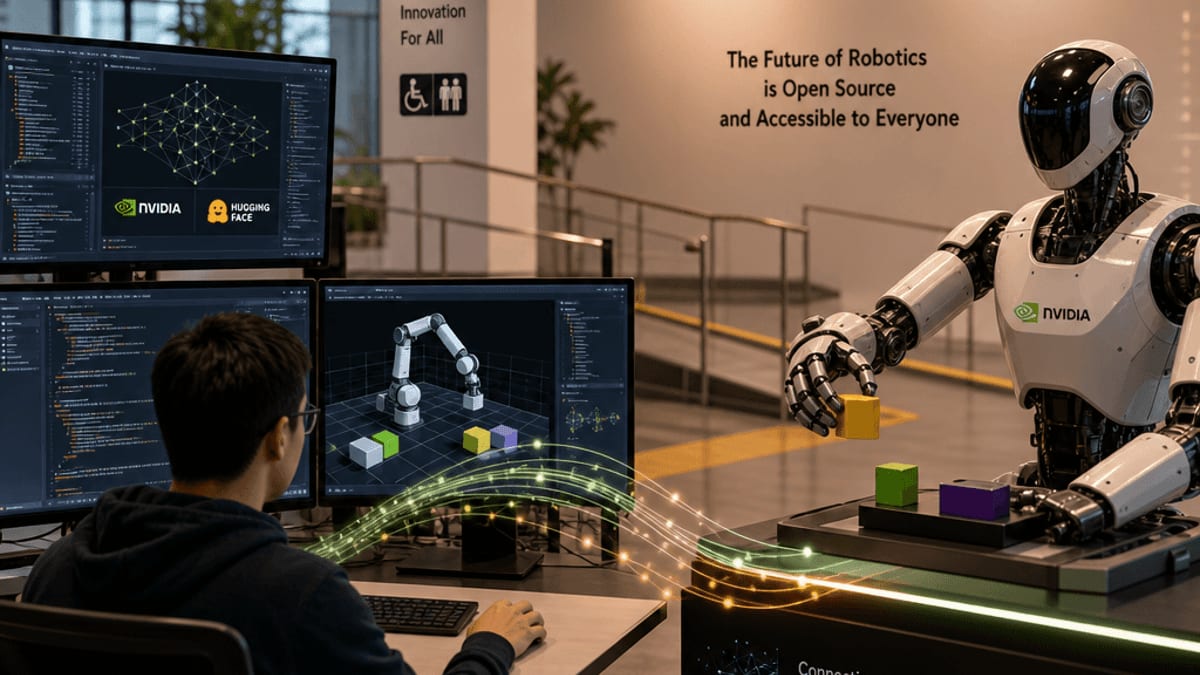
The two companies announced they're supercharging LeRobot, an open-source platform that lets anyone access the tools, training data, and pre-built models that were previously locked behind corporate walls. For robotics developers, this is like getting handed the keys to a Ferrari after years of riding a bike.
Until now, robotics has been stuck in an expensive catch-22. Collecting training data costs millions. Simulation environments don't work together. Foundation models stay hidden in corporate labs. While software AI exploded after models like ChatGPT went public, robotics innovation has been throttled by fragmentation and cost.
NVIDIA brought its industrial-grade simulation tools and training infrastructure directly into LeRobot's ecosystem. Developers can now tap into the same pre-trained models, cloud-based testing environments, and validation tools that NVIDIA uses for its own robotics research.
The timing couldn't be better. Tesla's Optimus robot and a wave of humanoid robotics startups prove there's real demand for smart, adaptable robots. But most developers can't afford Tesla's approach of collecting millions of hours of real-world data.
Now a researcher who previously needed $50,000 in hardware and months of data collection can prototype robot behaviors in simulation, train them on shared datasets, and deploy to affordable platforms. A startup building warehouse automation can start with foundation models instead of reinventing computer vision from scratch.
The Ripple Effect
This partnership signals something bigger than just free tools. NVIDIA sees physical AI as its next growth frontier after dominating language model chips. By making LeRobot the standard platform, they're building the infrastructure for a robotics revolution that hasn't quite arrived yet.
Hugging Face is making the same bet that transformed software development a decade ago: innovation happens faster when tools are accessible to everyone. Their language model hub helped launch thousands of AI startups by democratizing access to cutting-edge models.
The challenges are real. Physical systems are messy in ways software isn't. A policy that works perfectly in simulation often fails spectacularly on real hardware because of sensor noise, timing delays, or physics the simulator missed. Testing on real robots takes hours and risks breaking expensive equipment.
But the infrastructure play is undeniable. For the first time, developers who've been priced out of robotics AI can compete with the big corporate labs.
Whether LeRobot becomes the standard platform for robotics or just another tool that looked good on paper depends on whether the community actually builds on it, but now they finally have their shot.
More Images



Based on reporting by Google: robotics innovation
This story was written by BrightWire based on verified news reports.
Spread the positivity!
Share this good news with someone who needs it