Oxford Reveals Hidden Battery Secret for Faster Charging
Scientists at Oxford University have figured out how to see inside batteries in a way never done before, revealing why some charge slowly and wear out quickly. Small tweaks to manufacturing could cut charging time dramatically and make batteries last years longer.
Your phone battery might soon charge in half the time and last twice as long, thanks to a team of Oxford researchers who just cracked open one of battery science's best-kept secrets.
For years, scientists knew that tiny polymer binders inside lithium-ion batteries mattered, but they couldn't see exactly where these materials went or what they were doing. These binders act like microscopic glue holding battery parts together, making up less than 5% of a battery's weight but controlling how fast it charges and how long it lasts.
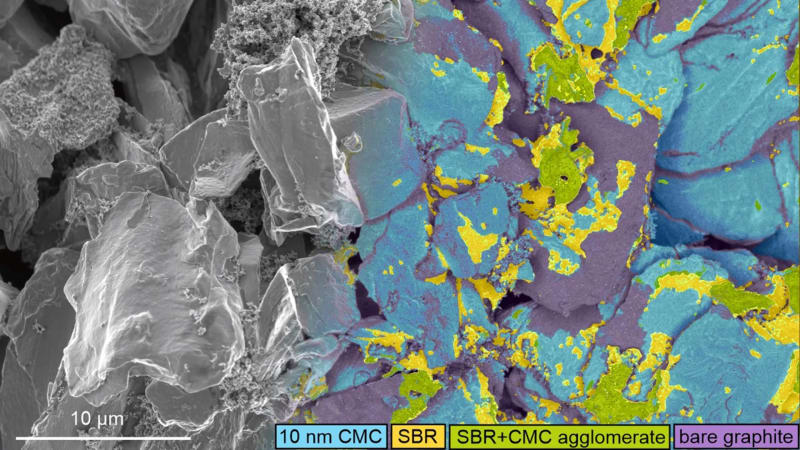
The Oxford team created a breakthrough staining technique that tags these invisible binders with traceable markers, like putting GPS trackers on something too small to see. Using electron microscopes, they produced the first detailed maps showing exactly where binders cluster and spread inside batteries.
What they found surprised everyone. The uniform coatings that manufacturers thought they were creating actually broke apart into uneven patches during production. These gaps and clusters were secretly slowing down charging and weakening batteries over time.
Armed with this new vision, the researchers made simple adjustments to how battery materials are mixed and dried. The result? Internal resistance dropped by up to 40% in test batteries. That's the difference between waiting an hour for your electric car to charge and waiting just 35 minutes.
Dr. Stanislaw Zankowski, who led the research, explained that the technique works with both current graphite batteries and next-generation silicon designs. The team could spot binder layers just 10 nanometers thick, thinner than a virus, giving manufacturers unprecedented control over battery quality.
The Ripple Effect spreads far beyond faster phone charging. Electric vehicle makers and major battery producers have already reached out to Oxford, recognizing that small manufacturing changes could transform how quickly we adopt clean transportation. Better batteries mean electric cars that charge faster, last longer, and cost less to replace.
This imaging breakthrough also matters for renewable energy storage. Solar and wind farms need reliable batteries to store power for cloudy, windless days. Longer-lasting batteries make clean energy more practical and affordable for everyone.
The research, published in Nature Communications and backed by the Faraday Institution, represents years of work across chemistry, microscopy, and electrical engineering. The team has already filed for a patent, ensuring the technique can move quickly from lab to factory floor.
Professor Patrick Grant noted that understanding these hidden surface processes will drive advancements across all battery applications, from medical devices to grid storage. The innovation opens entirely new possibilities for optimizing how batteries are built.
Sometimes the biggest breakthroughs come from finally seeing what was always there.
Based on reporting by Science Daily
This story was written by BrightWire based on verified news reports.
Spread the positivity!
Share this good news with someone who needs it