Saturn's Moon Titan Could Fuel Deep Space Exploration
NASA researchers say Titan, Saturn's largest moon, could become a cosmic gas station for future deep space missions. The moon's abundant natural resources could provide fuel, oxygen, and materials for interplanetary travel. #
Imagine a gas station floating 746 million miles from Earth, ready to fuel humanity's journey to the outer planets. That future might be closer than we think, thanks to Saturn's largest moon.
NASA researchers have identified Titan as a potential refueling outpost for deep space exploration. Unlike barren worlds where astronauts would need to manufacture everything from scratch, Titan comes naturally stocked with the ingredients needed for long-distance space travel.
The moon's atmosphere contains about 5% methane, and its surface features lakes and seas of liquid hydrocarbons. These are the same compounds we use on Earth as fuel, but on Titan, they literally rain from the sky and pool in massive reservoirs.
"Titan is gushing with hydrocarbons," says Conor A. Nixon, lead author of the NASA-supported study and planetary scientist at NASA's Goddard Space Flight Center. The moon holds more fossil fuel reserves than Earth, naturally produced through atmospheric chemistry rather than ancient biological decay.
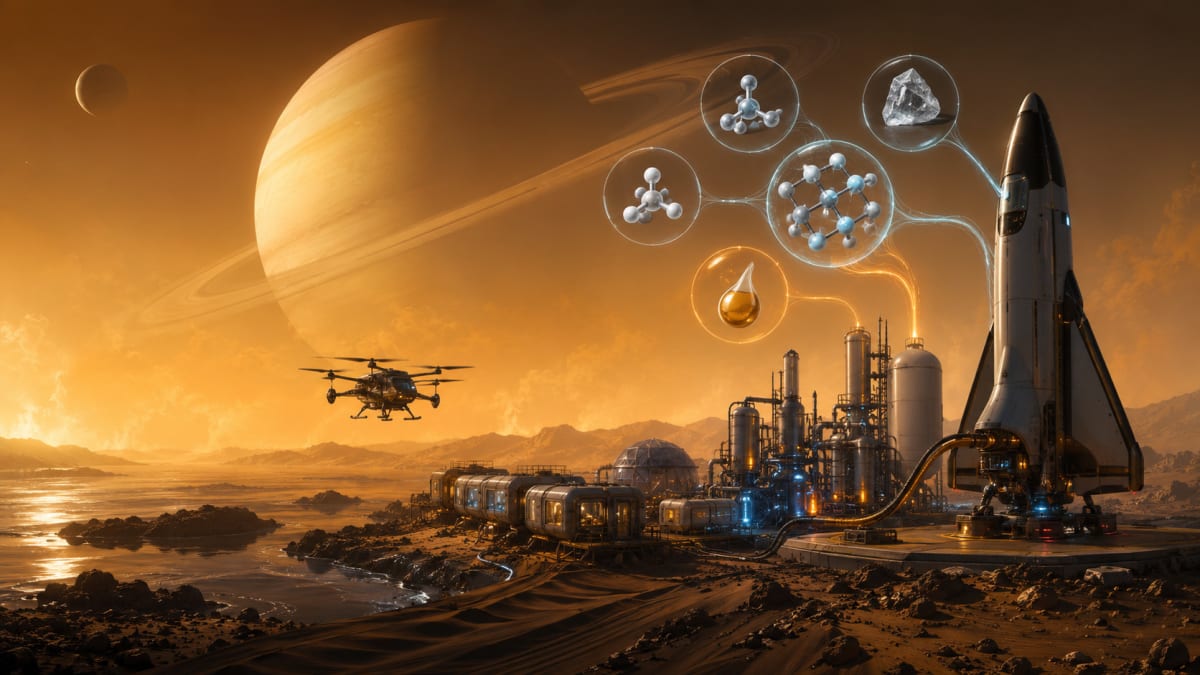
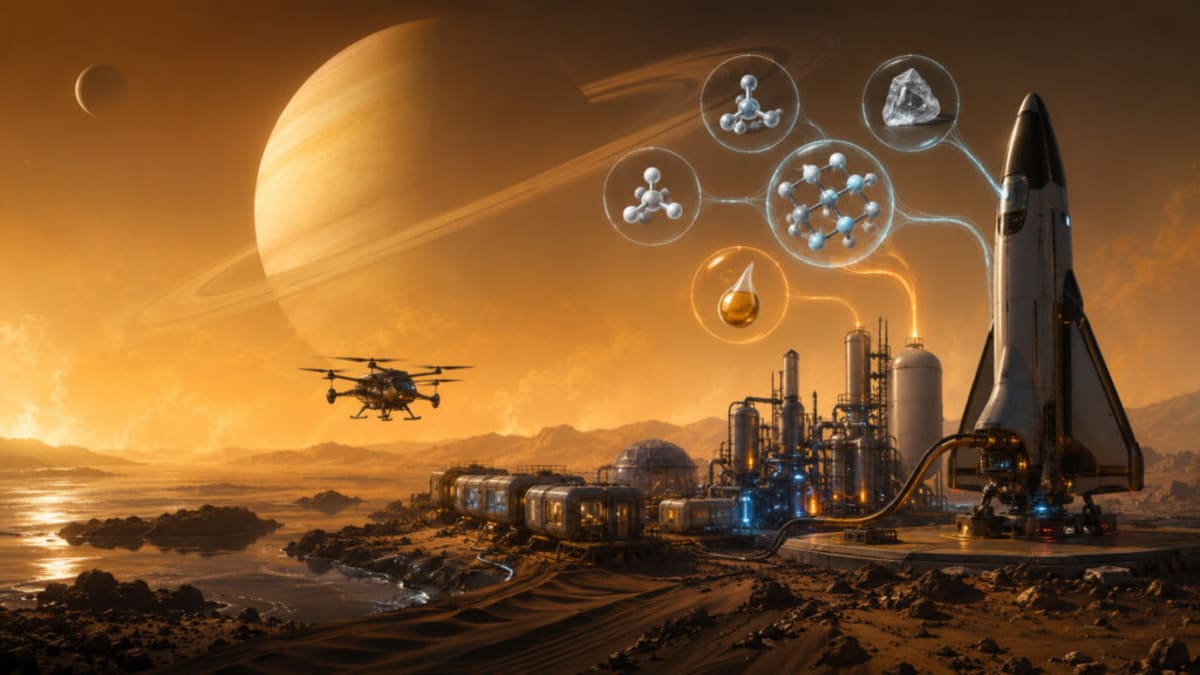
The practical applications are remarkable. Future missions could harvest methane for rocket fuel, split water ice into hydrogen and oxygen for breathing and propulsion, and extract nitrogen for habitat air and fertilizer. Heavier hydrocarbons like propane and butane could create plastics, synthetic rubber, and other essential materials.
Titan holds a major advantage over Mars, where engineers would need to convert carbon dioxide into useful compounds. On Titan, the carbon-rich ingredients already exist in usable forms, ready for collection and refinement.
Researchers envision several approaches. Spacecraft might skim Titan's atmosphere to collect gases, or landers could refine methane on the surface before returning to orbit. Eventually, permanent stations could stockpile supplies for ships traveling between Saturn's moons or venturing to Uranus and Neptune.
The Ripple Effect
This discovery transforms how we think about deep space exploration. Rather than carrying all fuel from Earth at enormous cost and weight, missions could "island hop" between resource-rich locations, making distant destinations suddenly more reachable.
A refueling station at Titan could support regular shuttles between colonies on different moons, enable exploration of the outer solar system, or help ships make the long journey back to Earth. The moon's abundant resources could sustain not just passing visitors but permanent settlements, creating a foothold for humanity in the outer planets.
The vision represents a shift from Earth-dependent missions to self-sustaining space infrastructure, where natural resources throughout the solar system support our expansion beyond home.
While still decades away from reality, this research shows that the solar system may be more welcoming to human exploration than we imagined, with cosmic rest stops already waiting for us among the stars.
#
More Images
Based on reporting by Google News - Science
This story was written by BrightWire based on verified news reports.
Spread the positivity!
Share this good news with someone who needs it