Saturn's Rings May Have Formed from Ancient Moon Crash
Scientists now believe Saturn's iconic rings could have formed when two ancient moons collided 100 million years ago, creating Titan and triggering cosmic chain reactions. The discovery solves multiple mysteries about Saturn's strange tilt and its unusual moon family.
One of the solar system's most beautiful mysteries might finally be solved, and it involves a cosmic collision that reshaped an entire planet system.
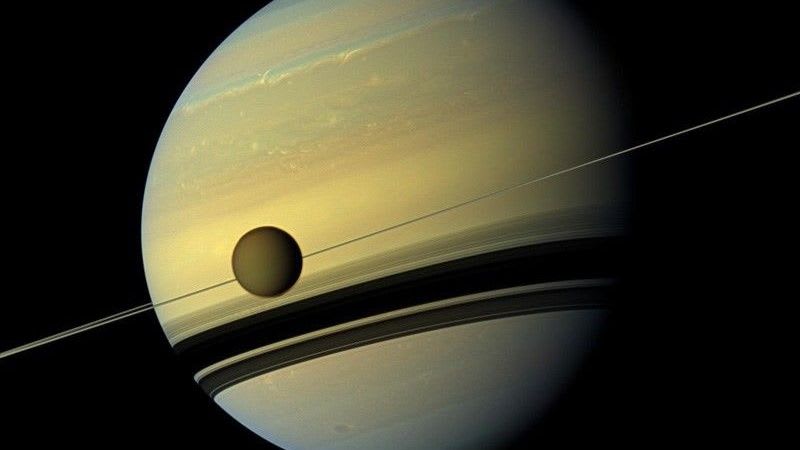
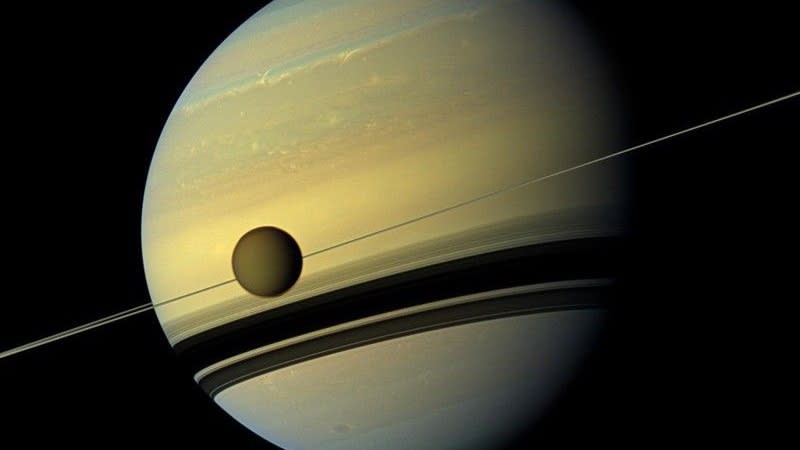
Scientists at the SETI Institute now believe that Saturn's stunning rings formed when two ancient moons crashed together about 100 million years ago. That collision created Titan, Saturn's largest moon, and set off a chain of events that tilted Saturn and scattered debris into the rings we see today.
The breakthrough came from data collected by NASA's Cassini spacecraft, which spent 13 years studying Saturn before its mission ended in 2017. Cassini measured how Saturn's mass is distributed inside the planet, revealing something unexpected.
Saturn wobbles slightly as it spins, like a spinning top. Scientists thought this wobble was locked in sync with Neptune's orbit, which would explain Saturn's 26.7 degree tilt. But Cassini's measurements showed Saturn had actually fallen out of sync with Neptune.
Something big must have happened to knock Saturn off balance. The team ran computer simulations to figure out what could cause such a dramatic change.
Their simulations kept showing the same result. An ancient moon they nicknamed Chrysalis likely had a close encounter with another large moon. Instead of being torn apart by Saturn's gravity as originally thought, Chrysalis collided with that other moon.
The collision merged the two bodies into what became Titan, the only moon in our solar system with a thick atmosphere. The impact sent Titan into a wider orbit, which pulled Saturn out of alignment with Neptune. Debris from the crash settled into orbit around Saturn, forming the rings.
Why This Inspires
This discovery shows how patient scientific detective work can unlock secrets hidden for millions of years. Cassini took measurements for over a decade, and scientists spent years analyzing that data to piece together this cosmic puzzle.
The research also explains other quirks in Saturn's moon system, like why some moons have strangely tilted orbits. These weren't random oddities but connected pieces of one dramatic event.
Lead researcher Matija Ćuk notes that even tiny Hyperion, which looks like a giant pumice stone tumbling through space, played a crucial role in confirming the theory. Its gravitational relationship with Titan helped scientists verify their timeline.
One cosmic collision 100 million years ago created the moon with organic chemistry, tilted an entire planet, and gave us one of the night sky's most gorgeous sights.
More Images
Based on reporting by Space.com
This story was written by BrightWire based on verified news reports.
Spread the positivity!
Share this good news with someone who needs it