Scientists Can Now Predict Solar Storms 7 Years Early
A breakthrough forecasting method could give us seven years' warning before the next major solar storm cycle hits. Scientists discovered the Sun's extreme weather switches off suddenly at a specific point, offering a clear prediction window.
Scientists just found a way to predict dangerous solar storms up to seven years before they peak, giving us unprecedented time to prepare our satellites and power grids.
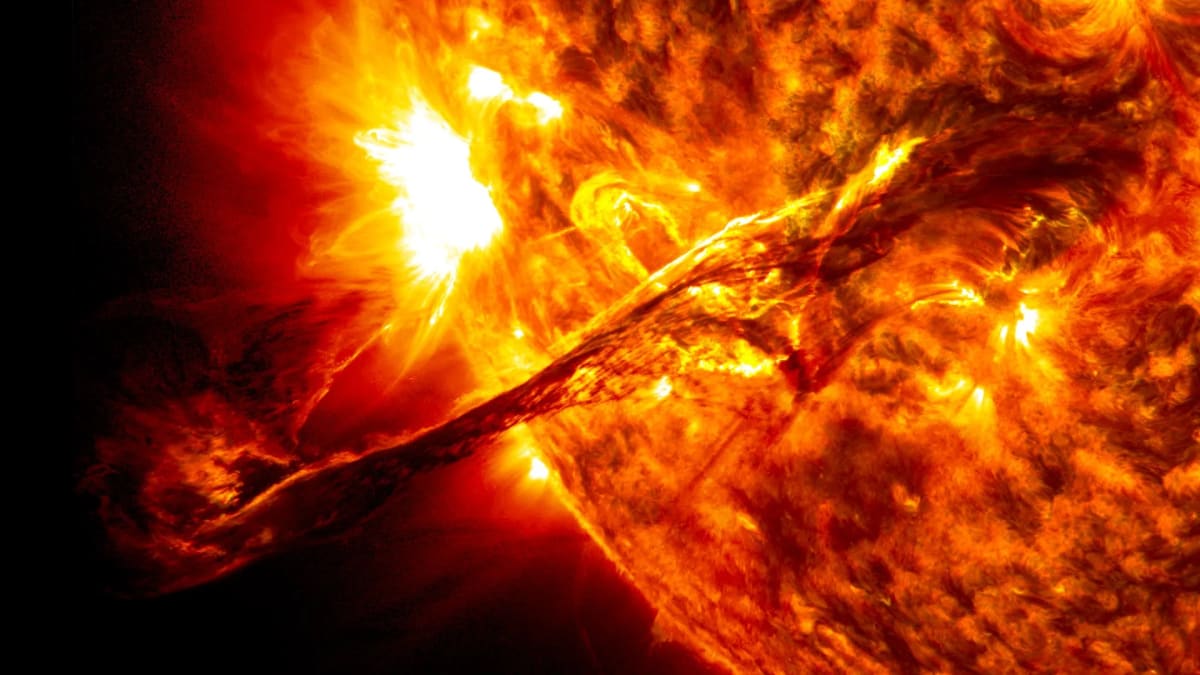
Researchers at the University of Warwick discovered something remarkable about our Sun. Instead of gradually calming down between cycles, it switches off its most extreme space weather abruptly at a specific point every time.
Professor Sandra Chapman and her team noticed this sudden "switch-off" happens consistently throughout the Sun's 11-year cycle. Even better, the number of sunspots visible at this exact moment reveals how strong the next cycle will be.
The team already tested their method on the current Solar Cycle 25. While many experts predicted a quiet cycle, the new technique correctly forecast stronger activity. That strength gave us the spectacular aurora displays across the UK in 2024, with northern lights visible as far south as Devon and Cornwall.
The forecasting works by counting sunspots at the switch-off point, which happens about six to seven years before the next cycle reaches its maximum. Traditional methods only work after the Sun reaches its quietest phase, giving far less warning time.
Solar storms aren't just pretty light shows. They send powerful energy and charged particles toward Earth that can knock out satellites, disrupt GPS navigation, damage communication systems, and even threaten electrical grids.
The research builds on Professor Chapman's earlier "sunclock" system, which standardizes the Sun's irregular cycles. This breakthrough showed that extreme space weather doesn't fade slowly but ends at a clearly defined stage every time.
The Bright Side
We're about two years away from the switch-off point for Solar Cycle 25. Once we reach it, scientists can use direct observations instead of estimates to predict Cycle 26 with much greater accuracy.
Early projections suggest Cycle 26 might be moderate, with activity comparable to or slightly weaker than our current cycle. The sunspot count could reach around 100 to 120 at its peak.
The discovery also helps scientists understand the solar dynamo, the mysterious process that creates and maintains the Sun's magnetic field. Knowing when this field establishes itself for the next cycle gives researchers a new window into how our star really works.
Professor Chapman received the Royal Astronomical Society's Chapman Medal in 2022 for her pioneering research into planetary magnetic fields and space weather. Her work has transformed how we understand solar cycles.
The team noticed the switch-off point aligns with when active sunspot regions drop below 15 degrees solar latitude. Sunspots follow a "butterfly pattern" during each cycle, starting at higher latitudes and gradually moving toward the solar equator.
Seven years of advance warning means utility companies can better protect power grids, satellite operators can prepare their equipment, and communications networks can develop backup systems before dangerous solar activity arrives.
Based on reporting by Science Daily
This story was written by BrightWire based on verified news reports.
Spread the positivity!
Share this good news with someone who needs it