Scientists Capture Solar Flare Birth in Stunning Detail
A spacecraft witnessed how solar flares really begin, revealing they start as tiny magnetic ripples that cascade into massive explosions. The discovery could help us better predict when these powerful eruptions might disrupt life on Earth.
Scientists just watched a solar flare ignite from its very first spark, and what they saw changed everything we thought we knew about these massive explosions.
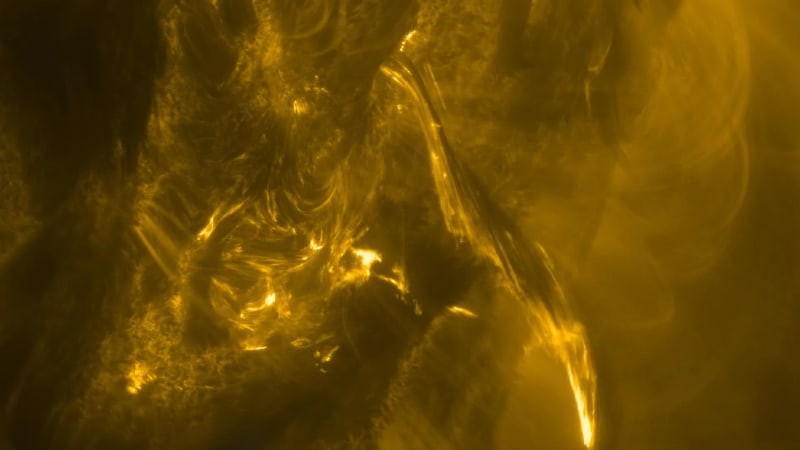
The European Space Agency's Solar Orbiter spacecraft captured the birth of a powerful solar flare on September 30, 2024, recording images every two seconds for 40 minutes before the main explosion. What the team saw looked surprisingly like an avalanche on a mountain slope.
Small magnetic disturbances on the Sun's surface started appearing and twisting like tightly wound ropes, each one spawning more nearby. These tiny disruptions multiplied and grew stronger, breaking apart and reconnecting in a spreading chain reaction that eventually triggered the massive flare.
"We were really very lucky to witness the precursor events of this large flare in such beautiful detail," says Pradeep Chitta of the Max Planck Institute for Solar System Research, who led the study published in Astronomy & Astrophysics. The spacecraft happened to be making a close pass by the Sun at exactly the right moment, with four instruments working together to capture different layers of the solar atmosphere.
The team watched as a dark, twisted arch of plasma gradually brightened over those 40 minutes. New magnetic strands appeared in almost every frame, building tension until the structure became unstable and exploded outward in a violent unrolling motion.
Scientists have long wondered whether solar flares ignite as one unified explosion or something more complex. These observations prove that even a single large flare can emerge from many smaller eruptions building on each other, rather than one big bang.
Why This Inspires
Understanding how solar flares really work brings us closer to predicting when they might happen. The strongest flares can trigger geomagnetic storms that disrupt radio communications, damage satellites, and even knock out power grids on Earth.
By catching these early warning signs, the subtle magnetic shifts that start appearing tens of minutes before the main event, scientists are building a roadmap for better space weather forecasting. Future monitoring systems could spot these cascading patterns and give us precious advance notice before a major flare reaches Earth.
The discovery also reveals something beautiful about nature's most powerful displays. Even the Sun's most violent explosions don't appear from nowhere but grow from countless small interactions working together, each one building momentum until something extraordinary happens.
Solar Orbiter will continue orbiting our star through 2030, capturing more of these rare detailed views and helping scientists piece together the full story of how our Sun creates its most spectacular shows.
Based on reporting by Science Daily
This story was written by BrightWire based on verified news reports.
Spread the positivity!
Share this good news with someone who needs it