Scientists Crack How Sperm Swim Through Impossible Fluids
Sperm cells shouldn't be able to swim at all, but scientists just discovered how they bend the rules of physics to move. The breakthrough could revolutionize how we build tiny medical robots.
At the microscopic scale, sperm cells face an impossible challenge every time they try to swim.
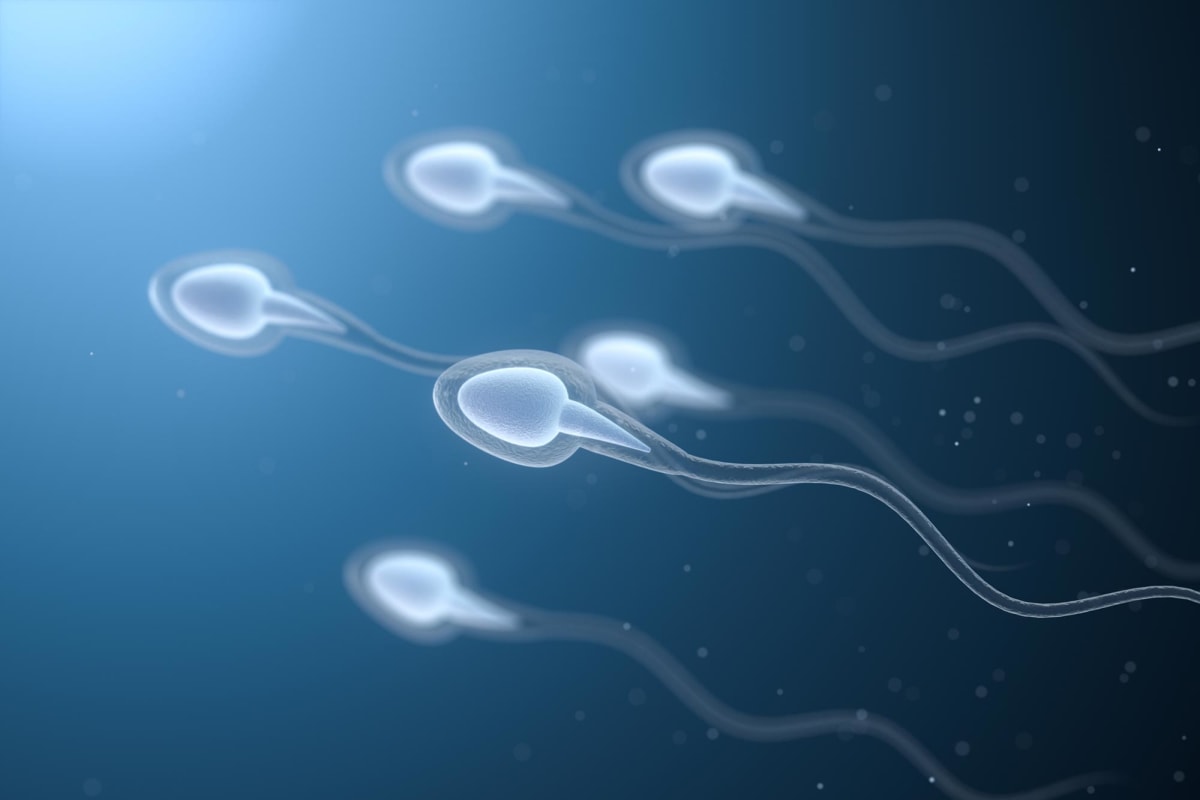
Imagine trying to paddle through honey that stops you the instant you pause. That's what sperm experience in the fluid world they inhabit, where thick resistance should halt their motion almost immediately. Yet somehow, these tiny cells keep moving forward with their whip-like tails.
Now researchers at Kyoto University have figured out how they do it. The answer reveals something remarkable about how living things work at the smallest scales.
The team, led by mathematical scientist Kenta Ishimoto, discovered that sperm exploit a property called "odd elasticity" in their tails. Unlike ordinary materials that push back predictably when bent, active living materials like sperm tails can produce forces that don't simply mirror what's acting on them. They're pumping energy into their motion from within, creating a kind of physics loophole.
This matters because at microscopic scales, the normal rules don't apply. There's no gliding or coasting between strokes. Stop beating your tail for even a moment, and you stop moving instantly.
The researchers developed a new mathematical framework called "odd elastohydrodynamics" to separate what the surrounding fluid does from what happens inside the sperm's tail. When they tested it on human sperm and a swimming green alga called Chlamydomonas, they found both organisms use internal energy to create traveling waves through their flexible tails.
The sperm tail isn't just a tiny whip being dragged through fluid. It's an energy-consuming structure whose internal mechanics help it succeed where ordinary back-and-forth motion would fail completely.
The Ripple Effect
This discovery reaches far beyond understanding reproduction. Scientists now have a blueprint for how living systems move at scales where viscosity dominates everything. That knowledge could transform how we design artificial microswimmers that deliver medicine inside the body, or tiny self-assembling robots that work in thick fluids.
The framework also helps explain how single cells coordinate movement and how groups of microscopic swimmers work together. Every time researchers crack another code in nature's playbook, we get closer to mimicking those solutions in technology that helps people.
These findings show that even the smallest living things have evolved elegant solutions to problems that would stump engineers.
More Images
Based on reporting by Google News - Scientists Discover
This story was written by BrightWire based on verified news reports.
Spread the positivity!
Share this good news with someone who needs it