Scientists Crack How Universe Creates Massive Magnetic Fields
A breakthrough supercomputer simulation has revealed how cosmic chaos creates the universe's vast, organized magnetic fields. The discovery could transform our understanding of everything from black holes to solar storms.
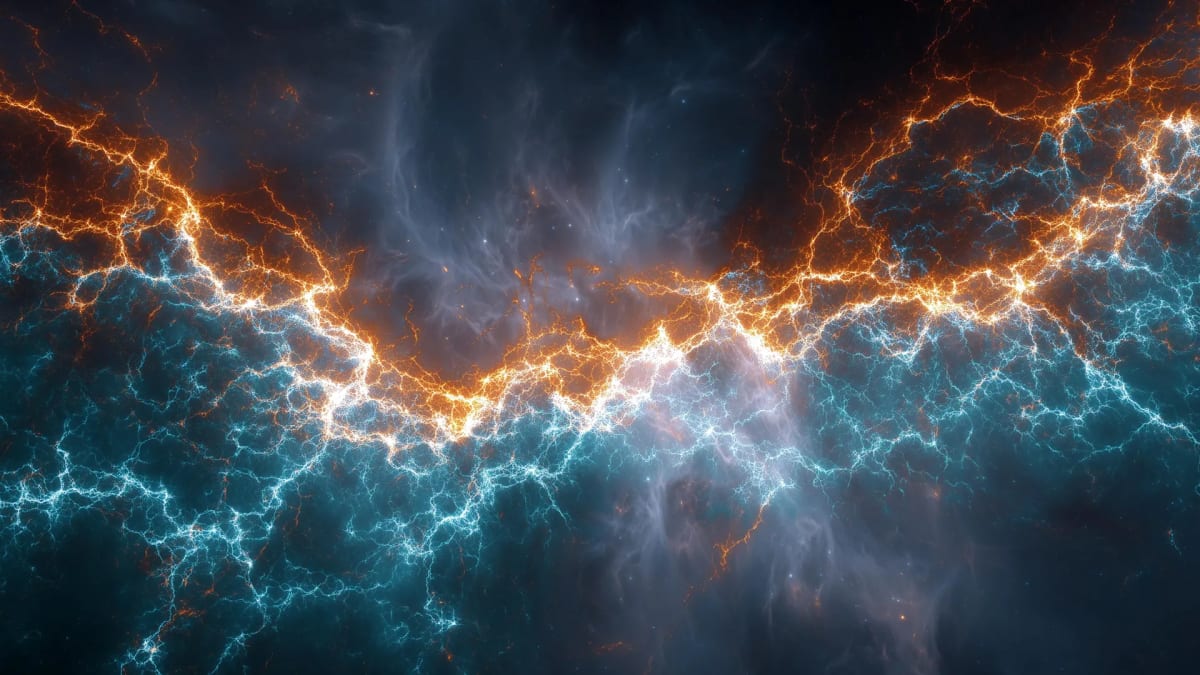
Scientists may have finally solved a puzzle that's stumped astronomers for 70 years: how does cosmic chaos create the universe's enormous, orderly magnetic fields?
Researchers at the University of Wisconsin-Madison used one of the most detailed supercomputer simulations ever created to watch magnetic fields form in real time. What they discovered could change how we understand stars, black holes, and even dangerous space weather near Earth.
Magnetic fields exist everywhere in the universe, from planets to entire galaxies. These invisible forces shape major cosmic events, including solar storms and galaxy formation. But scientists have long struggled with a paradox: small magnetic fields are chaotic and turbulent, yet massive magnetic structures appear surprisingly organized.
Lead researcher Bindesh Tripathi, now at Columbia University, noticed something odd while studying 3D magnetic turbulence. Large magnetic structures looked like organized flows, not random chaos. But proving the connection required serious computing power.
The team ran roughly 90 simulations using 137 billion grid points in 3D space. They burned through nearly 100 million CPU hours on Purdue University's Anvil supercomputer and generated 0.25 petabytes of data.
The simulations revealed something remarkable. When turbulent plasma develops organized jet-like flows in the presence of a velocity gradient, large magnetic fields naturally emerge. A velocity gradient happens when different parts of a system move at different speeds, like what occurs inside the Sun or during neutron star collisions.
When researchers ran the same simulations without maintaining that velocity gradient, the organized magnetic structures never formed. The system just stayed chaotic.
Physics professor Paul Terry, the study's senior author, captured the significance. For 70 years, magnetic field theories have produced small, disordered fields unlike what astronomers observe in space. This work potentially resolves that long-standing problem.
The discovery aligns with puzzling experimental results from 2012 at the Wisconsin Plasma Physics Laboratory that existing theories couldn't explain. The new model fits those observations far better.
Why This Inspires
This breakthrough shows how patient scientific detective work can unlock cosmic mysteries. The team didn't just throw computing power at a problem. They asked smarter questions about what creates order from chaos.
The implications reach across astrophysics. The findings could help explain magnetic dynamics in neutron star mergers and black hole formation, directly supporting multimessenger astronomy. Understanding these processes better may also help scientists predict dangerous solar eruptions that can damage satellites and power grids on Earth.
Sometimes the biggest discoveries come from watching the universe's invisible forces at work, revealing patterns that have been hiding in plain sight for billions of years.
Based on reporting by Science Daily
This story was written by BrightWire based on verified news reports.
Spread the positivity!
Share this good news with someone who needs it