Scientists Create 3D Image of Molecule's Quantum Shape
Researchers at the University of Göttingen have captured the first complete 3D image of a molecule's wavefunction, the mysterious quantum blueprint that determines how molecules behave. This breakthrough could soon let scientists watch chemical reactions unfold in real time at the atomic level.
For the first time ever, scientists can see the invisible quantum shape that governs how a molecule behaves in our world.
A team at the University of Göttingen has successfully captured a complete three-dimensional image of a molecule's wavefunction, one of the most fundamental yet elusive concepts in quantum physics. Published in Nature Communications, this achievement brings the strange world of quantum mechanics into sharp visual focus.
The wavefunction is essentially a molecule's quantum blueprint. It describes where electrons are likely to be found and determines how molecules absorb light, bond with other molecules, and participate in chemical reactions. Until now, creating a complete 3D picture of this quantum shape has been extremely difficult and required massive research facilities that only a handful of institutions could access.
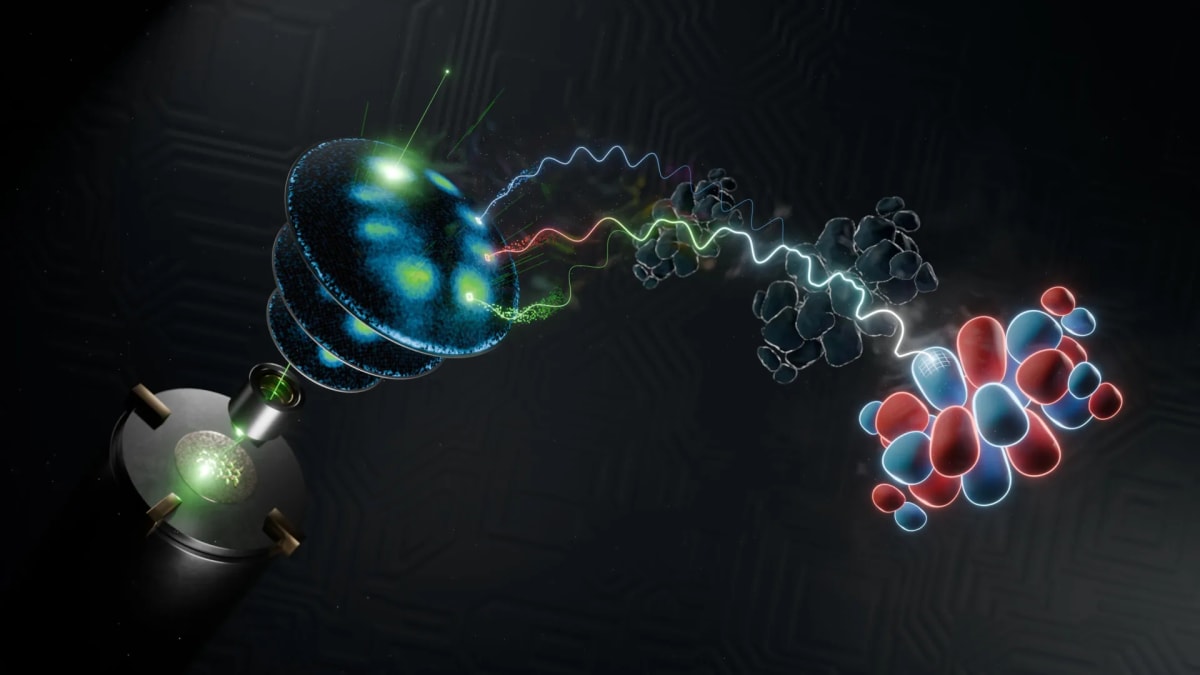
The Göttingen team solved this problem with two clever innovations. They redesigned the computer algorithms from scratch so that reliable 3D images could be generated using far less experimental data than before. They also built a powerful soft X-ray light source right in their own laboratory that produces incredibly short pulses of light.
The technique works indirectly because wavefunctions cannot be directly observed. The researchers use photoelectron spectroscopy to measure electrons emitted from the molecule, capturing one half of the wavefunction without disturbing it. Their new algorithms then reconstruct the missing half, creating images so detailed they can distinguish features smaller than the distance between carbon atoms.
Why This Inspires
This breakthrough transforms wavefunction imaging from an occasional feat at major facilities into something researchers can do regularly in their own labs. The combination of less data needed and accessible equipment means more scientists worldwide can now explore the quantum world.
The real magic lies in what comes next. The team's ultrafast light pulses work on femtosecond timescales, which are quadrillionths of a second. Dr. Wiebke Bennecke, the study's first author, explains this could enable "stroboscopic videography" that captures not just static images but actual movies of wavefunctions changing shape.
Imagine watching a molecule respond to light or begin a chemical reaction, frame by frame, at the atomic level. Scientists could observe how molecules adapt to electronic changes and discover new ways to control these interactions. This could revolutionize everything from designing better solar panels to creating more efficient chemical processes.
The team has already demonstrated their technique works beautifully on nanometer-sized organic molecules. As they refine the approach, researchers may gain unprecedented control over molecular behavior, opening doors to innovations we can barely imagine today.
Based on reporting by Science Daily
This story was written by BrightWire based on verified news reports.
Spread the positivity!
Share this good news with someone who needs it