Scientists Create Battery-Free Power Source Inspired by Rays
Researchers mimicked electric rays to create tiny stacked cells that generate over 100 volts without any external power source. The breakthrough could eliminate charging needs for watches, calculators, and wearable devices.
Scientists at South Korea's UNIST have cracked a problem that's plagued wearable electronics for years: how to power devices without batteries, solar panels, or plugging them in.
The team looked to nature for answers, specifically electric rays that stack specialized cells to deliver powerful shocks. But they solved something even electric rays can't do: generate electricity completely on their own, without any movement or external trigger.
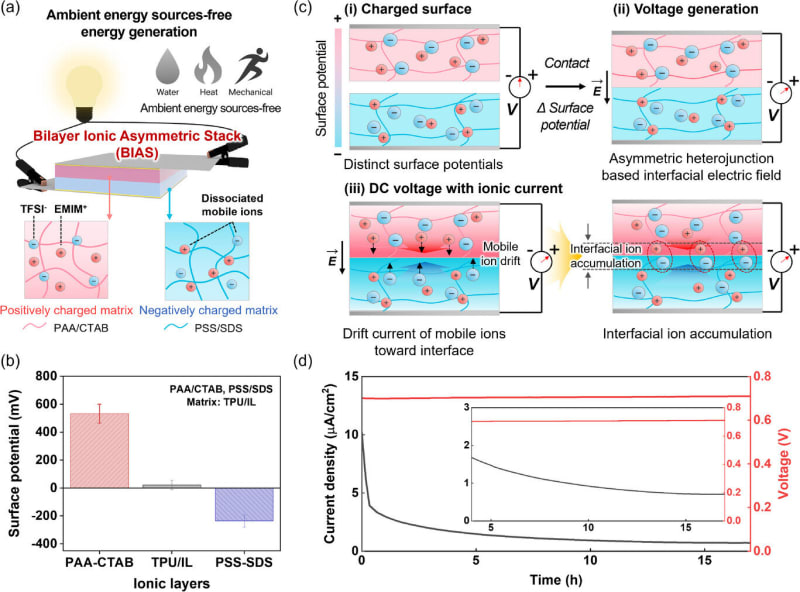
Led by Professor Hyunhyub Ko, the researchers built paper-thin ionic cells just 0.2 millimeters thick. Each cell uses two special polymer films—one positive, one negative—that create an internal electric field driving ions back and forth. This movement generates voltage just like the membrane potential in living cells.
A single cell produces 0.71 volts, about 30 times more than previous symmetric designs. Stack multiple cells together like pancakes, and the voltage climbs past 100 volts—enough to run LED lights, calculators, and digital watches directly without any conversion equipment.
The real magic is that these cells work autonomously. Unlike solar panels needing sunlight or piezoelectric devices requiring pressure, this technology generates power through internal ion migration alone. No wind, no temperature changes, no button pressing required.
The team put their invention through rigorous testing. The cells kept working after 3,000 stretching cycles and could elongate to 1.5 times their original length without breaking a sweat. They operated reliably in humidity ranging from bone-dry conditions to 90% moisture, with barely any power fluctuation.
The Bright Side
This breakthrough arrives at the perfect moment for wearable technology. Smartwatches and fitness trackers have become everyday essentials, but their Achilles heel remains battery life. Users still deal with nightly charging rituals and degrading batteries that need replacement.
The BIAS cells could change that equation entirely. Imagine a fitness tracker that never needs charging, or medical monitoring devices that work continuously without maintenance. For elderly patients or people managing chronic conditions, eliminating battery changes could mean better health outcomes and genuine independence.
The technology also opens doors for remote sensors in hard-to-reach places. Environmental monitors, infrastructure sensors, and IoT devices could operate indefinitely without battery swaps—reducing both maintenance costs and electronic waste.
First authors Seungjae Lee, Youngoh Lee, and Cheolhong Park emphasized they've created something fundamentally new: a unit cell generating high voltage autonomously through stacking. Professor Ko noted the approach sidesteps all conventional energy harvesting limitations by requiring zero external stimuli.
The research appears in Advanced Energy Materials, marking another win for biomimicry in solving modern engineering challenges.
More Images

Based on reporting by Phys.org - Technology
This story was written by BrightWire based on verified news reports.
Spread the positivity!
Share this good news with someone who needs it