Scientists Create Crystals That Heal Cracks in Milliseconds
Indian researchers discovered molecular crystals that automatically repair deep cracks in less than a hundredth of a second, no heat or chemicals required. This breakthrough could revolutionize electronics by making devices that fix themselves.
Imagine dropping your phone and watching the screen heal itself instantly, leaving zero trace of damage.
That future just moved closer to reality. A team of scientists from India's top research institutions discovered crystals that can snap broken pieces back together in milliseconds, all on their own.
Researchers from IISER Kolkata, the Indian Institute of Science, IIT Indore, and CSIR-National Chemical Laboratory made the discovery while experimenting with a lab-grown organic crystal called 2-methyl-4-nitroimidazole. When they poked it with a tiny needle under specialized microscopes, something remarkable happened.
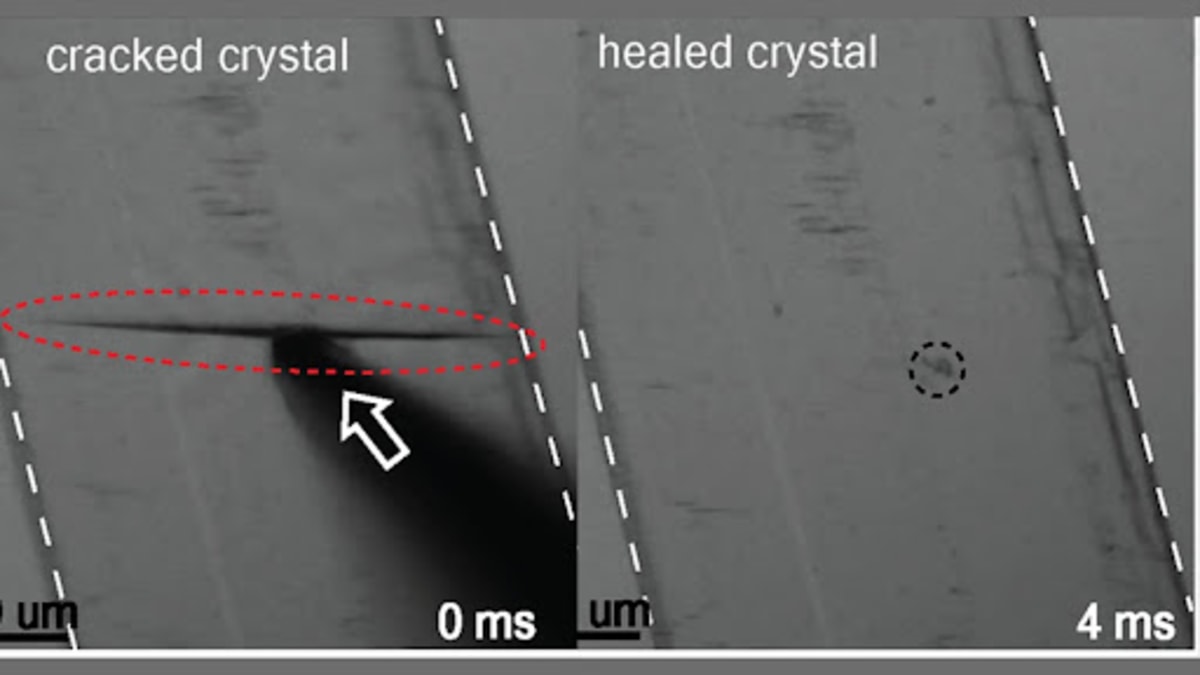
The crystal cracked under pressure, just like you'd expect. But the moment they released the needle, the broken halves pulled themselves back together with almost no visible damage remaining.
The secret lies in the crystal's structure. It's built like a microscopic deck of cards, with molecules stacked in perfectly symmetrical sheets. When pressure breaks that symmetry, it creates temporary electrical charges at the crack's surface that act like tiny magnets pulling the pieces back together.
Using laser technology and Raman spectroscopy, the team watched this healing happen at the molecular level. The crack tip slightly bends instead of breaking cleanly, working like a shock absorber. When the stress disappears, those flexible layers snap back into place, restoring the original structure in less than one hundredth of a second.
This discovery breaks new ground because previous self-healing crystals needed external help. They required intense heat, bright light, or chemical baths to repair themselves. The few that healed autonomously only worked with specific crystal types that lacked internal symmetry.
These new crystals are different. They're highly ordered and symmetrical, yet they achieve ultrafast healing without any outside intervention whatsoever.
The researchers acknowledge limitations. Apply massive force and the crystal will permanently shatter into fragments that can't fully reassemble once completely separated. The electrical charges driving the healing are so tiny and brief that standard sensors can't detect them directly.
The Ripple Effect
Our world runs on miniaturized electronics packed into smartphones, computers, and medical devices. These tiny components break easily from daily drops, bumps, and wear.
Self-healing crystals could transform this vulnerability into strength. Imagine devices that repair their own mechanical damage instantly, extending lifespans by years instead of months.
The environmental impact could be massive. Electronic waste is a growing global crisis, with millions of tons of discarded devices piling up annually. Technology that fixes itself means fewer replacements, less manufacturing, and dramatically reduced waste.
Medical devices could become more reliable. Sensors in pacemakers and surgical tools could self-repair from tiny stress fractures before they cause failures. Space technology could benefit too, with equipment fixing itself in environments where human repair is impossible.
The bridge between mechanical hardness and flexible self-repair has finally been built, opening doors to electronics that last longer and harm the planet less.
Tomorrow's technology just got tougher, smarter, and greener.
Based on reporting by Google News - Scientists Discover
This story was written by BrightWire based on verified news reports.
Spread the positivity!
Share this good news with someone who needs it