Scientists Create Digital Twin of Living Cell in 3D
Researchers built the first complete virtual model of a living cell that tracks every molecule as it grows and divides. The breakthrough could revolutionize drug discovery and help scientists understand diseases like cancer without harming real cells.
📺 Watch the full story above
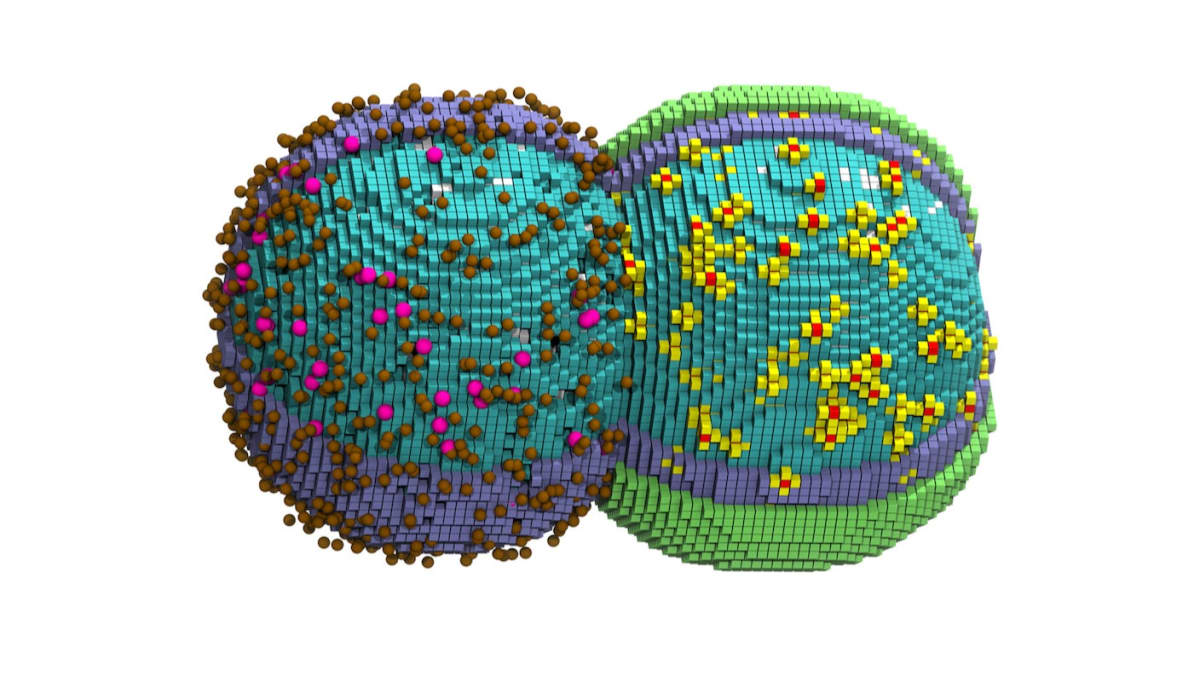
Scientists just created something that sounds like science fiction: a complete digital copy of a living cell that breathes, grows, and divides just like the real thing.
Researchers at the University of Illinois created a virtual model that tracks nearly every molecule inside a bacteria cell over its entire two-hour life cycle. Think of it as Google Earth, but for the microscopic world inside our bodies.
The team started with JCVI-syn3A, a simplified bacteria with only 493 genes. That's about half the genes of a normal bacteria, making it the smallest living thing that can still grow and divide on its own.
Building this digital twin wasn't easy. The first attempts kept crashing the software because cells are incredibly busy places with thousands of moving parts happening all at once.
The breakthrough came over Thanksgiving break when the team left their supercomputer running. They returned to find it had successfully simulated the cell's complete 105-minute life cycle for the first time ever.
The model captured details scientists had never seen before. It showed how proteins gather around DNA during copying, how the cell membrane reshapes itself during division, and even the unpredictable ways chromosomes move around inside the cell.
Every cell is unique, like a snowflake. When the researchers ran the simulation multiple times with slightly different starting conditions, each virtual cell behaved differently but still completed its life cycle successfully.
Why This Inspires
This digital cell could replace hundreds of real experiments. Instead of testing new drugs on living cells one at a time, scientists can run simulations to see what works before ever entering a lab.
The implications reach far beyond bacteria. Understanding how cells work at this level could help researchers develop better cancer treatments, design more effective medicines, and answer fundamental questions about what makes something alive.
Right now, simulating 105 minutes of cell life takes six days on a supercomputer. But as computers get faster, these simulations will speed up too.
The team plans to add more complexity next, including how cells respond to stress and interact with their environment. Eventually, they hope to simulate human cells, opening doors to personalized medicine where doctors can test treatments on your digital cells before prescribing anything.
We're witnessing the birth of a new way to understand life itself, one digital cell at a time.
More Images

Based on reporting by Singularity Hub
This story was written by BrightWire based on verified news reports.
Spread the positivity!
Share this good news with someone who needs it