Scientists Create Filter That Cuts Water Cleaning Energy by 90%
Indian researchers developed a "smart sieve" with perfectly uniform nanometer-sized holes that filters water and chemicals with ten times better precision than current technology. The breakthrough could slash industrial energy use while helping textile and pharmaceutical plants recycle more water.
A team of scientists just solved one of manufacturing's biggest energy problems with holes so tiny that millions would fit across a human hair.
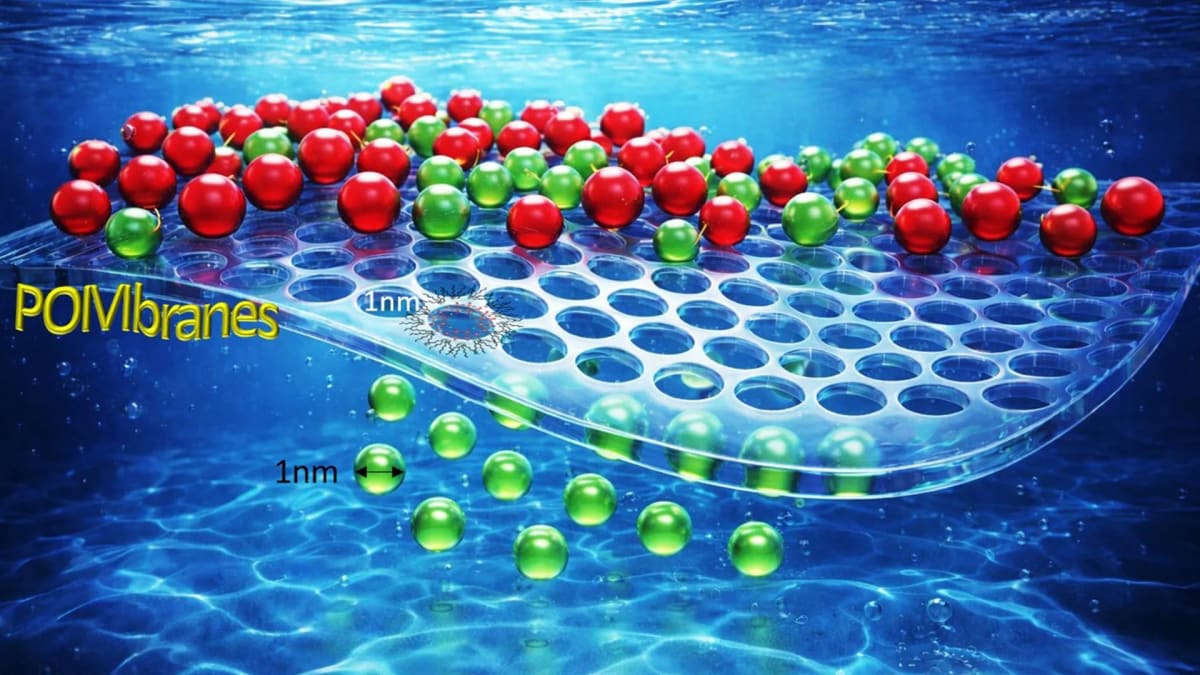
Researchers from India and Singapore created a new type of filter membrane with pores exactly one nanometer wide. These microscopic openings allow the filters to separate molecules with a precision that's nearly impossible with today's technology.
The breakthrough matters because separating different substances uses up to half of all energy consumed by factories worldwide. Most plants still rely on distillation and evaporation, which require massive amounts of power and contribute heavily to carbon emissions.
The new membranes, called POMbranes, take inspiration from nature. They mimic aquaporins, the protein channels that control what moves in and out of living cells. Each filter contains billions of tiny metal clusters shaped like crowns, with a permanent one-nanometer hole at the center that never changes shape or degrades.
Dr. Shilpi Kushwaha from India's Central Salt and Marine Chemicals Research Institute explained that traditional plastic filters contain uneven pores that shift over time. "These POMs have a permanent, perfect hole in their center that does not change or lose shape," she said.
Creating the membranes required arranging billions of these clusters into sheets without defects. The team attached flexible chemical chains to each cluster, then placed them on water where they naturally organized themselves into large, ultrathin films.
Tests showed the filters could distinguish between molecules differing by only 100 to 200 Daltons. That's like sorting grains of sand by weight. Dr. Ketan Patel noted the membranes show almost ten times better separation performance than existing technologies while remaining flexible and scalable for mass production.
The Ripple Effect
The technology could transform India's textile industry, which generates enormous amounts of contaminated wastewater. The new filters can selectively remove dye molecules while allowing clean water to be recycled back into production. This reduces both freshwater demand and chemical waste going into rivers.
India's textile sector contributes over 2% of the country's GDP and employs millions of workers. As the domestic market grows toward $350 billion by 2030, sustainable water solutions become increasingly critical.
Pharmaceutical manufacturers could also benefit by purifying drugs more efficiently with less energy. The membranes work across different acidity levels and can be manufactured in large sheets, making them practical for real-world factory adoption.
The research team published their findings in the Journal of the American Chemical Society. They're now working with industry partners to scale up production and begin pilot testing in manufacturing facilities.
Sometimes the biggest changes come through the smallest openings.
Based on reporting by Science Daily
This story was written by BrightWire based on verified news reports.
Spread the positivity!
Share this good news with someone who needs it