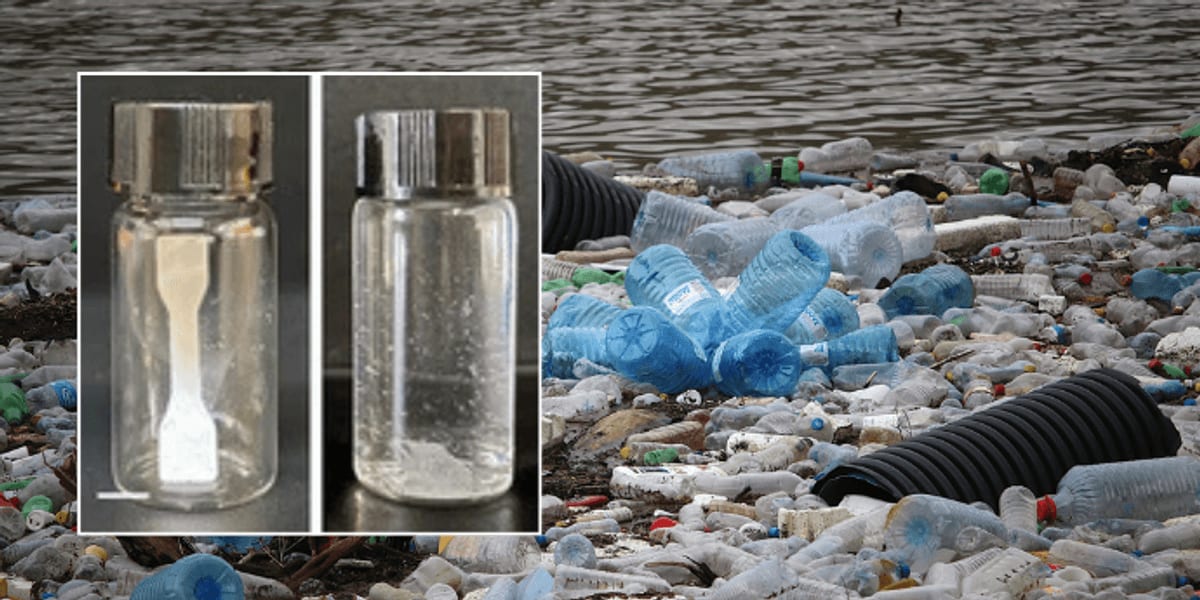
Scientists Create Self-Destroying Plastic That Leaves No Trace
Chinese researchers have engineered a "living plastic" that completely breaks down in six days without leaving behind harmful microplastics. The breakthrough could transform how we handle the billions of tons of plastic waste choking our planet.
Scientists in China just solved one of humanity's biggest environmental headaches by creating plastic that eats itself.
Researchers at the Shenzhen Institute of Synthetic Biology embedded bacteria into plastic that can break down the material completely in just six days. Unlike conventional plastics that linger in oceans and landfills for centuries, this revolutionary material disappears without leaving a trace of microplastics behind.
The secret lies in tiny bacteria called Bacillus subtilis. The team engineered two different strains of these common microbes, each producing its own plastic-eating enzyme that works like microscopic scissors.
The first enzyme cuts long plastic chains into smaller pieces. The second enzyme then breaks those pieces down into basic molecular building blocks, leaving nothing harmful behind.
To keep the bacteria dormant until needed, scientists stored them as spores inside the plastic itself. The material maintains its strength and durability for normal use, just like regular plastic used in 3D printing and medical sutures.
When you're done with the plastic, you simply place it in nutrient broth and heat it to 50 degrees Celsius. The spores wake up, the bacteria activate, and the plastic completely degrades within six days.
Study author Zhuojun Dai explained the thinking behind the innovation. "The realization that traditional plastics persist for centuries, while many applications like packaging are short-lived, led us to ask: could we build degradation directly into the material's life cycle?"
The breakthrough works far better than previous attempts using single enzymes. The two-bacteria system proved significantly more effective at completely eliminating plastic waste.
Why This Inspires
This discovery represents more than clever science. It shows how creative thinking can transform an environmental crisis into a manageable challenge.
Every year, millions of tons of plastic waste end up in our oceans, breaking down into microplastics that contaminate food chains and ecosystems. Single-use packaging designed for minutes of convenience can pollute for hundreds of years.
Now imagine a future where takeout containers, shopping bags, and shipping materials simply disappear when we're done with them. No landfills overflowing with waste. No plastic islands floating in the Pacific. No microplastics in our drinking water.
The research team isn't stopping here. They're already working on the next challenge: developing a water-based trigger for the bacteria so the plastic can break down naturally in oceans, lakes, and rivers where so much waste ultimately ends up.
Their findings, published in ACS Applied Polymer Materials, prove that the solutions to our biggest environmental problems might be hiding in nature itself, waiting for scientists brave enough to ask different questions.
The plastic pollution crisis has felt overwhelming for decades, but this breakthrough reminds us that human ingenuity can still turn durability from an environmental disaster into a programmable feature.
Based on reporting by Google News - Breakthrough Discovery
This story was written by BrightWire based on verified news reports.
Spread the positivity!
Share this good news with someone who needs it