Scientists Cut Catalyst Costs 90% With Atomic Discovery
Chinese researchers discovered a tiny atomic structure that makes methane conversion far more efficient, achieving the same results with just one-tenth the amount of expensive nickel metal. The breakthrough could slash costs for producing fuels and chemicals used across countless industries.
A team of scientists just solved a puzzle that could make producing everyday fuels and chemicals dramatically cheaper.
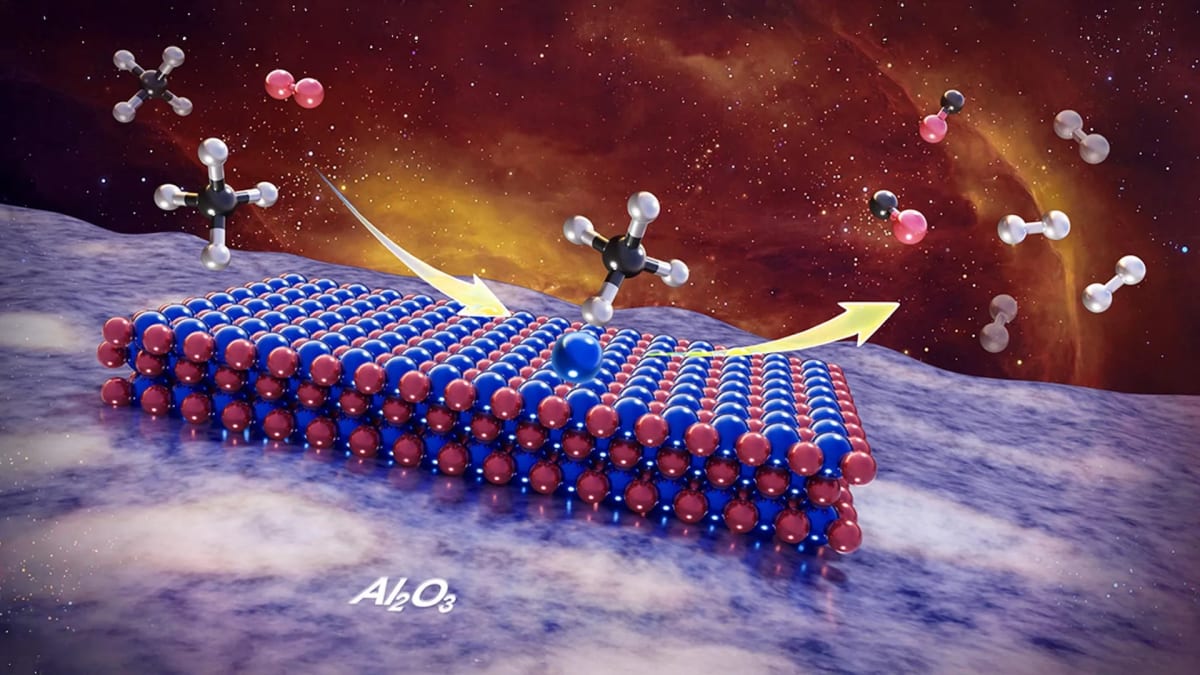
Researchers at the Dalian Institute of Chemical Physics discovered that a microscopic atomic structure forming on nickel oxide during methane conversion works better than the pure metallic nickel scientists have relied on for years. The finding turns decades of assumptions upside down.
The discovery started with a simple question: what if the metallic nickel found after chemical reactions wasn't actually doing the work? Professor Xiaoyan Liu and her international team decided to find out by watching the catalyst in action rather than examining it afterward.
What they saw changed everything. Using advanced imaging techniques, the team captured a special atomic arrangement called Ni1O4Ni4 forming spontaneously on the catalyst surface during the reaction. This tiny structure made breaking apart methane molecules three times easier than metallic nickel could manage.
The real world impact came next. The researchers created a catalyst using just 0.8% nickel that performed as well as one containing 10 times more metal. It converted 92% of methane into syngas, the building block mixture used to manufacture fuels, plastics, and countless chemicals.
Even more surprising, the low-nickel catalyst outperformed another version made with the same small amount of metal using traditional methods. That older approach could barely complete the reaction at all.
The Ripple Effect
This breakthrough arrives at exactly the right moment. Industries worldwide consume massive amounts of nickel-based catalysts to produce syngas for manufacturing everything from synthetic fuels to fertilizers. Reducing metal requirements by 90% could save manufacturers millions while making these essential processes more sustainable.
The discovery also opens doors for designing smarter catalysts across other chemical processes. By understanding that dynamic structures forming during reactions matter more than the starting materials, scientists can rethink how they approach catalyst design entirely.
Professor Liu emphasized that watching catalysts work in real time revealed secrets that examining them afterward never could. The active structure only exists while the reaction happens, vanishing once conditions change.
The team's calculations showed the reconstructed surface lowered the energy barrier for activating methane to just 12.5 kilocalories per mole, compared to 38.5 for ordinary nickel oxide and 15.7 for pure metallic nickel. Those numbers translate directly into faster, more efficient chemical production.
This research demonstrates how questioning long-held assumptions and using better observation tools can unlock solutions hiding in plain sight, making essential industrial processes cheaper and more efficient for everyone.
Based on reporting by Science Daily
This story was written by BrightWire based on verified news reports.
Spread the positivity!
Share this good news with someone who needs it