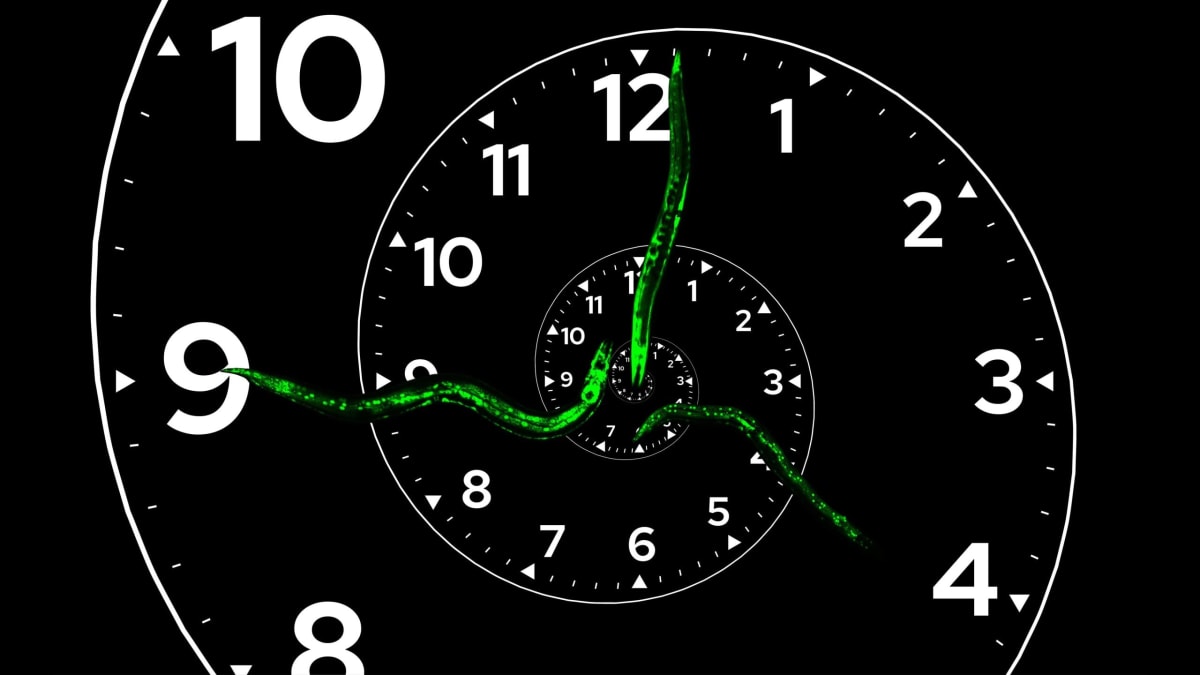
Scientists Find First Biological Clock That Never Repeats
Researchers discovered a unique genetic timer that acts like a one-way ratchet, coordinating growth in precise stages that happen once and never cycle back. Unlike your sleep schedule or circadian rhythm, this developmental clock moves cells forward through life in a single, irreversible direction.
Scientists at Cold Spring Harbor Laboratory just discovered something nature has been hiding in plain sight: a biological clock that works completely differently from any timing system we've ever seen.
Most biological clocks in our bodies repeat like clockwork. Your sleep cycle resets every 24 hours. Your heartbeat pulses continuously. But this newly identified timer in a tiny worm called C. elegans runs through its sequence exactly once, never repeating, like a train making scheduled stops on a one-way journey.
The discovery centers on two proteins, MYRF-1 and LIN-42, that work together as a master developmental clock. These proteins control when genes turn on during growth, how long they stay active, and when they switch off forever.
Professor Christopher Hammell and his team found that MYRF-1 acts like both the train engineer and the key maker. It launches each new wave of gene activity and creates the checkpoint that signals when each developmental stage ends. Then LIN-42 steps in to regulate how strong and how long each pulse of gene activity lasts.
When researchers blocked MYRF-1 in experiments, development stopped completely. The worm couldn't progress to its next growth stage, like a train stuck at the station with no signal to depart.
The research team used traditional biology experiments alongside DNA sequencing and artificial intelligence to piece together how this system works. What makes this clock special is that it's designed to run forward only. Think of a ratchet wrench that clicks in one direction but locks in the other.
Why This Inspires
This discovery could help scientists understand what goes wrong in developmental disorders and genetic diseases. When the body's timing systems fail, growth and maturation can't proceed normally.
The researchers are now exploring whether these individual cellular clocks communicate with each other. Every cell in the worm seems to stay perfectly synchronized during normal development, but nobody knows exactly how they coordinate.
Understanding these timing mechanisms could reveal why some developmental processes go smoothly while others falter. It's a reminder that even in the smallest creatures, nature has engineered incredibly precise systems we're only beginning to understand.
After decades of studying biological rhythms that repeat, scientists finally found one that measures life as a forward journey, where each moment happens exactly when it should, lasts as long as needed, and never comes around again.
More Images
Based on reporting by Google News - Scientists Discover
This story was written by BrightWire based on verified news reports.
Spread the positivity!
Share this good news with someone who needs it
%3Amax_bytes(150000)%3Astrip_icc()%3Afocal(999x0%3A1001x2)%2Fmichael-j-fox-1-16107b4a149a485e83a78fedd03d5096.jpg)