Scientists Find First Cracks in 50-Year Physics Theory
Researchers at CERN's Large Hadron Collider discovered particle behavior that defies our fundamental understanding of physics, potentially opening doors to unknown forces and particles. The findings could explain mysteries like dark matter that make up 25% of our universe.
Scientists at the world's most powerful particle accelerator may have just spotted something that wasn't supposed to exist.
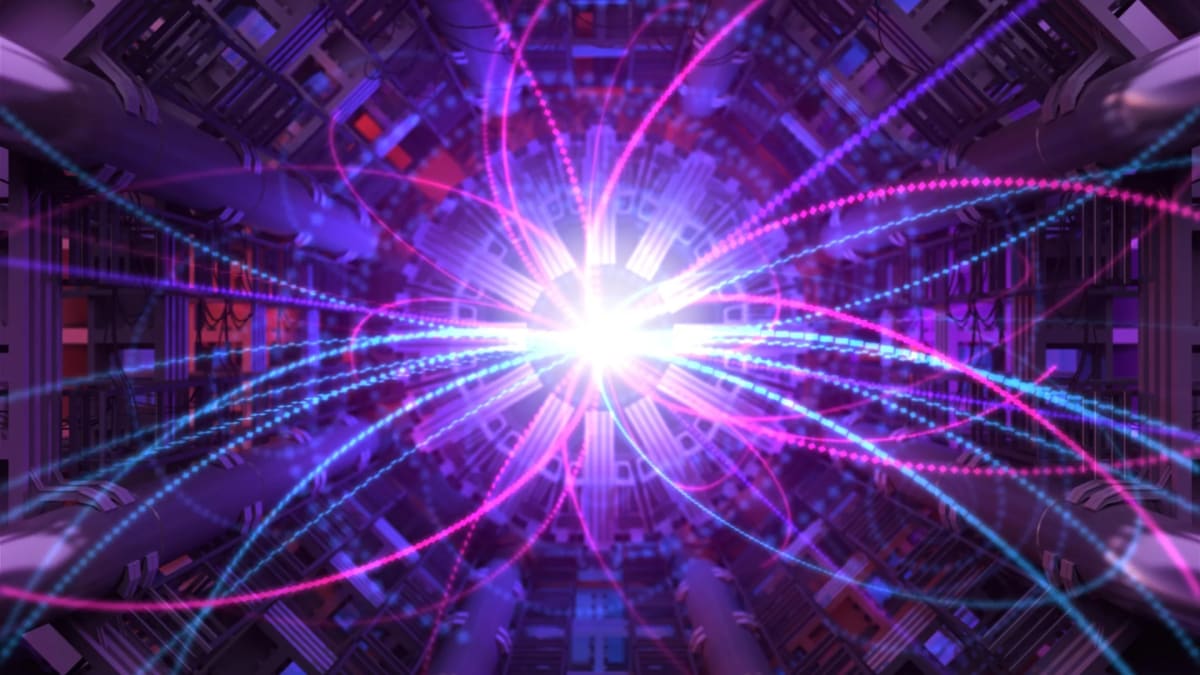
Researchers at CERN's Large Hadron Collider in Geneva discovered that tiny particles called B mesons are behaving in ways that contradict the Standard Model, the 50-year-old theory explaining how everything in the universe works. For five decades, this theory has passed every test physicists could throw at it.
The breakthrough came from studying something wonderfully named "penguin decays." These are incredibly rare transformations where one B meson breaks down into four other particles: a kaon, a pion, and two muons. Only one in every million B mesons decays this way.
When scientists measured the angles and energies of these particle transformations, the numbers didn't match predictions. The odds of this being a random fluke? One in 16,000.
The discovery gets even more exciting because an independent experiment called CMS found similar results earlier this year. When two different teams see the same unexpected behavior, the scientific community starts paying serious attention.
Why This Inspires
This discovery represents something truly remarkable about human curiosity and collaboration. Thousands of scientists from dozens of countries have spent decades building and operating the Large Hadron Collider, a 27-kilometer tunnel packed with cutting-edge technology, all to understand the deepest secrets of reality.
The potential implications stretch far beyond abstract physics. The Standard Model can't explain dark matter, the invisible substance making up a quarter of everything that exists. These new findings might finally point us toward answers.
Scientists believe the strange behavior could be caused by undiscovered particles influencing the decay process. Some theories suggest "leptoquarks," particles that unite two different types of matter in ways we've never seen before.
What makes this approach so powerful is that it lets researchers detect the influence of particles too heavy to create directly in the collider. It's similar to how scientists discovered radioactivity 80 years before they could directly observe the particles responsible for it.
The team's findings have been accepted for publication in Physical Review Letters, one of physics' most prestigious journals. While the results haven't quite reached the gold standard of "five sigma" certainty yet, the mounting evidence from multiple experiments is building a compelling case.
These measurements allow scientists to explore frontiers that might otherwise require particle colliders planned for the 2070s. We're getting a glimpse of tomorrow's physics today.
The work continues as researchers gather more data and refine their measurements, bringing us closer to understanding forces and particles that have remained hidden since the universe began.
More Images

Based on reporting by Science Daily
This story was written by BrightWire based on verified news reports.
Spread the positivity!
Share this good news with someone who needs it
%2Fhttps%3A%2F%2Ftf-cmsv2-smithsonianmag-media.s3.amazonaws.com%2Ffiler_public%2F3f%2F55%2F3f5579c8-c4a7-43a5-bb54-6498478792fd%2Fhelix1940__fitmaxwzk3mcw2ntbd.jpg)