Scientists Find Glowing Coral in Deep-Sea Cave
Researchers discovered a bright yellow coral that flashes green light when touched, the first bioluminescent animal ever documented inside a deep-sea cave. The new species, found 1,260 feet down near Japan, reveals how much of our ocean still holds surprises.
A glowing yellow coral discovered in an underwater cave near Japan is rewriting what scientists thought they knew about light in the deepest parts of the ocean.
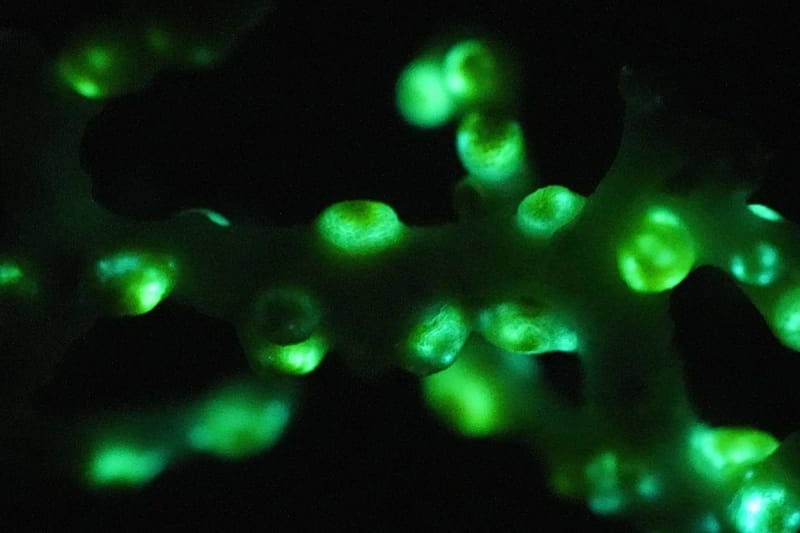
Researchers confirmed Corallizoanthus aureus as a brand new species after finding the soft coral living on cave walls 1,260 feet below the surface near Minamidaito Island. When disturbed, the tiny coral polyps flash bright green light from their tentacles, marking the first time anyone has documented bioluminescence inside a deep-sea cave.
Dr. Hiroki Kise at Japan's National Institute of Advanced Industrial Science and Technology led the team using a remotely operated vehicle to explore the tight cave passages. The golden-yellow polyps dotted the branches of a host coral, each tiny animal sporting 24 to 26 waving tentacles that could suddenly light up.
Back on the ship, scientists tested samples in dark, cold seawater. A gentle pinch or chemical trigger caused the coral to glow green, while a related species they tested produced blue-green light and a third stayed completely dark.
The team believes the light comes from chemicals inside the coral itself, not from glowing bacteria living on it. Microscope work showed no bacterial cells in the tissues, pointing to a luciferin-luciferase system where fuel meets enzyme to create light.
The glow might serve as a burglar alarm of sorts. When something attacks the coral, the sudden flash could attract bigger predators who might chase off the original threat. Another possibility involves glowing mucus that sticks to predators, briefly revealing their position to anything hunting them.
Genetic testing helped confirm this golden species as distinct from its close relatives. Because these soft corals can look similar when they contract or stretch, pairing DNA analysis with their choice of host coral helped separate a genuinely new species from mistaken identity.
Why This Inspires
This discovery shows how much wonder still waits in Earth's oceans, even in places scientists have started to explore. Deep-sea caves remain largely unsurveyed, and each expedition reveals animals and behaviors no one knew existed.
The finding also gives researchers a clearer map for future searches. If this coral species sticks to specific host corals in specific cave environments, those clues can guide teams to other hidden glowing species.
Finding one clearly identified bioluminescent coral gives evolution studies a solid data point instead of guesswork. Scientists can now better understand when and how the ability to create living light emerged across different coral groups.
The discovery reminds us that our planet still holds countless surprises, waiting just beyond the reach of current technology and curiosity.
Based on reporting by Google News - Scientists Discover
This story was written by BrightWire based on verified news reports.
Spread the positivity!
Share this good news with someone who needs it