Scientists Find Hidden Catalyst Path in Major Breakthrough
Chinese researchers discovered oxygen can travel through the inside of catalysts, not just on surfaces, overturning 50 years of scientific assumptions. This breakthrough could revolutionize how we design cleaner fuels and fight pollution.
Scientists in China just rewrote the rulebook on one of chemistry's most important tools, and it could make everything from cleaner fuel to pollution control work better.
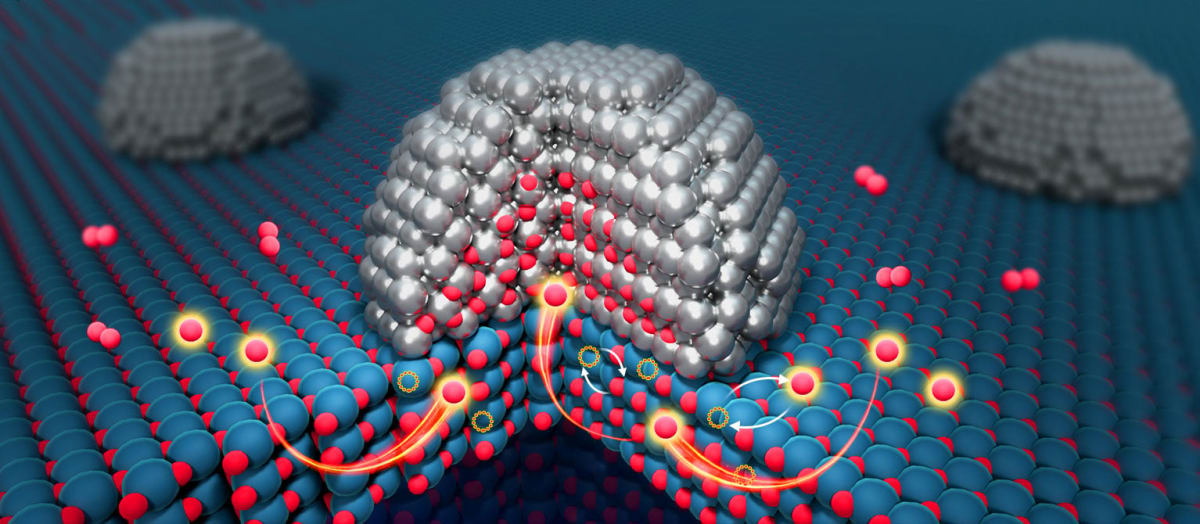
For half a century, researchers believed oxygen atoms in catalysts (materials that speed up chemical reactions) only moved along the surface. A team at the Dalian Institute of Chemical Physics, led by Tao Zhang and Yanqiang Huang, proved that assumption wrong.
Using powerful microscopes that can watch individual atoms in real time, they caught oxygen doing something unexpected. Instead of staying on the surface, oxygen atoms traveled through the interior of the catalyst itself, moving from layers three to five atoms deep toward the metal interface.
Think of it like discovering a secret highway running through the middle of a building everyone thought only had sidewalks. This hidden pathway opens up entire regions of the catalyst that scientists previously considered useless.
The team paired titanium dioxide (a material already used in solar panels and environmental cleanup) with ruthenium metal to create their test system. What they observed, published in Nature, was oxygen moving through channels inside the material, driven by natural chemical gradients.
Wei Liu, one of the collaborators, explained the discovery in simple terms: "A channel has been disclosed in TiO2 support to facilitate oxygen spillover, meanwhile the metal-support interface acts like an atomic-scale guard, controlling whether oxygen spillover can pass through."
The Ripple Effect
This discovery means catalyst designers can now think in three dimensions instead of just two. Previously, researchers focused only on maximizing surface area since they believed that's where all the action happened.
Now they know the bulk of the material can participate in reactions too. Professor Yanqiang Huang notes this "underscores the critical importance of interface engineering in controlling spillover behavior."
The practical applications could be enormous. Catalysts are essential in producing fuels, cleaning exhaust from cars and factories, and countless industrial processes. Making them more efficient means less waste, lower costs, and reduced environmental impact.
The team's next goal is ambitious but achievable: develop practical catalysts that put this bulk pathway to work in real chemical reactions. They're moving from two-dimensional surface reactions to what Tao Zhang calls "three-dimensional 'surface-interface-bulk' synergy."
This breakthrough shows how questioning basic assumptions, even ones held for decades, can open entirely new possibilities for solving today's challenges.
More Images

Based on reporting by Google News - Scientists Discover
This story was written by BrightWire based on verified news reports.
Spread the positivity!
Share this good news with someone who needs it