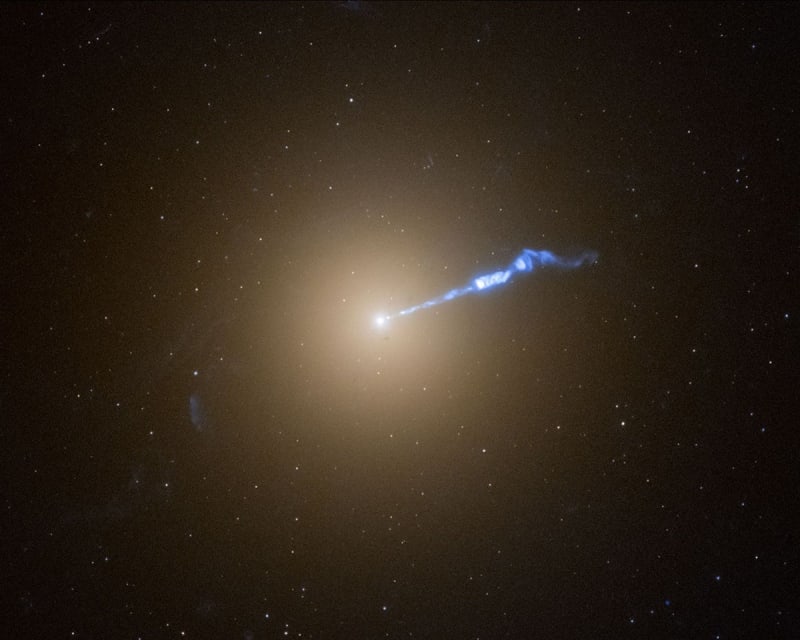
Scientists Find Origin Point of 3,000-Light-Year Jet
Astronomers have pinpointed where a massive jet of material begins its 3,000-light-year journey from M87, the first black hole ever photographed. The discovery helps scientists understand how these cosmic giants work.
Scientists just solved a mystery about one of the most spectacular shows in space.
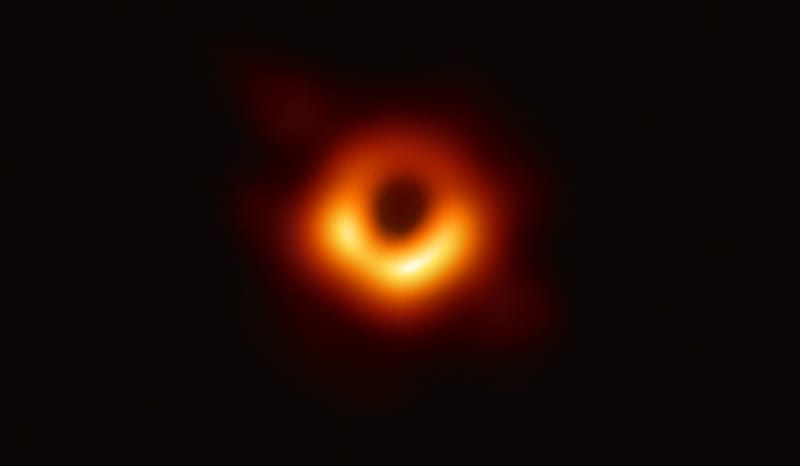
The supermassive black hole M87* made history in 2019 as the first black hole ever photographed. Now astronomers have traced the exact starting point of the enormous jet of material that shoots out from this cosmic giant, blazing a trail 3,000 light-years long through space.
The discovery came from researchers at the Max Planck Institute for Radio Astronomy who used the Event Horizon Telescope to examine the glowing ring of superhot material swirling around M87*. They identified what they believe is the launch pad for this spectacular cosmic fountain.
Black holes like M87* are messy eaters. As dust and gas spiral toward them, they shoot out powerful jets of charged particles at speeds approaching the speed of light. But scientists had never been able to pinpoint exactly where these jets begin their journey.
The new research, published in Astronomy & Astrophysics, changes that. The team found evidence of what lead author Saurabh calls "the first hints" of where the jet actually originates near the black hole's edge.
Why This Inspires
This breakthrough represents more than just another data point about a distant black hole. It connects theoretical ideas about how black holes work with actual observations we can see and measure.
Understanding how M87* launches its jet helps scientists grasp the mechanics of similar supermassive black holes throughout the universe. These cosmic engines sit at the centers of most galaxies, including our own Milky Way, and play a crucial role in shaping how galaxies evolve over billions of years.
The discovery also shows how far astronomical technology has come. The Event Horizon Telescope links radio dishes around the world to create an Earth-sized virtual telescope capable of capturing details that seemed impossible just years ago.
As Saurabh explained, identifying where the jet originates and how it connects to the black hole's shadow adds a key piece to understanding how these central engines operate. Each new observation brings us closer to grasping the fundamental forces that shape our universe.
The same team continues studying M87* with even more sophisticated observations planned for the coming years.
More Images


Based on reporting by Scientific American
This story was written by BrightWire based on verified news reports.
Spread the positivity!
Share this good news with someone who needs it
%2Fhttps%3A%2F%2Ftf-cmsv2-smithsonianmag-media.s3.amazonaws.com%2Ffiler_public%2F3f%2F55%2F3f5579c8-c4a7-43a5-bb54-6498478792fd%2Fhelix1940__fitmaxwzk3mcw2ntbd.jpg)