Scientists Find Pulsar Near Black Hole to Test Einstein
Researchers discovered a potential pulsar just 8 milliseconds from our galaxy's central black hole, offering a cosmic laboratory to test Einstein's gravity theories. If confirmed, this stellar lighthouse could unlock secrets about how massive objects warp space and time.
Scientists may have found the perfect cosmic clock sitting right next to one of the most extreme objects in our galaxy.
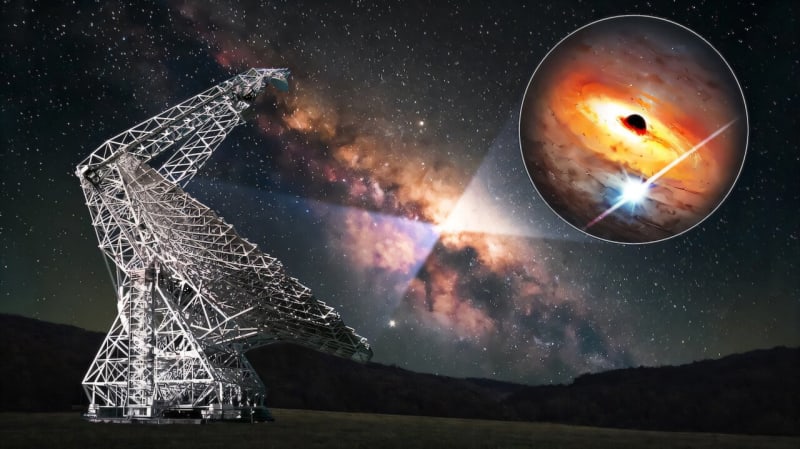
Researchers from Columbia University and Breakthrough Listen discovered a possible pulsar spinning near Sagittarius A*, the supermassive black hole at the Milky Way's center. This tiny neutron star, rotating every 8.19 milliseconds, could become one of the most important scientific tools for understanding how gravity works.
Pulsars are like cosmic lighthouses. These rapidly spinning stars shoot beams of radio waves across space with extraordinary regularity, acting as nature's most accurate clocks. When nothing interferes with them, their pulses arrive at Earth with perfect timing.
That's exactly what makes this discovery so exciting. Sitting near a black hole 4 million times heavier than our sun, this pulsar experiences intense gravitational forces that should affect how its pulses reach us.
Lead researcher Karen Perez, a recent Columbia Ph.D. graduate, and her team conducted one of the most sensitive radio searches ever attempted in this region. The galactic center is a dynamically complex area, making pulsar detection incredibly challenging.
Why This Inspires
If confirmed through follow-up observations, this pulsar will let scientists test Einstein's General Theory of Relativity in ways never before possible. The black hole's massive gravity should bend space and time around it, causing the pulsar's signals to arrive slightly delayed or deflected.
Research scientist Slavko Bogdanov explains that any gravitational pull from the black hole would introduce measurable anomalies in the pulsar's otherwise steady rhythm. Scientists can measure these tiny changes and compare them against Einstein's predictions with unprecedented precision.
The team is making all their observations publicly available so researchers worldwide can analyze the data independently. This collaborative approach means multiple teams can verify the findings and explore additional scientific questions.
The discovery represents years of patient observation using sensitive radio telescopes, including the Green Bank Observatory. Detecting faint signals from the crowded, noisy galactic center required cutting-edge technology and innovative analysis techniques.
Breakthrough Listen, typically known for searching for signs of alien civilizations, proved its tools are equally powerful for advancing our understanding of fundamental physics. The same technology used to listen for extraterrestrial signals helped find this cosmic gem.
Beyond testing Einstein's century-old theory, this pulsar could reveal new details about how supermassive black holes influence their surroundings. It might also help scientists better understand the population of objects orbiting near galactic centers.
The research team emphasizes this is still a candidate awaiting confirmation, but the initial data looks promising. Additional observations are currently underway to verify the signal and measure its properties more precisely.
This discovery reminds us that our galaxy still holds profound secrets waiting to be uncovered, and each new finding brings us closer to understanding the fundamental laws governing our universe.
More Images
Based on reporting by Google News - Science
This story was written by BrightWire based on verified news reports.
Spread the positivity!
Share this good news with someone who needs it