Scientists Decode Black Hole Origins Using Spacetime Ripples
Scientists discovered the universe's biggest black holes form through violent collisions in densely packed star clusters, not from dying stars alone. Gravitational wave detectors revealed two distinct black hole populations, solving a cosmic mystery about how these giants grow.
Scientists just solved a cosmic mystery that's been puzzling astronomers for decades: where the universe's most massive black holes actually come from.
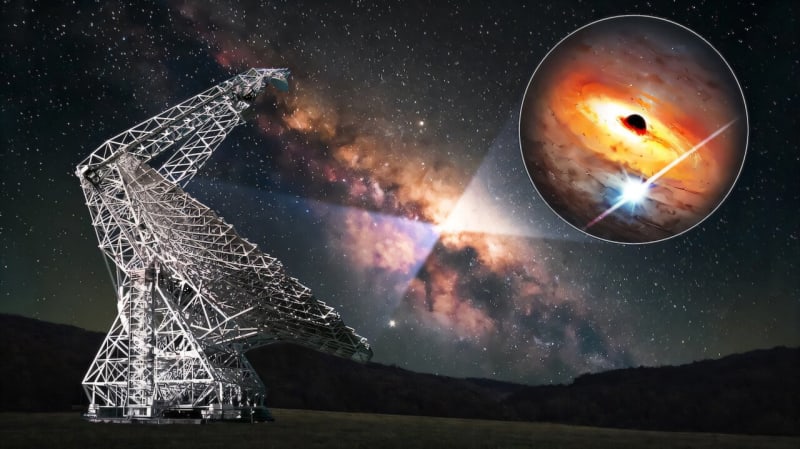
By listening to ripples in spacetime called gravitational waves, researchers at Cardiff University discovered that the biggest black holes don't form from dying stars alone. Instead, they're born in chaotic stellar neighborhoods called globular clusters, where black holes repeatedly slam into each other and merge into progressively larger monsters.
The team analyzed 153 black hole collisions detected by gravitational wave observatories LIGO, Virgo, and KAGRA. These detectors can "hear" the ripples that black hole mergers send through the fabric of space and time, exactly as Einstein predicted back in 1915.
What they found surprised even the scientists themselves. The data revealed two completely different black hole populations living in our universe.
Smaller black holes spin slowly and formed the traditional way, through supernova explosions when massive stars collapsed. But larger black holes spin rapidly in random directions, a telltale signature that they grew through multiple mergers in crowded star clusters.
"Gravitational wave astronomy is now doing more than counting black hole mergers," said team leader Fabio Antonini. "It's starting to reveal how black holes grow, where they grow, and what that tells us about the lives and deaths of massive stars."
The research also confirmed a long-theorized "mass gap" in black hole formation. The most massive stars don't collapse into black holes when they die; instead, they explode so violently that they're completely destroyed, leaving nothing behind.
This creates a forbidden zone starting at about 45 times the sun's mass. Any black hole heavier than that threshold must have formed through mergers, not stellar collapse.
"What surprised us most was how clearly the high-mass black holes stand out as a separate population," said researcher Isobel Romero-Shaw. The spinning patterns were unmistakable evidence of their cluster origins.
Why This Inspires
This discovery shows how far human ingenuity has come in understanding the cosmos. We're now listening to the universe in an entirely new way, detecting invisible ripples that travel billions of light-years to reach Earth.
These findings don't just solve one mystery. They're opening windows into how stars evolve, how the densest environments in space behave, and how the universe's most extreme objects come to be.
Every gravitational wave detection adds another piece to the cosmic puzzle, revealing secrets about places and events so violent and distant they seemed forever beyond our reach. Now we're reading the universe's history written in spacetime itself.
More Images



Based on reporting by Space.com
This story was written by BrightWire based on verified news reports.
Spread the positivity!
Share this good news with someone who needs it