Scientists Find Sugar in Space Cloud Near Milky Way Center
Researchers detected a life-building sugar molecule floating in interstellar space for the first time, suggesting the ingredients for life might form in cosmic dust clouds before reaching Earth. This discovery could help solve the mystery of how life began on our planet.
Scientists just spotted something remarkable floating in a gas cloud near the center of our galaxy: sugar molecules that help build the foundations of life.
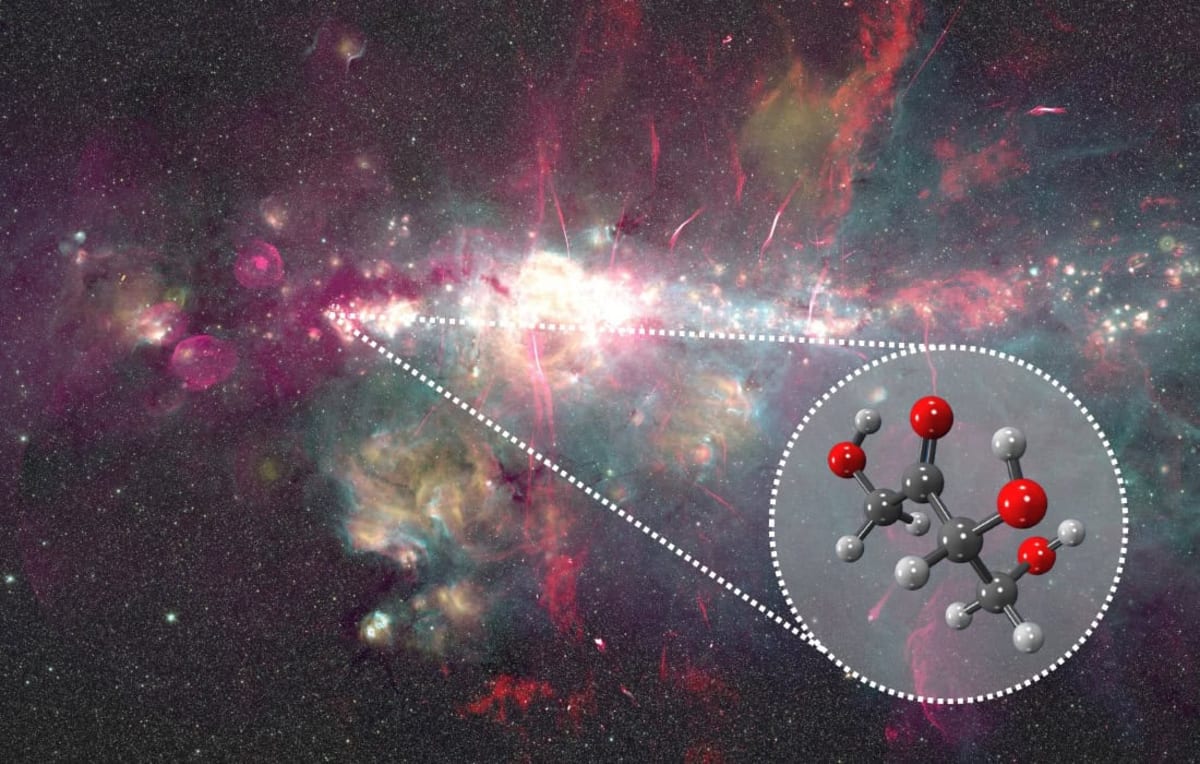
For the first time ever, researchers detected erythrulose, a four-carbon sugar, in the interstellar medium. Led by Izaskun Jiménez-Serra at Spain's Centro de Astrobiología, the team used powerful telescopes to identify this crucial biomolecule drifting in space, far from any planet.
This discovery matters because it helps answer one of science's biggest questions: where did life's building blocks come from? Laboratory experiments show that early Earth's conditions couldn't produce enough of these essential sugars on their own. Scientists have long suspected they arrived from space, carried by meteorites and comets.
Previous asteroid samples confirmed this theory. NASA's analysis of the asteroid Bennu found glucose and ribose, sugars vital for energy and DNA formation. But this new research looks even further back, showing these molecules can form in the dust clouds that create asteroids in the first place.
The team pointed Spain's Yebes 40m and IRAM 30m telescopes at a gas cloud called G+0.693−0.027. Finding erythrulose wasn't easy. They had to identify over 180 different molecules to ensure they weren't mistaking another substance's signature for sugar.
What surprised them most was the abundance. Erythrulose appeared eight times more plentiful than simpler three-carbon sugars. The team believes it forms when smaller two-carbon molecules combine on the surface of space dust grains.
Why This Inspires
Here on Earth, you'll find erythrulose in melons and raspberries. But its cosmic significance runs deeper. In watery environments like early Earth's oceans, erythrulose transforms into threose, a sugar found in threose nucleic acid (TNA). Scientists believe TNA might be one of the simplest nucleic acids, potentially among the first involved in life's earliest development.
The discovery opens exciting possibilities for understanding how common life's ingredients might be across the galaxy. If these sugars form naturally in molecular clouds where stars and planets are born, the building blocks of life could be forming throughout the universe right now.
Jiménez-Serra's team plans to search for even larger sugars next, including five-carbon ribose found in RNA. By combining telescope observations with laboratory experiments and computer modeling, they're tracing the chemical journey from cosmic dust to living organisms.
This interdisciplinary work brings us closer to understanding our deepest origins, showing that the story of life on Earth might have begun written in the stars.
More Images

Based on reporting by Google News - Scientists Discover
This story was written by BrightWire based on verified news reports.
Spread the positivity!
Share this good news with someone who needs it
%2Fhttps%3A%2F%2Ftf-cmsv2-smithsonianmag-media.s3.amazonaws.com%2Ffiler_public%2Ff0%2Ffe%2Ff0fe19e4-e68b-474d-b0a4-19c5beb9d19d%2Fspeedy-star.webp)
%2Fhttps%3A%2F%2Ftf-cmsv2-smithsonianmag-media.s3.amazonaws.com%2Ffiler_public%2F7c%2Fa4%2F7ca45b97-a5b6-4cdb-9391-d20dd31bd01d%2Fmit-blackholestar-01-press_0.jpg)