Scientists Map Hidden 'Sea of Light' Between Galaxies
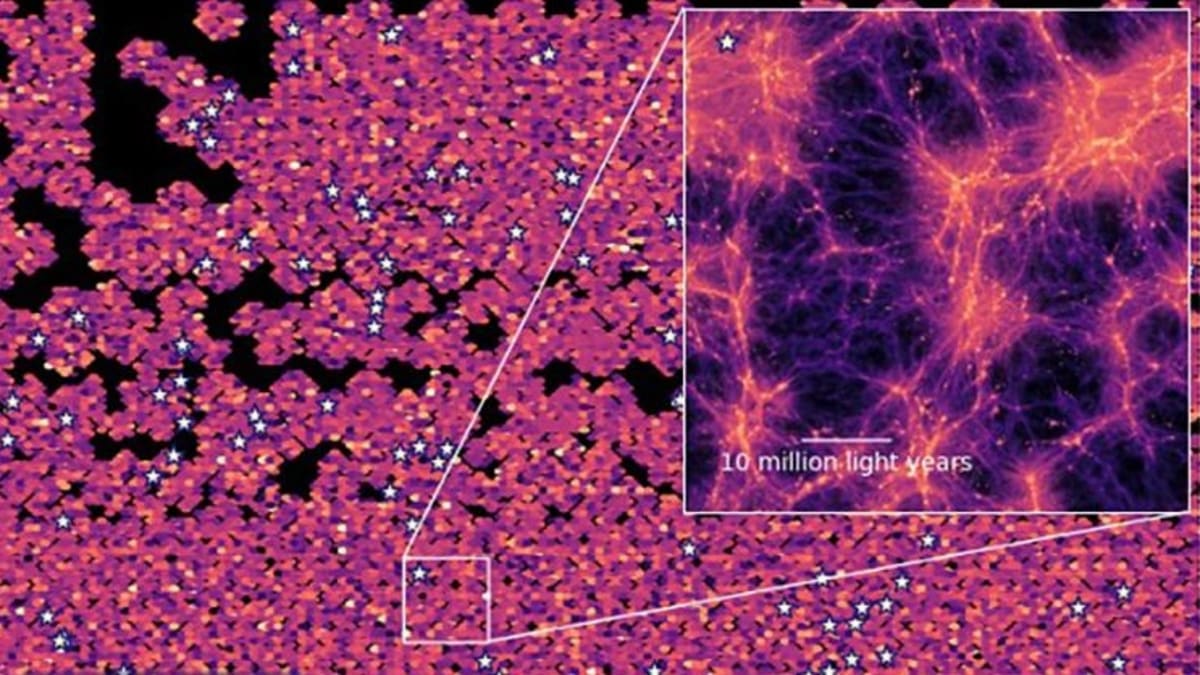
Astronomers have created the largest 3D map of the early universe, revealing a glowing web of hydrogen gas that fills seemingly empty space between galaxies. The breakthrough captures light from 9 to 11 billion years ago, during the universe's most active star-forming era.
Scientists just revealed what's been hiding in the "empty" space between galaxies: a vast, glowing sea of hydrogen light that's been there all along.
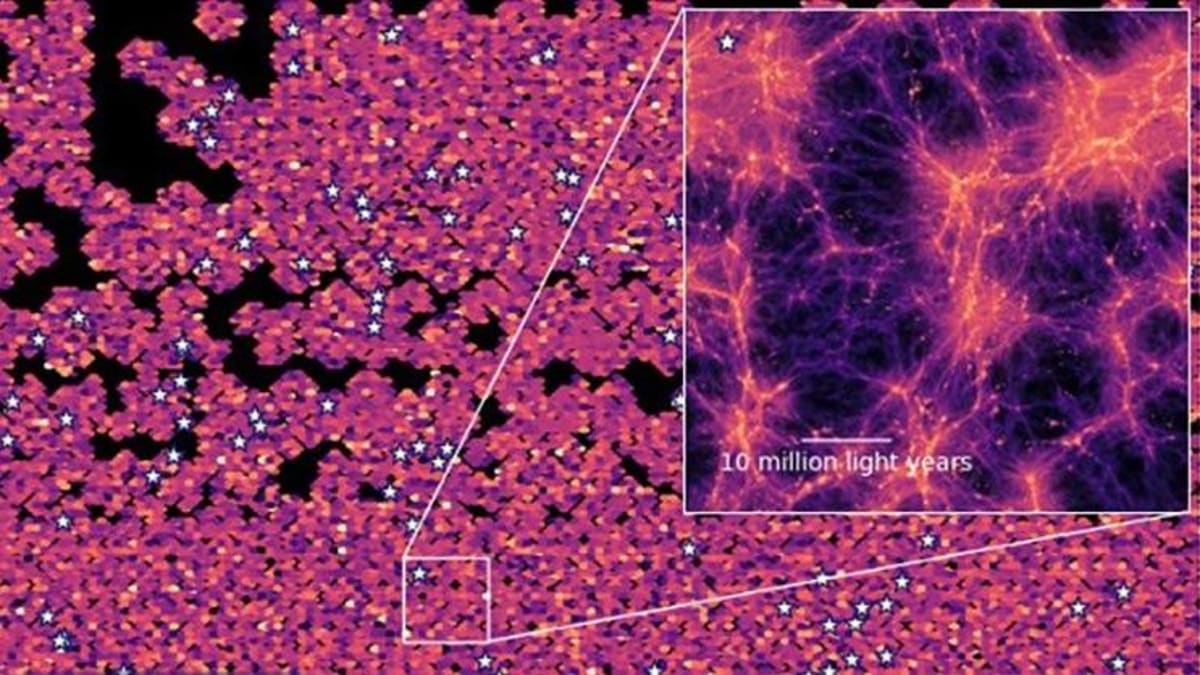
Using the Hobby-Eberly Telescope in Texas, astronomers created the most ambitious 3D map yet of the early universe. The map captures light emitted by excited hydrogen gas 9 to 11 billion years ago, when the cosmos was at "cosmic noon," its peak era of churning out new stars.
Previous universe maps focused on plotting individual galaxies, like mapping only the bright cities and missing everything in between. This new approach is different: it captures the faint ultraviolet glow of hydrogen, the universe's most abundant element, as it gets energized by young, hot stars.
"There's a whole sea of light in the seemingly empty patches in between," said Maja Lujan Niemeyer, the study's lead author. That glow, called Lyman-alpha radiation, had remained largely invisible until now.
The team used a technique called Line Intensity Mapping, which measures combined light across huge swaths of sky rather than identifying galaxies one by one. Think of it less like a sharp city map and more like a heat map showing all the illumination threading through space.
The breakthrough came from mining an enormous dataset: over 600 million spectra originally collected to study dark energy. With supercomputers and custom programming, researchers reconstructed a 3D view of hydrogen distribution across a vast cosmic volume, revealing hidden structures previous surveys couldn't detect.
Why This Inspires
This map does more than show us what's out there. It helps us understand how galaxies actually formed, revealing how they drew in gas, sparked stars into existence, and assembled into the large-scale structures we see today.
The timing matters too: by charting hydrogen during the universe's most productive era, scientists gain insights into the building blocks that shaped everything we observe in the cosmos now. The diffuse gas between galaxies wasn't just empty space; it was the connective tissue of the cosmic web.
"This study is an exciting first step in using intensity mapping to understand the processes involved in how galaxies form and evolve," said co-author Caryl Gronwall. She called it "a golden age for mapping the cosmos."
The research signals a broader shift in how we explore space: future surveys will increasingly reveal not just the brightest objects in the universe, but the full, glowing framework that binds them together.
We're learning that what once looked like darkness was actually filled with light all along.
More Images

Based on reporting by Space.com
This story was written by BrightWire based on verified news reports.
Spread the positivity!
Share this good news with someone who needs it