Scientists Map Tiny Crystals Too Small for X-Rays
A breakthrough technique lets researchers study microscopic crystals that were previously impossible to analyze, opening doors for faster drug discovery and advanced materials. By combining data from thousands of tiny crystals instead of needing one perfect specimen, scientists can now unlock the atomic secrets of countless substances.
Scientists just solved a decades-old puzzle that was blocking progress in drug development and materials research.
For over 70 years, researchers studying new substances hit the same frustrating wall. They could only map atomic structures if they had a single, perfect crystal large enough to withstand powerful X-rays. If a promising new drug or material only formed as microscopic powder, its secrets stayed locked away.
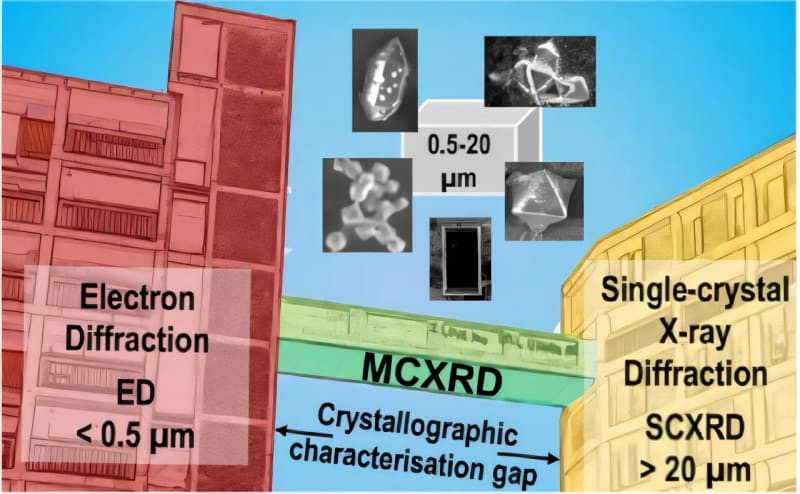
Professor Lee Brammer at the University of Sheffield led a team that flipped this approach on its head. Instead of searching for that elusive perfect crystal, they developed Multi-Crystal X-ray Diffraction (MCXRD), which pieces together information from thousands of tiny crystals.
The technique works like assembling a jigsaw puzzle. Scientists hit each microscopic crystal with a gentle dose of X-rays, just enough to capture a fragment of information without destroying it. Special software then stitches these thousands of fragments into one complete, high-resolution picture showing exactly where every atom sits.
The method bridges a crucial gap. Some crystals are too small for traditional X-rays but too large for electron microscopes. These in-between materials, which include many promising pharmaceuticals and advanced compounds, were simply off limits until now.
The research team tested their approach on Metal-Organic Frameworks, the same porous materials that earned scientists the 2025 Nobel Prize in Chemistry. These sponge-like substances capture gases, speed up chemical reactions, and deliver drugs inside the body.
The Ripple Effect
This breakthrough reaches far beyond one type of material. Pharmaceutical companies can now analyze drug candidates that form only as fine powders, potentially shaving years off development time. Materials scientists can study fragile crystals that would crumble under traditional methods.
The ability to see exactly how atoms arrange themselves is like getting the instruction manual for any substance. That knowledge lets researchers understand why materials behave the way they do and how to design better versions.
Brammer's team borrowed inspiration from an unlikely source: protein scientists. Structural biologists face similar challenges when studying delicate biological molecules and pioneered early versions of multi-crystal approaches. The Sheffield researchers adapted these methods for chemistry and proved they work across countless applications.
The study appears in Angewandte Chemie International Edition, bringing this tool to the wider scientific community. Research teams worldwide can now tackle materials that stumped them for years.
Every substance around us, from life-saving medications to the catalysts that clean car exhaust, depends on how its atoms connect. This new window into the microscopic world means scientists can finally see what was always there, just waiting to be discovered.
More Images
Based on reporting by Phys.org
This story was written by BrightWire based on verified news reports.
Spread the positivity!
Share this good news with someone who needs it