Scientists Map Weather 700 Light-Years Away on Alien World
Astronomers just made a stunning first: creating a weather forecast for a planet 700 light-years from Earth. The discovery reveals cloudy mornings and clear evenings on a distant gas giant, changing how we understand alien atmospheres.
For the first time ever, scientists have mapped the weather on an alien planet nearly 700 light-years away, discovering a world where mornings are cloudy but evenings are crystal clear.
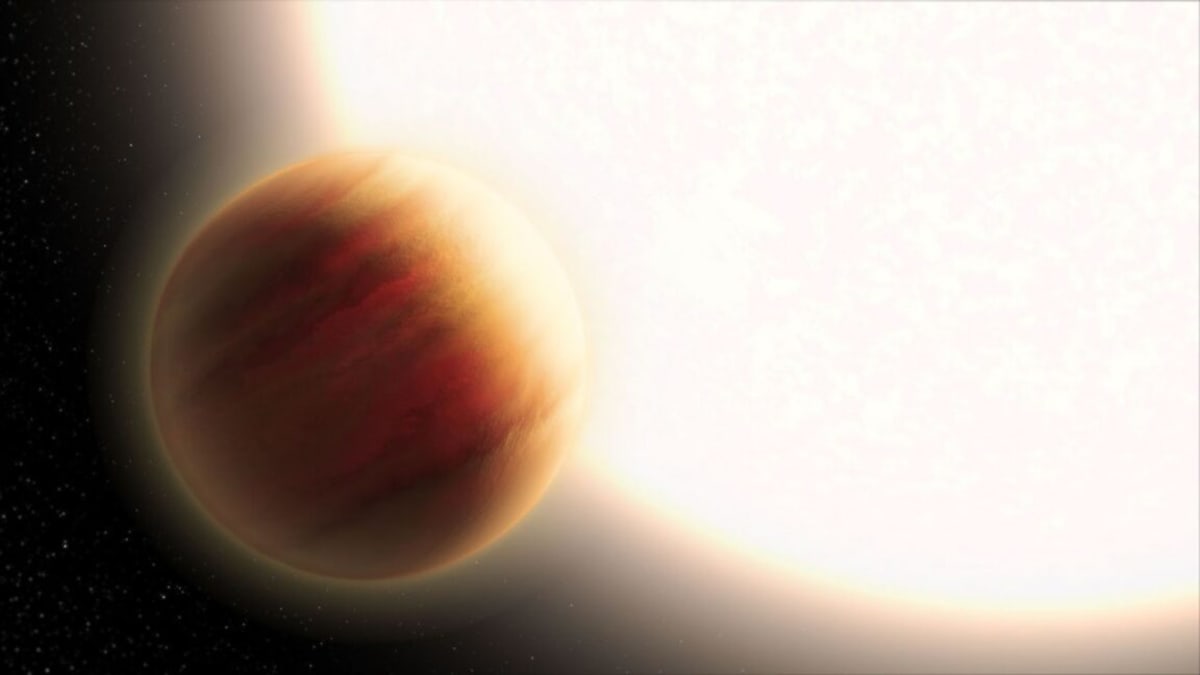
Using the James Webb Space Telescope, a team led by astrophysicist Sagnick Mukherjee at Johns Hopkins University studied WASP-94A b, a puffy gas giant locked in orbit around a distant star. What they found completely changes how we understand planets beyond our solar system.
WASP-94A b is tidally locked, meaning one side always faces its star while the other stays in permanent darkness. This creates wild temperature swings of 450 degrees Kelvin between the hot day side and cold night side, powerful enough to drive weather patterns unlike anything we see on Earth.
The breakthrough came from a new technique called limb-resolved spectroscopy. Instead of averaging the planet's entire atmosphere into one blur, the team captured separate snapshots of the morning and evening sides as the planet crossed in front of its star.
The morning side showed thick clouds of iron and magnesium silicate high in the atmosphere, blocking light from deeper layers. The evening side revealed clear skies filled with water vapor and other gases, no clouds in sight.
Here's what's happening: on the frozen night side, atmospheric gases condense into mineral droplets, forming clouds. Powerful equatorial winds then drag these clouds around the planet faster than it rotates, a phenomenon called super-rotation.
As the clouds race into the scorching day side, they evaporate in the extreme heat. By the time the atmosphere reaches the evening side, the skies have cleared completely.
The Ripple Effect
This discovery matters far beyond one alien world. Scientists have been studying exoplanet atmospheres for years, but they've been averaging all the data together, treating each planet like one uniform ball of gas.
That assumption may have gotten the chemistry of countless planets surprisingly wrong. When Mukherjee's team reanalyzed their data the old way, without separating morning from evening, the results changed dramatically.
The finding opens a new window into understanding the thousands of exoplanets we've discovered. Many are tidally locked like WASP-94A b, meaning their atmospheres likely vary wildly from one side to another.
The winds on this distant world are so powerful they can keep heavy mineral droplets suspended in the atmosphere, fighting against gravity as they race around the planet. It's a reminder that even 700 light-years away, we can still understand the physics governing alien skies.
Thanks to JWST's incredible precision, we're now reading weather reports from worlds we'll never visit, understanding their climates with shocking detail.
More Images


Based on reporting by Google News - Science
This story was written by BrightWire based on verified news reports.
Spread the positivity!
Share this good news with someone who needs it