Scientists May Have Found Dark Matter's Missing Link
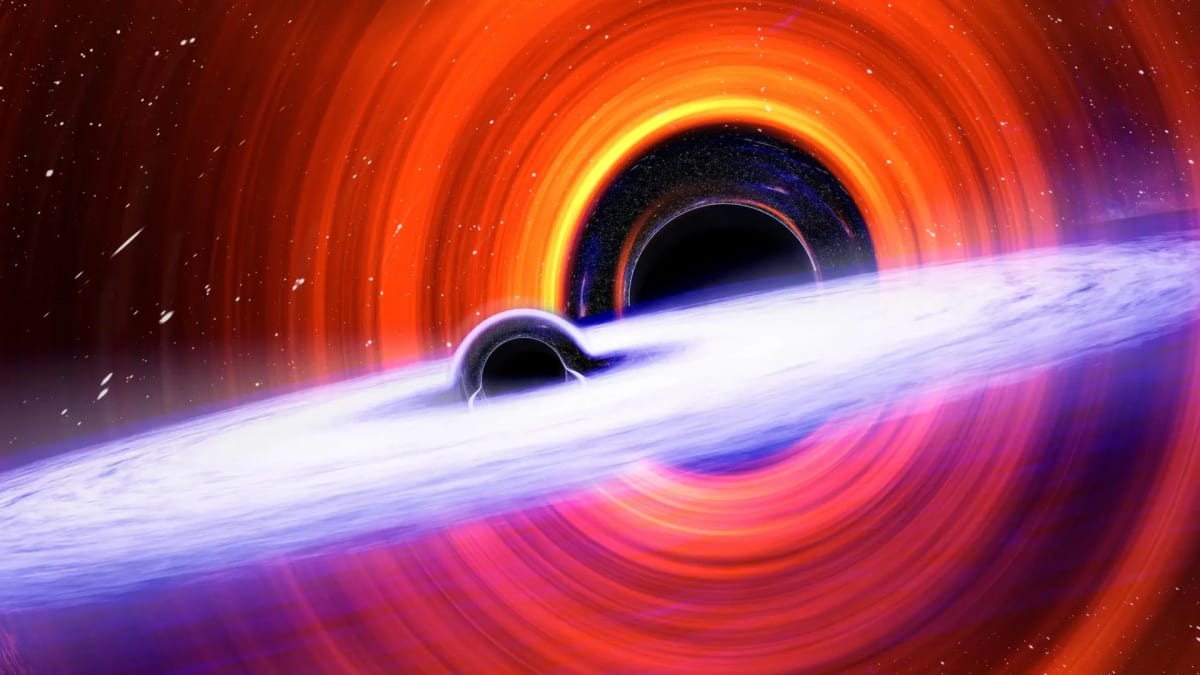
An unusual gravitational wave signal detected by LIGO could be the first evidence of primordial black holes, ancient objects formed moments after the Big Bang that might finally explain what dark matter actually is. If confirmed, this discovery would solve one of astronomy's greatest mysteries.
Scientists at the University of Miami believe they've detected something incredible: the first real evidence of primordial black holes, mysterious objects that could explain what dark matter is made of.
The discovery hinges on an unusual signal picked up by LIGO, the observatory that detects gravitational waves or ripples in spacetime. Last November, LIGO detected a collision involving at least one object smaller than our Sun, which shouldn't exist according to everything we know about how black holes form.
Most black holes form when massive stars explode. But this tiny black hole would be too small to come from a star, suggesting it formed differently during the first fraction of a second after the Big Bang, long before any stars existed.
"We believe our study will aid in confirming that they actually do exist," said Nico Cappelluti, an associate professor who conducted the research with Ph.D. student Alberto Magaraggia. Their findings were published in The Astrophysical Journal.
Why does this matter so much? Dark matter makes up about 85 percent of all matter in the universe and provides the gravitational glue holding galaxies together. Yet nobody knows what it actually is because we can't see it directly.
Primordial black holes could be the answer scientists have been searching for decades to find. The researchers calculated how many of these ancient black holes might exist throughout space and how often LIGO should detect them.
"Our results are encouraging," Magaraggia said. "We predict that subsolar black holes like the one LIGO may have observed should indeed be rare, consistent with how infrequently such events have been seen so far."
Not everyone is convinced yet. Some scientists think the signal might just be noise in LIGO's sensitive equipment rather than a groundbreaking discovery.
The concept isn't new. Soviet scientists first proposed primordial black holes during the Cold War, and Stephen Hawking expanded the idea in the 1970s, suggesting these objects could explain dark matter.
Now, modern technology might finally prove them right. LIGO made history in 2015 by detecting gravitational waves for the first time, confirming Einstein's predictions and opening an entirely new way to study the universe.
Why This Inspires
This discovery represents more than just finding a new type of black hole. It shows how patient, careful scientific work can chip away at mysteries that have puzzled humanity for generations.
The researchers are refreshingly honest about what comes next. One signal isn't enough proof, and they'll need to detect more similar events to confirm their findings. But planned upgrades to LIGO will make it even more sensitive, increasing the chances of finding additional evidence.
"LIGO picked up what is very strong evidence that these types of black holes exist," Cappelluti said. "But what is clear is that they cannot be excluded as being real."
After decades of theory and speculation, we might finally be on the verge of understanding what makes up most of the matter in our universe.
Based on reporting by Science Daily
This story was written by BrightWire based on verified news reports.
Spread the positivity!
Share this good news with someone who needs it
%2Fhttps%3A%2F%2Ftf-cmsv2-smithsonianmag-media.s3.amazonaws.com%2Ffiler_public%2F3f%2F55%2F3f5579c8-c4a7-43a5-bb54-6498478792fd%2Fhelix1940__fitmaxwzk3mcw2ntbd.jpg)