Scientists May Have Found First Evidence of Big Bang Holes
Ripples in spacetime just gave us the first real hint that tiny black holes formed during the Big Bang, and they might solve the universe's biggest mystery. These primordial black holes could be the dark matter scientists have been searching for since the 1970s.
Scientists may have just detected evidence of black holes that formed in the first moments after the Big Bang, and the discovery could explain what most of the universe is made of.
Researchers at the University of Miami analyzed an unusual signal picked up by LIGO, the laser observatory that listens for gravitational waves. The signal showed two black holes colliding, but here's what makes it special: at least one of them was smaller than our sun.
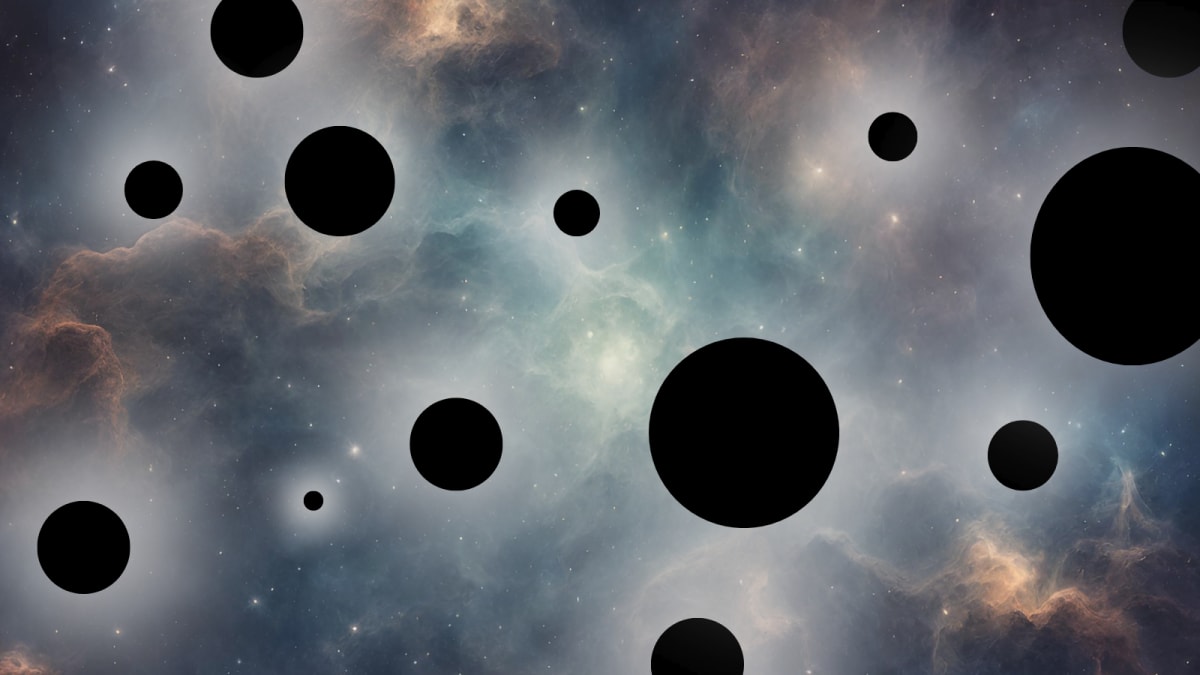
That matters because regular black holes form when massive stars die, so they're always huge. But black holes born in the Big Bang, called primordial black holes, can be much tinier. Some might weigh as little as an asteroid.
Stephen Hawking first proposed these primordial black holes in the 1970s, but scientists have never found proof they exist. Until now, maybe.
"We believe our study will aid in confirming that they actually do exist," said University of Miami researcher Nico Cappelluti. His team calculated how many of these tiny black holes might be out there and how often LIGO should detect them.
The numbers match up. Subsolar black holes should be rare, and LIGO has only spotted this kind of signal once. That makes sense if primordial black holes are real.
Why This Inspires
This discovery could solve one of science's biggest head-scratchers. Dark matter makes up 85% of all matter in the universe, but scientists have no idea what it is. They only know it exists because its gravity holds galaxies together.
For decades, researchers have searched for exotic particles that could be dark matter. They've come up empty every time. But primordial black holes fit perfectly. They have mass, they interact with gravity, and they're essentially invisible because light can't escape them.
"The most plausible explanation for the LIGO signal is the detection of a primordial black hole," said researcher Alberto Magaraggia. "And our research indicates that these primordial black holes could account for a significant portion, if not all, of dark matter."
There's still a chance the signal was just noise in LIGO's instruments. But the researchers are confident they've found something real.
Better news is coming. LIGO and its partner observatories in Italy and Japan are getting sensitivity upgrades. Future detectors like the space-based LISA will be even more powerful. If primordial black holes are out there, we'll find more of them soon.
After 50 years of searching, we might finally understand what the universe is really made of.
More Images



Based on reporting by Space.com
This story was written by BrightWire based on verified news reports.
Spread the positivity!
Share this good news with someone who needs it