Scientists Push 7,000 Atoms Into Quantum Wave State
Physicists just shattered records by observing 7,000 sodium atoms acting as a wave instead of particles, bringing the bizarre quantum world into our visible reality. This breakthrough opens doors to studying biological molecules in ways never before possible.
The microscopic world just got a lot bigger, and it's bringing quantum physics closer to our everyday reality than ever before.
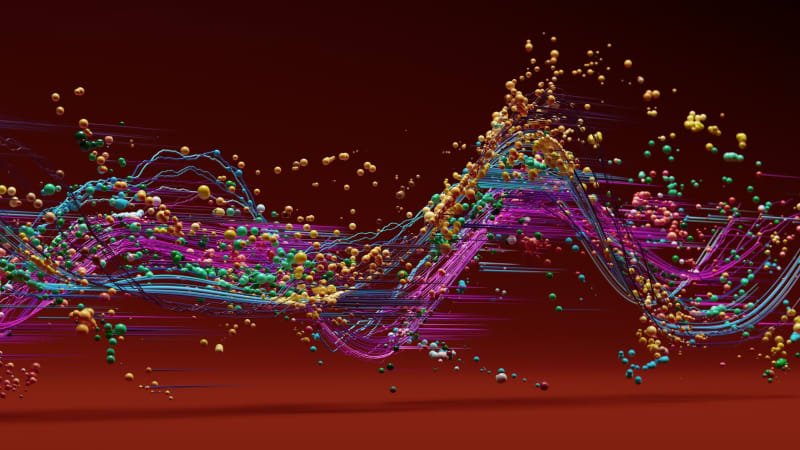
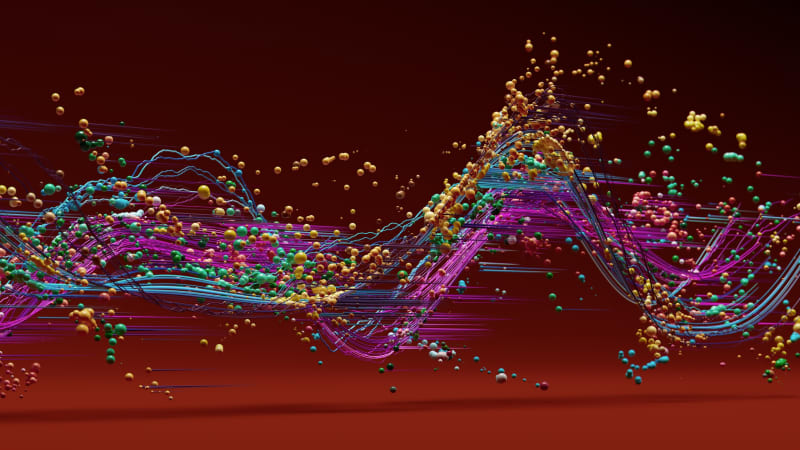
Physicists at the University of Vienna have successfully placed clusters of 7,000 sodium atoms into a "Schrödinger's cat" state, where they exist in multiple places at once. The nanoparticles acted as waves instead of solid particles, shattering the previous record for the largest objects ever observed in a quantum superposition.
Lead researcher Sebastian Pedalino and his team achieved this by firing a beam of sodium nanoparticles through a narrow slit. When the particles passed through, they spread out and created an interference pattern, proving they were acting as waves. This means thousands of atoms were simultaneously existing in multiple places at once.
In our everyday world, a tennis ball is just a tennis ball in one location. But in quantum mechanics, particles can be both here and there at the same time until someone observes them. This strange phenomenon usually only happens with tiny particles like electrons or photons.
The real challenge wasn't just observing these larger particles behaving quantum mechanically. It was keeping them isolated from their environment long enough to maintain their wave-like state. When quantum particles interact with anything around them, they "decohere" and snap back to behaving like normal objects.
The Bright Side
This research isn't just about breaking records or proving quantum theory. It's opening entirely new pathways for scientific discovery that could benefit everyone.
Future experiments building on this work could put biological molecules into quantum states for the first time. This means scientists could study the physical properties of life's building blocks in revolutionary new ways, potentially leading to breakthroughs in medicine and materials science.
The experiment proves that quantum mechanics has no hard limits on size. What we thought was impossible at larger scales is simply difficult, not forbidden. Each leap forward in observing bigger objects acting quantum mechanically brings us closer to understanding where the microscopic world of possibility meets the solid world we experience.
The findings published in Nature show that the boundary between quantum weirdness and everyday reality isn't as fixed as we once believed. With each experiment, physicists are expanding what's possible and pushing that boundary further into the visible world.
The universe's strangest behaviors are becoming less strange and more accessible every day.
More Images

Based on reporting by Live Science
This story was written by BrightWire based on verified news reports.
Spread the positivity!
Share this good news with someone who needs it