Scientists Solve Mystery of Ultra-Powerful Space Particle
The puzzling Amaterasu particle, one of the most energetic cosmic rays ever detected, may actually be an ultraheavy atomic nucleus rather than a proton. This breakthrough could finally explain where the universe's most powerful particles come from.
Scientists may have cracked a 60-year mystery about the most energetic particles in the universe.
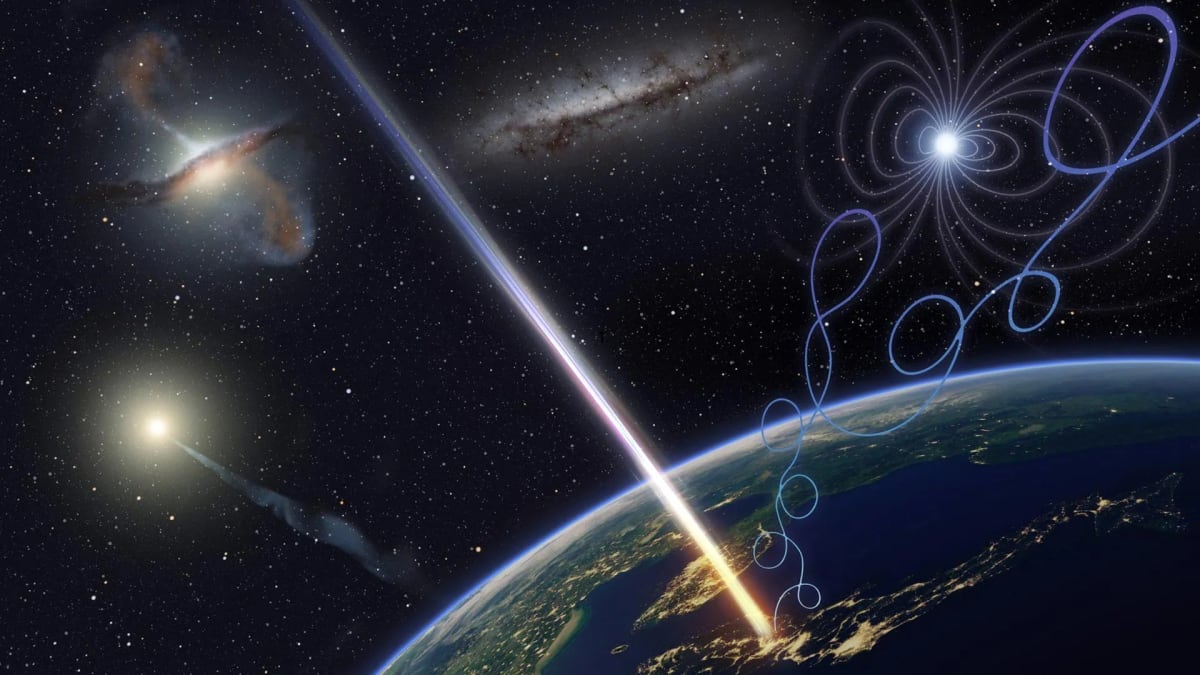
The Amaterasu particle slammed into Earth in 2021 with the kinetic energy of a fast-moving tennis ball packed into a single cosmic ray. Named after the Japanese sun goddess, it carried 240 exa-electron volts of energy, making it 10 million times more powerful than anything humans can create in our most advanced particle accelerators.
Until now, nobody knew what it was or where it came from. Its arrival direction pointed back to a cosmic void, an empty region of space with no obvious source capable of launching such an extreme particle.
New research from Penn State offers an exciting answer. The particle might not be a simple proton at all, but an ultraheavy atomic nucleus heavier than iron.
Lead researcher Kohta Murase and his team ran detailed computer simulations to test how different particles would travel through intergalactic space. They discovered something surprising: ultraheavy nuclei lose energy much more slowly than protons or lighter particles, allowing them to survive the cosmic journey while keeping their extraordinary power intact.
This finding changes everything about how scientists search for the sources of these rare cosmic bullets. Only the most violent events in the universe could create and accelerate such massive particles.
Why This Inspires
The most likely birthplaces for ultraheavy cosmic rays are spectacularly powerful cosmic events. Massive stars collapsing into black holes, strongly magnetized neutron stars, and binary neutron star mergers that produce gravitational waves could all launch these particles across space.
These same cosmic explosions also power gamma-ray bursts, among the most energetic events in the universe. Understanding ultraheavy cosmic rays could help scientists better identify and study these distant cosmic fireworks.
The research team's calculations also revealed how many of these ultraheavy particles might exist among all the cosmic rays hitting Earth. This data gives astronomers new targets to search for when looking skyward with their telescopes.
For over six decades, scientists have puzzled over where ultrahigh-energy cosmic rays originate and how they get accelerated to such mind-bending speeds. Each new cosmic ray detection adds another clue to this cosmic detective story.
The Amaterasu particle stands among only a handful of cosmic rays this powerful ever recorded, sharing rare company with the legendary "Oh-My-God particle" detected in 1991. Every one of these extreme events helps scientists piece together how the universe's most violent processes work.
This breakthrough reminds us that even the smallest particles can carry the biggest secrets about our universe's most powerful forces.
Based on reporting by Science Daily
This story was written by BrightWire based on verified news reports.
Spread the positivity!
Share this good news with someone who needs it